 Hello! now
 tms@lcdchip.com



Microchip Technology HCS515/P

- Part No.:
- HCS515/P
- Manufacturer:
- Microchip Technology
- Category:
- Specialized ICs
- Package:
- 14-DIP (0.300", 7.62mm)
- Description:
- IC CODE HOPPING DECODER 14DIP
- Quantity:
Unit Price:$0
Ext Price:$0
- Payment:

- Shipping:


Product Details
HCS515/P - KEELOQ Code Hopping Decoder
Microchip Technology HCS515/P is a KEELOQ code-hopping decoder for unidirectional remote keyless entry and access-control receivers, supplied in a 14-lead, 300 mil plastic DIP package.
Confirm the receiver protocol, key-management plan, pin connections and environmental rating against the current Microchip documentation before design approval.
Overview
The HCS515 accepts a compatible encoded signal at RF_IN, checks the received code word and provides decoded status to a host through its synchronous serial interface. It stores learned transmitter information internally and supports normal and secure learning. It can operate as a stand-alone decoder or alongside a microcontroller.
Key Advantages
Code-word validation and KEELOQ decryption reduce host-side protocol work.
Normal and secure learning modes support different provisioning strategies.
Internal EEPROM retains information for up to seven learned transmitters.
Automatic bit-rate detection and a synchronous host interface aid system integration.
Feature Summary
4.5 V to 5.5 V operating supply with an internal oscillator.
Accepts compatible PWM code words and detects transmitter bit rate automatically.
Internal transmitter storage and 1 Kbit of user EEPROM.
S_DAT and S_CLK provide synchronous communication with a controller.
Package & Footprint
HCS515/P uses the registered 14-DIP through-hole package. Microchip defines P as a 14-lead plastic DIP with a 300 mil body; the catalog records 0.300 in (7.62 mm).
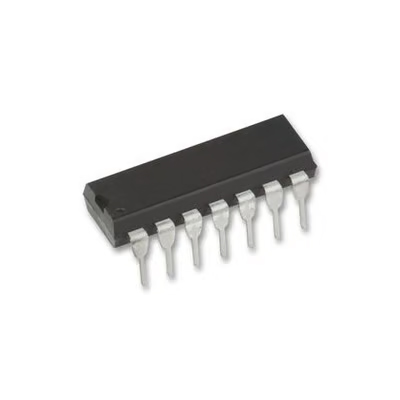
- Use a 14-position, 300 mil through-hole footprint.
- Check pin-1 orientation and board clearance against the Microchip drawing.
- Do not substitute the 14-lead SOIC footprint for the /P variant.
The expected 14-DIP JPG is not present in the local package image directory; the image must be verified and added before publication.
Pin Functions
The 14-lead PDIP and SOIC pin assignments in Microchip data sheet DS40183E share the following signal positions.
Check the full electrical pin descriptions and required external connections in the manufacturer data sheet; do not use NC pins as circuit nodes.
Key Specifications
| Function | KEELOQ code-hopping decoder |
|---|---|
| Operating supply | 4.5 V to 5.5 V |
| Commercial temperature | 0°C to +70°C for HCS515/P |
| Package | 14-lead, 300 mil plastic DIP |
| Learned transmitters | Up to seven |
| User EEPROM | 1 Kbit |
| Compatible modulation | PWM, 1/3–2/3 format |
| Encoder element time | 100 µs to 400 µs |
| Header | 10 × encoder element time |
| Serial number | 28 bits |
| Synchronization counter | 16 bits |
| Code-word length | 66 to 69 bits |
Protocol compatibility figures are manufacturer-stated conditions, not guaranteed interoperability with every encoder configuration. Review DS40183E for timing limits and test conditions.
Replacement Considerations
HCS515-I/P is an industrial-temperature ordering variant, but its temperature grade and complete order code must be checked against the application. HCS515/SL uses a 14-lead SOIC package and is not footprint-compatible with the /P DIP. Other KEELOQ decoders or microcontroller implementations require a review of learned-key handling, modulation, synchronization behavior, host protocol, supply, pinout and package. No unverified device is presented as a drop-in replacement.
Manufacturer Information
Microchip Technology documents HCS515 in data sheet DS40183E, revision E. Its product-identification table defines the /P plastic DIP and the commercial and industrial temperature suffixes. Match the marking and full ordering code to the required package and grade.
Applications
Automotive receiver designs using compatible KEELOQ encoders.
Gate, garage and electronic door-lock receivers.
Alarm and immobilizer receiver architectures.
Systems that validate enrolled code-hopping transmitters.
Quality & Authenticity
For incoming inspection, compare the complete part marking, 14-lead DIP body, lead condition and traceability records with the purchase specification. Confirm firmware and provisioning compatibility in the actual receiver before production qualification.
FAQ
What does /P identify?
Microchip defines /P as the 14-lead, 300 mil plastic DIP package.
Can HCS515/P use any KEELOQ encoder?
No. The encoder must match the documented PWM format, element time, header, serial-number, synchronization and code-word conditions, as well as the programmed keys.
How many transmitters can it learn?
Microchip specifies storage for up to seven transmitters.
Is the package drawing available here?
The expected 14-DIP JPG has not yet been verified locally; confirm it before using the image for layout review.
Engineering Notice
Use the current Microchip data sheet and a receiver-level test to verify electrical limits, code-word compatibility, key provisioning, synchronization behavior and security requirements. This description does not replace a formal design review. The package image is pending and must not be treated as a verified mechanical drawing.
HCS515/P Information
- Specifications
- Tags
- Product attributes
- Attribute value
- Manufacturer:
- Microchip Technology
- Series:
- KEELOQ®
- Package/Case:
- 14-DIP (0.300", 7.62mm)
- Packaging:
- Tube
- Product Status:
- Active
- Programmable:
- Not Verified
- Type:
- Code Hopping Decoder
- Applications:
- Remote Secure Access, Keyless Entry
- Mounting Type:
- Through Hole
- Supplier Device Package:
- 14-PDIP
- Grade:
- -
- Qualification:
- -
- Include Parts
- Popular Search
The following parts include "HCS515/P" in Silicon Labs HCS515/P.
- Part Number
- Manufacturer
- Package
- Description
- CAP200DG-TL Power Integrations 8-SOIC (0.154", 3.90mm Width) IC AUTOMATIC DISCHARGE 8SO
- ATSHA204A-MAHDA-T Microchip Technology 8-UFDFN Exposed Pad IC AUTHENTICATION CHIP 8UDFN
- ATSHA204A-SSHDA-T Microchip Technology 8-SOIC (0.154", 3.90mm Width) IC AUTHENTICATION CHIP 8SOIC
- ATSHA204A-STUCZ-T Microchip Technology TO-236-3, SC-59, SOT-23-3 IC AUTHENTICATION CHIP SOT23-3
- ATECC608B-MAHDA-T Microchip Technology 8-UFDFN Exposed Pad IC AUTHENTICATION CHIP 8UDFN
- ATECC608B-MAHCZ-S Microchip Technology 8-UFDFN Exposed Pad IC AUTHENTICATION CHIP 8UDFN
- ATECC608B-SSHDA-T Microchip Technology 8-SOIC (0.154", 3.90mm Width) IC AUTHENTICATION CHIP 8SOIC
- ATECC608B-MAHDA-S Microchip Technology 8-UFDFN Exposed Pad IC AUTHENTICATION CHIP 8UDFN
- ATECC608A-MAHDA-S Microchip Technology 8-UFDFN Exposed Pad IC AUTHENTICATION CHIP 8UDFN
- ATECC608B-MAVDA-T Microchip Technology 8-UFDFN Exposed Pad IC AUTHENTICATION CHIP 8UDFN
The following parts are popular search parts in Test and Measurement.
Inventory:2,660
Please send an inquiry. Send us your inquiry, and we will respond immediately.


