 Hello! now
 tms@lcdchip.com



Microchip Technology HCS500-I/P

- Part No.:
- HCS500-I/P
- Manufacturer:
- Microchip Technology
- Category:
- Specialized ICs
- Package:
- 8-DIP (0.300", 7.62mm)
- Description:
- IC CODE HOPPING DECODER 8DIP
- Quantity:
Unit Price:$0
Ext Price:$0
- Payment:

- Shipping:


Product Details
HCS500-I/P — Industrial KEELOQ Code-Hopping Decoder
Microchip 8-pin, 300-mil PDIP decoder for compatible remote-keyless-entry and access-control receivers.
Exact I temperature and P package suffixes are defined by Microchip data sheet DS40000153E; verify system configuration against the controlled revision.
Overview
The HCS500 receives and validates compatible KEELOQ code-hopping transmissions. It can operate as a stand-alone decoder or communicate with a host microcontroller through a synchronous clock/data interface. The device uses an external EEPROM for protected manufacturer-code, transmitter-key, and synchronization information. The HCS500-I/P order option specifies the industrial -40 to +85 °C grade in an 8-lead plastic DIP.
Key Advantages
Decrypts learned hopping codes and checks synchronization before accepting a command.
Supports stand-alone receiver designs or a host-controller interface.
Stores information for up to seven learned transmitters in the external EEPROM scheme.
The I/P ordering suffix identifies the industrial-temperature 8-pin through-hole package.
Feature Summary
- KEELOQ code-hopping decoder with normal and secure learning mechanisms.
- Automatic bit-rate detection for the supported encoder transmission format.
- External EEPROM interface for transmitter records and secret information.
- Synchronous serial data and clock interface to a controller.
- Internal oscillator and 3.0 to 5.5 V specified supply range.
- Requires a compatible receiver front end and properly configured encoder keys and formats.
Package & Footprint
The P ordering code denotes an 8-pin plastic DIP; the catalog identifies a 0.300-inch (7.62 mm) row spacing. The local package registry contains 8-DIP, but the associated JPG is not yet available. Use the current Microchip mechanical drawing for footprint dimensions and pin-1 orientation.
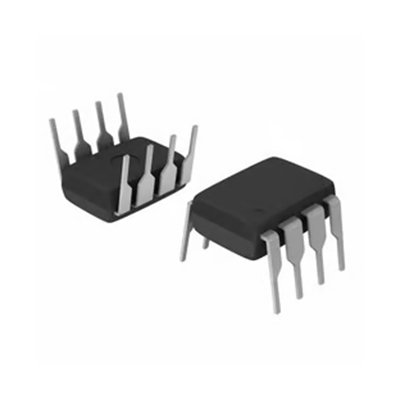
- Confirm pin-1 marking and socket orientation.
- Check row spacing, lead pitch, and drilled-hole size against the mechanical specification.
- Verify the I temperature marking and purchase order.
Pin Functions
The manufacturer's Table 2-1 identifies pin 1 VDD, pin 2 EE_CLK, pin 3 EE_DAT, pin 4 MCLR, pin 5 S_DAT, pin 6 S_CLK, pin 7 RFIN, and pin 8 GND/VSS. EE_CLK and EE_DAT connect to the external EEPROM; S_DAT and S_CLK communicate with a controller; RFIN receives decoded RF-front-end data. Design reset and interface levels to the data-sheet requirements.
Key Specifications
| Exact order code | HCS500-I/P |
|---|---|
| Function | KEELOQ code-hopping decoder |
| Supply voltage | 3.0 to 5.5 V operating range |
| Order temperature | -40 to +85 °C industrial grade |
| Package | 8-lead PDIP, P ordering code |
| Transmitter capacity | Up to seven learned transmitters |
| Learning modes | Normal and secure learning |
| Host interface | Synchronous S_DAT/S_CLK |
| Memory interface | External EEPROM via EE_DAT/EE_CLK |
| Input | RFIN from compatible RF receiver |
| Clock source | Internal oscillator |
| Encoder format | Compatible KEELOQ format and configured cryptographic data required |
Operating limits, timing, and logic thresholds depend on the data-sheet test conditions; absolute maximum ratings are not operating specifications.
Replacement Considerations
HCS500-C/P uses the same P package family but a different 0 to +70 °C ordering grade. HCS500-I/SM uses an SOIJ footprint rather than the PDIP footprint. Neither option should be treated as a drop-in substitute without verifying temperature qualification, pinout, memory programming, key handling, receiver timing, and supply/interface limits. No unverified internal alternative link is included.
Manufacturer Information
Microchip data sheet DS40000153E defines the HCS500 feature set, pin assignment, operating range, electrical characteristics, packaging, and ordering suffixes. The product page identifies the HCS500 family as in production. Review the latest manufacturer documents and device change notices for controlled design decisions.
Applications
Receiver-side validation of compatible learned remotes.
Code-hopping access-control receivers.
Authenticated commands from configured transmitters.
Decoder function within a validated access system.
Quality & Authenticity
Confirm the full HCS500-I/P marking, manufacturer traceability, PDIP geometry, and programmed manufacturer-code relationship. Secure the cryptographic provisioning flow and test valid, replayed, and out-of-window transmissions in the complete receiver design.
FAQ
What do I and P mean?
I specifies the industrial -40 to +85 °C range; P specifies the 8-pin PDIP package.
Does the decoder store transmitter data by itself?
The manufacturer describes an external EEPROM arrangement for learned transmitter and key information.
Can any KEELOQ encoder be used without configuration?
No. Transmission format, keys, serial number handling, and synchronization must match the receiver design.
Engineering Notice
Before publication, supply and inspect the registered 8-DIP JPG and verify the rendered page. Before use, validate the latest Microchip data sheet, secure key provisioning, external EEPROM interface, compatible encoder format, environmental limits, and full-system security behavior.
HCS500-I/P Information
- Specifications
- Tags
- Product attributes
- Attribute value
- Manufacturer:
- Microchip Technology
- Series:
- KEELOQ®
- Package/Case:
- 8-DIP (0.300", 7.62mm)
- Packaging:
- Tube
- Product Status:
- Active
- Programmable:
- Not Verified
- Type:
- Code Hopping Decoder
- Applications:
- Remote Secure Access, Keyless Entry
- Mounting Type:
- Through Hole
- Supplier Device Package:
- 8-PDIP
- Grade:
- -
- Qualification:
- -
- Include Parts
- Popular Search
The following parts include "HCS500-I/P" in Silicon Labs HCS500-I/P.
- Part Number
- Manufacturer
- Package
- Description
- CAP200DG-TL Power Integrations 8-SOIC (0.154", 3.90mm Width) IC AUTOMATIC DISCHARGE 8SO
- ATSHA204A-MAHDA-T Microchip Technology 8-UFDFN Exposed Pad IC AUTHENTICATION CHIP 8UDFN
- ATSHA204A-SSHDA-T Microchip Technology 8-SOIC (0.154", 3.90mm Width) IC AUTHENTICATION CHIP 8SOIC
- ATSHA204A-STUCZ-T Microchip Technology TO-236-3, SC-59, SOT-23-3 IC AUTHENTICATION CHIP SOT23-3
- ATECC608B-MAHDA-T Microchip Technology 8-UFDFN Exposed Pad IC AUTHENTICATION CHIP 8UDFN
- ATECC608B-MAHCZ-S Microchip Technology 8-UFDFN Exposed Pad IC AUTHENTICATION CHIP 8UDFN
- ATECC608B-SSHDA-T Microchip Technology 8-SOIC (0.154", 3.90mm Width) IC AUTHENTICATION CHIP 8SOIC
- ATECC608B-MAHDA-S Microchip Technology 8-UFDFN Exposed Pad IC AUTHENTICATION CHIP 8UDFN
- ATECC608A-MAHDA-S Microchip Technology 8-UFDFN Exposed Pad IC AUTHENTICATION CHIP 8UDFN
- ATECC608B-MAVDA-T Microchip Technology 8-UFDFN Exposed Pad IC AUTHENTICATION CHIP 8UDFN
The following parts are popular search parts in Test and Measurement.
Inventory:3,619
Please send an inquiry. Send us your inquiry, and we will respond immediately.


