 Hello! now
 tms@lcdchip.com



Microchip Technology HCS412-I/P

- Part No.:
- HCS412-I/P
- Manufacturer:
- Microchip Technology
- Category:
- Specialized ICs
- Package:
- 8-DIP (0.300", 7.62mm)
- Description:
- IC CODE HOP ENCOD/TRNSPND 8DIP
- Quantity:
Unit Price:$0
Ext Price:$0
- Payment:

- Shipping:


Product Details
HCS412-I/P - KEELOQ Code-Hopping Encoder and Transponder
Microchip Technology HCS412-I/P combines a code-hopping transmitter and bidirectional transponder functions in an industrial-temperature, 8-lead 300-mil plastic DIP package.
The /P variant is through-hole PDIP; verify programming, key management and receiver compatibility for the complete access-control system.
Overview
The HCS412 uses Microchip KEELOQ code-hopping technology for remote-control transmission and also supports asynchronous, bidirectional transponder communication. The transmitter code word has a 32-bit hopping-code portion and a 37-bit nonencrypted portion. Three switch inputs can select seven functions. An on-chip EEPROM, tunable RC oscillator and control logic support programmed transmitter identity and operating modes.
Key Advantages
One device can serve a code-hopping transmitter and an LC-coupled transponder design.
S0, S1 and multifunction S2 support seven button functions.
Specified operating supply is 2.0 V to 6.3 V.
The /P ordering suffix selects an 8-lead, 300-mil plastic DIP body.
Feature Summary
69-bit transmission comprising 32 hopping-code bits and 37 nonencrypted bits.
Battery-less bidirectional mode with an LC input interface.
PWM or Manchester data encoding and an RF-enable function.
EEPROM, battery-low detection, automatic code-word completion and a programmable oscillator.
Package & Footprint
The LCDCHIP record specifies 8-DIP (0.300 in, 7.62 mm). Microchip's order-code key defines P as an 8-lead, 300-mil plastic DIP, consistent with that record. The existing package registry uses the normalized name 8-DIP.
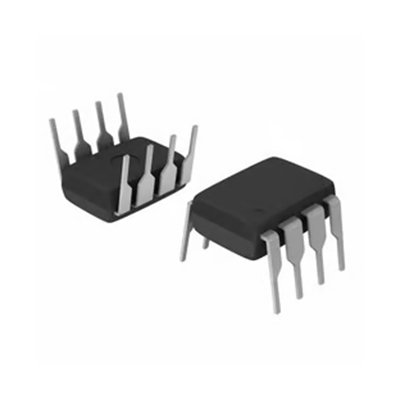
- Use Microchip's 8-lead PDIP mechanical drawing for hole spacing and body dimensions.
- Verify pin-1 orientation before wiring the LC and RF stages.
- Do not substitute the SOIC footprint for this /P variant.
Package image pending: the local 8-DIP.jpg is absent and the production image URL returns HTTP 404. This page must remain unpublished until the correct image is available online.
Pin Functions
Microchip's 8-pin PDIP/SOIC pin diagram gives the following assignments.
Switch input 0.
Switch input 1.
Multifunction switch, RF-enable or LC interface pin.
LC transponder interface pin.
Ground reference.
Data interface pin.
LED output.
Positive supply.
Programmed operating mode determines the multifunction-pin behavior; consult the datasheet before connecting external circuitry.
Key Specifications
| Function | KEELOQ code-hopping encoder and transponder |
|---|---|
| Orderable variant | HCS412-I/P |
| Package | 8-lead, 300-mil PDIP |
| Operating temperature | -40°C to +85°C (I suffix) |
| Operating supply | 2.0 V to 6.3 V |
| Switch inputs | 3; seven combinations/functions |
| Transmission length | 69 bits |
| Hopping-code portion | 32 bits |
| Nonencrypted portion | 37 bits |
| Encoder crypt key | Programmable 64 bits |
| Serial number | Programmable 28/32-bit option |
| Transponder carrier | 125 kHz typical |
| LC input sensitivity | 100 mV peak-to-peak typical; datasheet marks this parameter not tested |
Typical figures and security functions require the conditions and configuration described in the full manufacturer datasheet.
Replacement Considerations
Do not assume that another HCS-series device is interchangeable. Check the complete order code, DIP footprint, pin functions, programmed keys, transmitted format, transponder mode and receiver firmware. No unverified internal substitute link is supplied.
Manufacturer Information
Manufacturer: Microchip Technology. The manufacturer identifies HCS412 as a code-hopping encoder; I specifies industrial temperature and P the 8-lead plastic DIP. Consult the current HCS412 datasheet and Microchip package drawing before production release.
Applications
Transmitter designs paired with a compatible receiver and programmed keys.
LC-coupled proximity or challenge-response systems.
Code-hopping remote-control systems with system-level security review.
Door-access products using a matched encoder and receiver design.
Quality & Authenticity
Verify the exact HCS412-I/P marking, 8-lead DIP construction and pin-1 indicator against Microchip's documentation. Maintain lot traceability and confirm programmed credentials under the project's controlled provisioning process.
FAQ
What does -I/P identify?
It identifies industrial-temperature operation (-40°C to +85°C) and the 8-lead, 300-mil plastic DIP package.
Is this a fixed-code encoder?
No. HCS412 uses KEELOQ code hopping and also includes transponder capability.
Does the DIP package provide an RF transmitter?
No. The system needs a suitable external RF stage and a compatible, correctly provisioned receiver.
Engineering Notice
Validate supply, pin multiplexing, code format, oscillator calibration, key provisioning and receiver interoperability against Microchip's datasheet. The registered package illustration currently fails the production image check; do not publish this detail until that resource is corrected and rechecked.
HCS412-I/P Information
- Specifications
- Tags
- Product attributes
- Attribute value
- Manufacturer:
- Microchip Technology
- Series:
- KEELOQ®
- Package/Case:
- 8-DIP (0.300", 7.62mm)
- Packaging:
- Tube
- Product Status:
- Obsolete
- Programmable:
- Not Verified
- Type:
- Code Hopping Encoder and Transponder
- Applications:
- Remote Secure Access, Keyless Entry
- Mounting Type:
- Through Hole
- Supplier Device Package:
- 8-PDIP
- Grade:
- -
- Qualification:
- -
- Include Parts
- Popular Search
The following parts include "HCS412-I/P" in Silicon Labs HCS412-I/P.
- Part Number
- Manufacturer
- Package
- Description
- CAP200DG-TL Power Integrations 8-SOIC (0.154", 3.90mm Width) IC AUTOMATIC DISCHARGE 8SO
- ATSHA204A-MAHDA-T Microchip Technology 8-UFDFN Exposed Pad IC AUTHENTICATION CHIP 8UDFN
- ATSHA204A-SSHDA-T Microchip Technology 8-SOIC (0.154", 3.90mm Width) IC AUTHENTICATION CHIP 8SOIC
- ATSHA204A-STUCZ-T Microchip Technology TO-236-3, SC-59, SOT-23-3 IC AUTHENTICATION CHIP SOT23-3
- ATECC608B-MAHDA-T Microchip Technology 8-UFDFN Exposed Pad IC AUTHENTICATION CHIP 8UDFN
- ATECC608B-MAHCZ-S Microchip Technology 8-UFDFN Exposed Pad IC AUTHENTICATION CHIP 8UDFN
- ATECC608B-SSHDA-T Microchip Technology 8-SOIC (0.154", 3.90mm Width) IC AUTHENTICATION CHIP 8SOIC
- ATECC608B-MAHDA-S Microchip Technology 8-UFDFN Exposed Pad IC AUTHENTICATION CHIP 8UDFN
- ATECC608A-MAHDA-S Microchip Technology 8-UFDFN Exposed Pad IC AUTHENTICATION CHIP 8UDFN
- ATECC608B-MAVDA-T Microchip Technology 8-UFDFN Exposed Pad IC AUTHENTICATION CHIP 8UDFN
The following parts are popular search parts in Test and Measurement.
Inventory:2,385
Please send an inquiry. Send us your inquiry, and we will respond immediately.


