 Hello! now
 tms@lcdchip.com



Microchip Technology HCS370-I/SL

- Part No.:
- HCS370-I/SL
- Manufacturer:
- Microchip Technology
- Category:
- Specialized ICs
- Package:
- 14-SOIC (0.154", 3.90mm Width)
- Description:
- IC CODE HOPPING ENCODER 14SOIC
- Quantity:
Unit Price:$0
Ext Price:$0
- Payment:

- Shipping:


Product Details
HCS370-I/SL - KeeLoq Code Hopping Encoder
Microchip Technology HCS370 is a code-hopping encoder for secure remote-control transmitters, with six button inputs and selectable serial transmission formats.
Technical information is based on Microchip's HCS370 data sheet, document 41111E; verify the exact orderable suffix and current documentation before design release.
Overview
The HCS370 integrates Microchip's KeeLoq code-hopping encoder function for a handheld transmitter or other keyed wireless-control design. A button event initiates an encoded transmission whose hopping portion changes between uses, helping a correctly designed receiver reject simple replay attempts.
Six input lines support button selection and combinations. The device includes nonvolatile configuration and synchronization-related information; the complete system still requires a compatible receiver, secure key provisioning, and a suitable RF stage.
Key Advantages
KeeLoq code hopping makes each normal transmission different, subject to proper transmitter and receiver configuration.
Six button inputs allow up to 15 button functions according to the data sheet.
Dedicated DATA, RFEN and LED signals assist a compact remote-control implementation.
Selectable baud rates and transmission options support system-level protocol choices.
Feature Summary
KeeLoq code-hopping architecture with a 32-bit hopping-code portion.
67-bit and 69-bit transmission formats are documented; receiver compatibility must be checked.
S0 through S4 and the shared SLEEP/S5 function support control inputs.
On-chip EEPROM supports programmed device and transmitter information.
Package & Footprint
The cataloged package is 14-SOIC (0.154 in / 3.90 mm nominal body width). The /SL suffix is associated with the SOIC ordering option; check Microchip's latest package drawing for dimensions and tolerances.
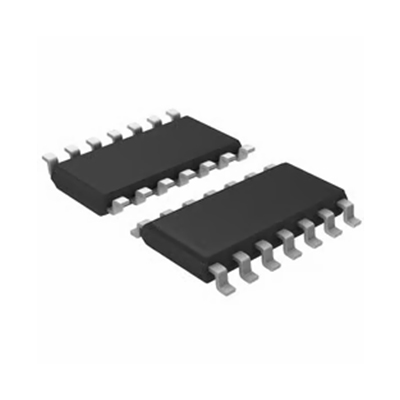
- Match the 14-pin orientation and pin-1 marking.
- Verify pad geometry using the manufacturer package drawing.
- Place supply decoupling close to VDD and VSS.
- Validate RF interface and antenna layout at system level.
Package registry entry exists, but the local 14-SOIC JPG is missing. This resource must be restored and checked before publication.
Pin Functions
The Microchip data sheet's 14-pin PDIP/SOIC/TSSOP diagram identifies these signals. Consult the pin descriptions for electrical behavior and alternate use.
Pin numbering is shown for the 14-lead device; confirm orientation against the physical package.
Key Specifications
| Manufacturer | Microchip Technology |
|---|---|
| Function | KeeLoq code-hopping encoder |
| Supply range | 2.05 V to 5.5 V, subject to data-sheet conditions |
| Button inputs | Six; up to 15 functions |
| Transmission | 67-bit or 69-bit format; four selectable baud rates |
| Hopping-code portion | 32 bits |
| Package | 14-SOIC, 0.154 in / 3.90 mm body-width class |
| Operating temperature suffix | I industrial grade; verify exact rating in the current ordering information |
These are selection-level characteristics, not a substitute for electrical limits, timing tables or ordering details in the current manufacturer data sheet.
Replacement Considerations
A substitute must match the transmitter and receiver's KeeLoq protocol details, programmed key, serial number, synchronization method, frame format, baud rate, I/O behavior, supply range and package pinout. Similar-looking encoders are not automatically drop-in replacements.
No internal catalog alternative is asserted here without an exact product and engineering compatibility check.
Manufacturer Information
Microchip Technology publishes the HCS370 product information and HCS370 KeeLoq Code Hopping Encoder data sheet. See the official product page and official data sheet (41111E). The Microchip affected-part listing includes HCS370-I/SL.
Applications
Encoded button transmitters in compatible access systems.
Handheld arming and disarming controls with a matching receiver.
Code-hopping commands for appropriately designed access equipment.
Compact transmitters where a changing encoded message is required.
Quality & Authenticity
Confirm the full orderable marking, package orientation, traceability and handling requirements against Microchip documentation. Treat programmed keys and EEPROM contents as security-sensitive; verify configuration in the intended receiver system.
FAQ
No. It is an encoder; the RF circuitry, antenna, receiver and provisioning process are system-level design elements.
No. Security depends on key generation, programming, receiver validation and the overall system implementation.
Only after verifying protocol, configuration, electrical behavior and pin compatibility with both sides of the link.
Engineering Notice
Use the latest Microchip data sheet, errata, application guidance and package drawings for design decisions. This summary does not specify all electrical limits or commissioning steps. The local package illustration is presently unavailable, so publication must remain on hold until the image is restored and verified.
HCS370-I/SL Information
- Specifications
- Tags
- Product attributes
- Attribute value
- Manufacturer:
- Microchip Technology
- Series:
- KEELOQ®
- Package/Case:
- 14-SOIC (0.154", 3.90mm Width)
- Packaging:
- Tube
- Product Status:
- Active
- Programmable:
- Verified
- Type:
- Code Hopping Encoder
- Applications:
- Remote Secure Access, Keyless Entry
- Mounting Type:
- Surface Mount
- Supplier Device Package:
- 14-SOIC
- Grade:
- -
- Qualification:
- -
- Include Parts
- Popular Search
The following parts include "HCS370-I/SL" in Silicon Labs HCS370-I/SL.
- Part Number
- Manufacturer
- Package
- Description
- CAP200DG-TL Power Integrations 8-SOIC (0.154", 3.90mm Width) IC AUTOMATIC DISCHARGE 8SO
- ATSHA204A-MAHDA-T Microchip Technology 8-UFDFN Exposed Pad IC AUTHENTICATION CHIP 8UDFN
- ATSHA204A-SSHDA-T Microchip Technology 8-SOIC (0.154", 3.90mm Width) IC AUTHENTICATION CHIP 8SOIC
- ATSHA204A-STUCZ-T Microchip Technology TO-236-3, SC-59, SOT-23-3 IC AUTHENTICATION CHIP SOT23-3
- ATECC608B-MAHDA-T Microchip Technology 8-UFDFN Exposed Pad IC AUTHENTICATION CHIP 8UDFN
- ATECC608B-MAHCZ-S Microchip Technology 8-UFDFN Exposed Pad IC AUTHENTICATION CHIP 8UDFN
- ATECC608B-SSHDA-T Microchip Technology 8-SOIC (0.154", 3.90mm Width) IC AUTHENTICATION CHIP 8SOIC
- ATECC608B-MAHDA-S Microchip Technology 8-UFDFN Exposed Pad IC AUTHENTICATION CHIP 8UDFN
- ATECC608A-MAHDA-S Microchip Technology 8-UFDFN Exposed Pad IC AUTHENTICATION CHIP 8UDFN
- ATECC608B-MAVDA-T Microchip Technology 8-UFDFN Exposed Pad IC AUTHENTICATION CHIP 8UDFN
The following parts are popular search parts in Test and Measurement.
Inventory:2,217
Please send an inquiry. Send us your inquiry, and we will respond immediately.


