 Hello! now
 tms@lcdchip.com



Microchip Technology HCS320/P

- Part No.:
- HCS320/P
- Manufacturer:
- Microchip Technology
- Category:
- Specialized ICs
- Package:
- 8-DIP (0.300", 7.62mm)
- Description:
- IC CODE HOPPING ENCODER 8DIP
- Quantity:
Unit Price:$0
Ext Price:$0
- Payment:

- Shipping:


Product Details
HCS320/P - KEELOQ Code-Hopping Encoder
HCS320/P is a Microchip KEELOQ code-hopping encoder for unidirectional remote-keyless-entry transmitters. The exact /P ordering option is an eight-lead, 300-mil plastic DIP rated for 0°C to +70°C; LCDChip registers it as 8-DIP (0.300", 7.62mm).
System security depends on protected key provisioning, receiver learning and synchronization policy, not on the encoder alone.
Overview
The HCS320 creates a 66-bit code word consisting of a 32-bit encrypted hopping portion and a 34-bit fixed portion. It combines a programmable 64-bit encryption key, 28-bit serial number, nonvolatile synchronization information and switch status. Unlike a four-switch-input encoder, this device provides three normal switch inputs plus a SHIFT input to select 16 functions. Its PWM pin supplies encoded data to an external transmitter stage.
Key Advantages
Changing encrypted transmissions reduce exposure to simple replay of a captured fixed code.
Three switch inputs and a SHIFT key implement the full set of 16 function codes.
On-chip EEPROM stores the read-protected crypt key and synchronization data.
Integrated timing, oscillator and LED-drive functions simplify transmitter design.
Feature Summary
66-bit transmitted code word with 32-bit hopping and 34-bit fixed fields.
Programmable 28-bit serial number and 64-bit crypt key.
Specified 3.5 V to 13.0 V operation with battery-low status handling.
PWM encoded output and a current-limited LED cathode output.
Package & Footprint
LCDChip's original registered package is 8-DIP (0.300", 7.62mm). Microchip's identification table defines /P as an eight-lead plastic DIP with a 300-mil body. Use the controlled package drawing for row spacing, drill diameter and pin-one orientation. The /SN SOIC ordering option is a different footprint.
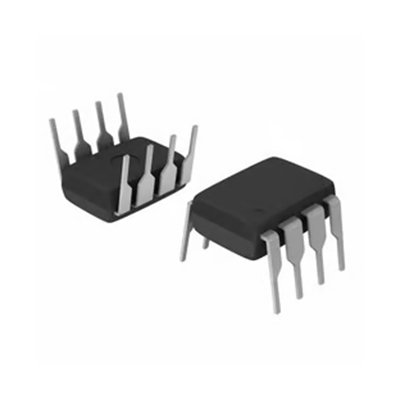
- Check 300-mil body and through-hole footprint dimensions.
- Verify SHIFT, switch-input and programming-pin routing.
- Route PWM to suitable external RF-transmitter circuitry.
The expected local 8-DIP JPG is absent and the production image returns HTTP 404. Keep this detail unpublished until the correct image is restored and inspected.
Pin Functions
Microchip's eight-pin HCS320 table assigns switch inputs S0, S1 and S2 to pins 1, 2 and 3; S2 is also the programming clock. Pin 4 is SHIFT, pin 5 VSS, pin 6 PWM/programming data, pin 7 the LED cathode connection and pin 8 VDD.
Normal switch inputs; S2 doubles as programming clock.
Selects the alternate function set.
Ground and positive supply.
Encoded-data output/programming data and LED cathode drive.
Follow the manufacturer's application and programming circuits when sharing pins between operating and programming modes.
Key Specifications
| Exact order code | HCS320/P |
|---|---|
| Function | KEELOQ code-hopping transmitter encoder |
| Package | Eight-lead plastic DIP, 300-mil body |
| Temperature range | 0°C to +70°C for the unsuffixed /P order code |
| Operating supply | 3.5 V to 13.0 V |
| Transmission length | 66 bits |
| Hopping code | 32 bits |
| Fixed code | 34 bits: 28-bit serial, four function bits and two status bits |
| Encryption key | 64 bits, programmable and read-protected |
| Serial number | 28 bits, programmable |
| Function controls | Three switch inputs plus SHIFT; 16 functions |
| EEPROM | 192 bits organized as twelve 16-bit words |
| Outputs | PWM encoded data and LED cathode drive |
Specifications are taken from Microchip HCS320 data sheet DS41097D. The industrial -I/P option has a different temperature rating and must not be substituted by suffix alone.
Replacement Considerations
Other KEELOQ encoders may share code-word length yet differ in switch mapping, SHIFT behavior, programming configuration, receiver learning requirements, temperature range or physical package. Compare the full order code, 300-mil DIP footprint, programmed key and host decoder firmware. No unverified internal alternative is linked.
Manufacturer Information
Microchip Technology's HCS320 KEELOQ Code Hopping Encoder data sheet DS41097D provides the feature list, eight-pin table, EEPROM and code-word descriptions, and product identification table that defines the /P package and commercial-temperature range.
Applications
Supply changing code words to a compatible learned receiver.
Encode remote button events with receiver-side synchronization.
Implement a key-fob encoder with external RF circuitry.
Associate a provisioned transmitter with an access-control policy.
Quality & Authenticity
Check top marking, traceability, 300-mil DIP dimensions and pin-one orientation. Validate device provisioning and transmitter-to-receiver learning using authorized test fixtures. Confirm SHIFT input behavior, code-word decoding and supply operation in the intended system.
FAQ
What does the /P suffix mean?
Microchip specifies an eight-lead, 300-mil plastic DIP; the absence of I denotes 0°C to +70°C.
How is HCS320 different from a four-switch-input encoder?
It uses three switch inputs and a separate SHIFT input to implement 16 functions.
Does the chip generate an RF carrier?
No. PWM provides encoded data for external transmitter circuitry.
Why is the detail unpublished?
The registered 8-DIP package JPG is missing from the production site.
Engineering Notice
Safeguard manufacturer-code secrets and crypt-key provisioning records. Validate receiver learning, synchronization, SHIFT mapping, the RF transmitter stage and the controlled DIP footprint. Restore and inspect the live package JPG before formal publication.
HCS320/P Information
- Specifications
- Tags
- Product attributes
- Attribute value
- Manufacturer:
- Microchip Technology
- Series:
- KEELOQ®
- Package/Case:
- 8-DIP (0.300", 7.62mm)
- Packaging:
- Tube
- Product Status:
- Active
- Programmable:
- Not Verified
- Type:
- Code Hopping Encoder
- Applications:
- Remote Secure Access, Keyless Entry
- Mounting Type:
- Through Hole
- Supplier Device Package:
- 8-PDIP
- Grade:
- -
- Qualification:
- -
- Include Parts
- Popular Search
The following parts include "HCS320/P" in Silicon Labs HCS320/P.
- Part Number
- Manufacturer
- Package
- Description
- CAP200DG-TL Power Integrations 8-SOIC (0.154", 3.90mm Width) IC AUTOMATIC DISCHARGE 8SO
- ATSHA204A-MAHDA-T Microchip Technology 8-UFDFN Exposed Pad IC AUTHENTICATION CHIP 8UDFN
- ATSHA204A-SSHDA-T Microchip Technology 8-SOIC (0.154", 3.90mm Width) IC AUTHENTICATION CHIP 8SOIC
- ATSHA204A-STUCZ-T Microchip Technology TO-236-3, SC-59, SOT-23-3 IC AUTHENTICATION CHIP SOT23-3
- ATECC608B-MAHDA-T Microchip Technology 8-UFDFN Exposed Pad IC AUTHENTICATION CHIP 8UDFN
- ATECC608B-MAHCZ-S Microchip Technology 8-UFDFN Exposed Pad IC AUTHENTICATION CHIP 8UDFN
- ATECC608B-SSHDA-T Microchip Technology 8-SOIC (0.154", 3.90mm Width) IC AUTHENTICATION CHIP 8SOIC
- ATECC608B-MAHDA-S Microchip Technology 8-UFDFN Exposed Pad IC AUTHENTICATION CHIP 8UDFN
- ATECC608A-MAHDA-S Microchip Technology 8-UFDFN Exposed Pad IC AUTHENTICATION CHIP 8UDFN
- ATECC608B-MAVDA-T Microchip Technology 8-UFDFN Exposed Pad IC AUTHENTICATION CHIP 8UDFN
The following parts are popular search parts in Test and Measurement.
Inventory:1,562
Please send an inquiry. Send us your inquiry, and we will respond immediately.


