 Hello! now
 tms@lcdchip.com



Microchip Technology HCS301-I/P

- Part No.:
- HCS301-I/P
- Manufacturer:
- Microchip Technology
- Category:
- Specialized ICs
- Package:
- 8-DIP (0.300", 7.62mm)
- Description:
- IC CODE HOPPING ENCODER 8DIP
- Quantity:
Unit Price:$0
Ext Price:$0
- Payment:

- Shipping:


Product Details
HCS301-I/P - KEELOQ Code-Hopping Encoder
HCS301-I/P is a Microchip KEELOQ code-hopping encoder for unidirectional remote-keyless-entry transmitters. The exact I/P order code specifies an industrial-temperature device in an eight-lead, 300-mil plastic DIP; LCDChip registers the package as 8-DIP (0.300", 7.62mm).
Security depends on protected manufacturer-code handling, unique key provisioning and a compatible receiver learning policy.
Overview
The HCS301 generates a 66-bit transmitted code word from a 32-bit hopping portion and 34 fixed information bits. A programmable 64-bit crypt key and 28-bit serial number are stored with synchronization and configuration information in on-chip EEPROM. Four switch inputs select transmitter functions; the PWM output carries the encoded data to external transmitter circuitry.
Key Advantages
The hopping portion is updated when the synchronization counter advances, reducing simple capture-and-replay exposure.
On-chip EEPROM holds the read-protected crypt key and transmitter configuration.
Four switch inputs permit multiple button combinations and up to 15 functions.
Integrated oscillator, timing and LED drive reduce external encoder circuitry.
Feature Summary
66 bits total: 32-bit hopping code and 34 fixed bits.
Programmable 28-bit serial number and 64-bit encryption key.
3.5 V to 13.0 V operating range; battery-low signaling and LED indication.
PWM encoded-data output and current-limited LED output.
Package & Footprint
Original LCDChip registration: 8-DIP (0.300", 7.62mm). Microchip's HCS301 identification table defines the /P suffix as an eight-lead plastic DIP with a 300-mil body. Check the manufacturer's controlled drawing, row spacing and pin-one orientation before selecting a socket or PCB footprint; the /SN SOIC option is not mechanically interchangeable.
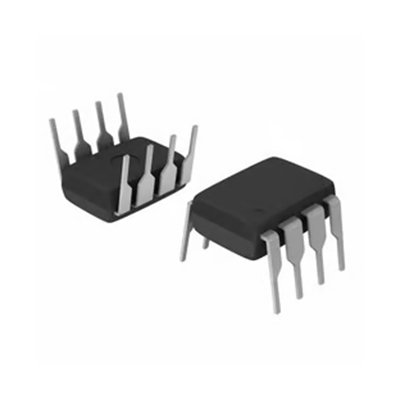
- Confirm 300-mil body and through-hole row spacing.
- Keep VDD and VSS wiring within the rated supply range.
- Route PWM to appropriate transmitter circuitry, not directly to an antenna.
The expected local JPG is absent and the production image returns HTTP 404. Keep the detail unpublished until the correct image is restored and inspected.
Pin Functions
Microchip's eight-pin HCS301 pin table assigns S0, S1, S2 and S3 switch inputs to pins 1 through 4. S2 doubles as the programming clock. Pin 5 is VSS, pin 6 is PWM output/programming data, pin 7 is the LED cathode connection and pin 8 is VDD.
Four button inputs; S2 is the programming clock.
Ground and positive supply.
Encoded output and programming data.
Cathode connection for the indicator LED.
Observe the manufacturer's programming and application circuits before multiplexing switch and programming functions.
Key Specifications
| Exact order code | HCS301-I/P |
|---|---|
| Function | KEELOQ code-hopping transmitter encoder |
| Package | Eight-lead plastic DIP, 300-mil body |
| Temperature suffix | I: -40°C to +85°C |
| Operating supply | 3.5 V to 13.0 V |
| Transmitted code word | 66 bits |
| Hopping portion | 32 bits |
| Fixed portion | 34 bits: 28-bit serial, four button bits and two status bits |
| Encryption key | 64 bits, programmable and read-protected |
| Serial number | 28 bits, programmable |
| Switch inputs | Four, with up to 15 button functions |
| EEPROM | 192 bits organized as twelve 16-bit words |
| Outputs | PWM encoded-data output and LED cathode drive |
Values are from the manufacturer's HCS301 data sheet DS21143C. Confirm receiver protocol, timing and power-circuit details for the final application.
Replacement Considerations
Microchip describes HCS301 as functionally identical to HCS300, but any substitution still requires review of the exact order code, package, programmed key material, serial-number policy, receiver learning method and synchronization behavior. The HCS301 /SN version uses SOIC rather than the registered through-hole DIP footprint. No unverified internal alternative is linked.
Manufacturer Information
Microchip Technology's HCS301 KEELOQ Code Hopping Encoder data sheet DS21143C provides the official feature list, pin descriptions, programming and code-word information, and the product identification table confirming the I/P industrial-temperature 300-mil DIP order code.
Applications
Encode button events for a compatible learned receiver.
Supply changing transmitter code words to the alarm receiver.
Support key-fob transmitters with code-hopping verification.
Use provisioned transmitter identity in a controlled access system.
Quality & Authenticity
Inspect top marking, date and lot traceability, 300-mil DIP geometry and pin-one indication. Verify the programmed serial number and key policy using authorized test fixtures, then confirm receiver learning and synchronization under repeated button activations. Protect programming records and manufacturer-code secrets.
FAQ
What does I/P mean?
Microchip defines I as the -40°C to +85°C temperature range and /P as the eight-lead 300-mil plastic DIP.
Does this IC include a radio transmitter?
No. PWM carries the encoded data to external transmitter circuitry.
Which pins are used in programming?
S2 on pin 3 is the programming clock and PWM on pin 6 is programming data.
Why is this detail unpublished?
The registered 8-DIP JPG is absent from the production site.
Engineering Notice
Use the controlled Microchip programming flow; safeguard the manufacturer code, unique crypt keys and receiver learn records. Validate the complete RF transmitter and receiver system, supply network and DIP footprint. Restore and inspect the live package JPG before formal publication.
HCS301-I/P Information
- Specifications
- Tags
- Product attributes
- Attribute value
- Manufacturer:
- Microchip Technology
- Series:
- KEELOQ®
- Package/Case:
- 8-DIP (0.300", 7.62mm)
- Packaging:
- Tube
- Product Status:
- Active
- Programmable:
- Verified
- Type:
- Code Hopping Encoder
- Applications:
- Remote Secure Access, Keyless Entry
- Mounting Type:
- Through Hole
- Supplier Device Package:
- 8-PDIP
- Grade:
- -
- Qualification:
- -
- Include Parts
- Popular Search
The following parts include "HCS301-I/P" in Silicon Labs HCS301-I/P.
- Part Number
- Manufacturer
- Package
- Description
- CAP200DG-TL Power Integrations 8-SOIC (0.154", 3.90mm Width) IC AUTOMATIC DISCHARGE 8SO
- ATSHA204A-MAHDA-T Microchip Technology 8-UFDFN Exposed Pad IC AUTHENTICATION CHIP 8UDFN
- ATSHA204A-SSHDA-T Microchip Technology 8-SOIC (0.154", 3.90mm Width) IC AUTHENTICATION CHIP 8SOIC
- ATSHA204A-STUCZ-T Microchip Technology TO-236-3, SC-59, SOT-23-3 IC AUTHENTICATION CHIP SOT23-3
- ATECC608B-MAHDA-T Microchip Technology 8-UFDFN Exposed Pad IC AUTHENTICATION CHIP 8UDFN
- ATECC608B-MAHCZ-S Microchip Technology 8-UFDFN Exposed Pad IC AUTHENTICATION CHIP 8UDFN
- ATECC608B-SSHDA-T Microchip Technology 8-SOIC (0.154", 3.90mm Width) IC AUTHENTICATION CHIP 8SOIC
- ATECC608B-MAHDA-S Microchip Technology 8-UFDFN Exposed Pad IC AUTHENTICATION CHIP 8UDFN
- ATECC608A-MAHDA-S Microchip Technology 8-UFDFN Exposed Pad IC AUTHENTICATION CHIP 8UDFN
- ATECC608B-MAVDA-T Microchip Technology 8-UFDFN Exposed Pad IC AUTHENTICATION CHIP 8UDFN
The following parts are popular search parts in Test and Measurement.
Inventory:3,804
Please send an inquiry. Send us your inquiry, and we will respond immediately.


