 Hello! now
 tms@lcdchip.com



Microchip Technology HCS201-I/P

- Part No.:
- HCS201-I/P
- Manufacturer:
- Microchip Technology
- Category:
- Specialized ICs
- Package:
- 8-DIP (0.300", 7.62mm)
- Description:
- IC CODE HOPPING ENCODER 8DIP
- Quantity:
Unit Price:$0
Ext Price:$0
- Payment:

- Shipping:


Product Details
HCS201-I/P - KEELOQ Code-Hopping Encoder
HCS201-I/P is a Microchip KEELOQ code-hopping encoder for unidirectional remote-keyless-entry transmitters. The exact /P suffix specifies an eight-lead, 300-mil plastic DIP; the -I temperature code specifies the industrial range.
Match the encoder to a correctly provisioned and synchronized receiver; evaluate the legacy security scheme against current system requirements.
Overview
When a button input is activated, HCS201 produces a 66-bit transmission comprising a 32-bit hopping portion and 34 fixed/status bits. On-chip EEPROM holds the crypt key, serial number, configuration, and synchronization value. The encoder uses a PWM DATA output and a compatible receiver must learn and validate the transmitter.
Key Advantages
The synchronization counter changes the hopping portion for successive activations.
Three button inputs and seven available functions support typical remote-control functions.
EEPROM, timing circuitry, and step-up regulator control reduce external logic.
The /P package supports an eight-lead 300-mil DIP assembly.
Feature Summary
28-bit serial number and 64-bit encryption key are programmed into read-protected EEPROM.
66 bits combine a 32-bit hopping code with serial, button, and status information.
The datasheet states 3.5 V to 13 V operation, or down to 2.0 V minimum when using the step-up feature.
PWM DATA output drives external transmitter circuitry; selectable baud rate and synchronous transmission are documented.
Package & Footprint
LCDChip registers 8-DIP (0.300", 7.62mm). Microchip's product identification system defines /P as an eight-lead, 300-mil plastic DIP and -I as -40°C to +85°C. This through-hole footprint is not interchangeable with the /SN SOIC or /ST TSSOP options.
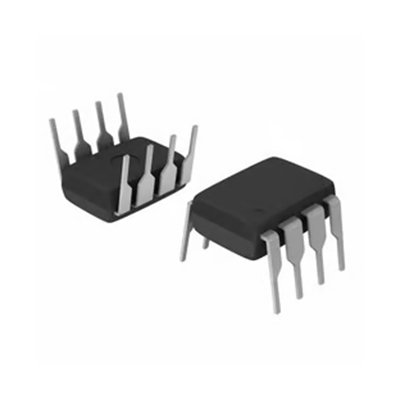
- Verify row spacing and hole pattern against the controlled package drawing.
- Orient pin 1 before routing the button inputs and supply.
- Do not reuse a surface-mount land pattern.
The expected local JPG is absent and the production package URL returns HTTP 404; retain this as an unpublished draft until artwork is verified.
Pin Functions
Microchip's eight-pin table assigns pin 1 S0 (switch input 0), pin 2 S1, pin 3 S2 (also programming clock), pin 4 VDDB (battery input for step-up control), pin 5 VSS, pin 6 DATA (PWM output and programming data), pin 7 STEP (step-up switch control), and pin 8 VDD. Follow the datasheet's programming and application circuits for external connections.
Key Specifications
| Function | KEELOQ code-hopping encoder |
|---|---|
| Exact order code | HCS201-I/P |
| Registered package | 8-DIP, 300-mil body |
| Temperature grade | Industrial, -40°C to +85°C |
| Nominal supply span | 3.5 V to 13 V per datasheet feature summary |
| Step-up operation | 2.0 V minimum when step-up feature is used |
| Button inputs | Three |
| Available functions | Seven |
| Code word | 66 bits |
| Hopping portion | 32 bits |
| Fixed/status portion | 34 bits |
| Serial number | 28-bit programmable |
| Encryption key | 64-bit programmable, read-protected |
| Output | PWM DATA |
Apply the detailed electrical and timing tables under their specified test conditions; the feature summary is not a substitute for design limits.
Replacement Considerations
Other HCS-family encoders are not unconditional replacements. Compare code format, input count, programming method, step-up behavior, receiver learning, temperature grade, and package. No unverified LCDChip alternative link is asserted.
Manufacturer Information
Microchip's HCS201 KEELOQ Code Hopping Encoder Data Sheet, DS41098D, defines the pin map, transmission format, operating features, electrical limits, and product identification system. Use the manufacturer's latest controlled revision and current lifecycle status during qualification.
Applications
Encode user-button activity for a compatible receiver.
Support learned remote transmitters in access systems.
Provide a changing encoded transmission to external RF circuitry.
Use only after assessing receiver compatibility and system threat model.
Quality & Authenticity
Verify marking, package dimensions, traceable lot, button inputs, and DATA waveform. Protect manufacturer codes and encoder keys through controlled provisioning. Test receiver learning, counter resynchronization, and low-battery signaling. Review legacy cipher suitability with a current security assessment.
FAQ
Does HCS201 include the radio?
No. It is the code-hopping encoder; external RF and receiver circuitry are required.
What does -I/P specify?
Industrial temperature grade and an eight-lead, 300-mil plastic DIP.
Can a different HCS encoder be substituted directly?
Only after checking programming, code format, receiver compatibility, electrical behavior, and footprint.
Why is this detail unpublished?
The registered 8-DIP production JPG currently returns HTTP 404.
Engineering Notice
Use the current Microchip datasheet for absolute limits, recommended conditions, timing, programming, and package dimensions. Verify receiver learning and security architecture, then deploy a validated 8-DIP JPG before publication.
HCS201-I/P Information
- Specifications
- Tags
- Product attributes
- Attribute value
- Manufacturer:
- Microchip Technology
- Series:
- KEELOQ®
- Package/Case:
- 8-DIP (0.300", 7.62mm)
- Packaging:
- Tube
- Product Status:
- Active
- Programmable:
- Verified
- Type:
- Code Hopping Encoder
- Applications:
- Remote Secure Access, Keyless Entry
- Mounting Type:
- Through Hole
- Supplier Device Package:
- 8-PDIP
- Grade:
- -
- Qualification:
- -
- Include Parts
- Popular Search
The following parts include "HCS201-I/P" in Silicon Labs HCS201-I/P.
- Part Number
- Manufacturer
- Package
- Description
- CAP200DG-TL Power Integrations 8-SOIC (0.154", 3.90mm Width) IC AUTOMATIC DISCHARGE 8SO
- ATSHA204A-MAHDA-T Microchip Technology 8-UFDFN Exposed Pad IC AUTHENTICATION CHIP 8UDFN
- ATSHA204A-SSHDA-T Microchip Technology 8-SOIC (0.154", 3.90mm Width) IC AUTHENTICATION CHIP 8SOIC
- ATSHA204A-STUCZ-T Microchip Technology TO-236-3, SC-59, SOT-23-3 IC AUTHENTICATION CHIP SOT23-3
- ATECC608B-MAHDA-T Microchip Technology 8-UFDFN Exposed Pad IC AUTHENTICATION CHIP 8UDFN
- ATECC608B-MAHCZ-S Microchip Technology 8-UFDFN Exposed Pad IC AUTHENTICATION CHIP 8UDFN
- ATECC608B-SSHDA-T Microchip Technology 8-SOIC (0.154", 3.90mm Width) IC AUTHENTICATION CHIP 8SOIC
- ATECC608B-MAHDA-S Microchip Technology 8-UFDFN Exposed Pad IC AUTHENTICATION CHIP 8UDFN
- ATECC608A-MAHDA-S Microchip Technology 8-UFDFN Exposed Pad IC AUTHENTICATION CHIP 8UDFN
- ATECC608B-MAVDA-T Microchip Technology 8-UFDFN Exposed Pad IC AUTHENTICATION CHIP 8UDFN
The following parts are popular search parts in Test and Measurement.
Inventory:4,652
Please send an inquiry. Send us your inquiry, and we will respond immediately.


