 Hello! now
 tms@lcdchip.com



Analog Devices Inc./Maxim Integrated DS28E39Q+T

- Part No.:
- DS28E39Q+T
- Manufacturer:
- Analog Devices Inc./Maxim Integrated
- Category:
- Specialized ICs
- Package:
- 6-WDFN Exposed Pad
- Description:
- IC AUTHENTICATION CHIP 6TDFN
- Quantity:
Unit Price:$0
Ext Price:$0
- Payment:

- Shipping:


Product Details
DS28E39Q+T - 1-Wire ECDSA Secure Authenticator
DS28E39Q+T is an Analog Devices/Maxim DeepCover bidirectional authenticator using ECC-P256 ECDSA and ChipDNA physically unclonable-function protection. The exact Q+T order code is a six-pin exposed-pad TDFN supplied on tape and reel, rated -40°C to +85°C.
Security depends on controlled key provisioning, host validation, power delivery and the complete system trust model.
Overview
The DS28E39 combines a ChipDNA PUF, ECC-P256 cryptographic engine, true-random-number generator and protected EEPROM for challenge-response authentication over a 1-Wire connection. ChipDNA-derived material protects stored data and can, under user control, provide the ECDSA private key. A factory-programmed 64-bit ROM ID identifies the device on the bus. Authentication can be used in both host-to-device and device-to-host system flows.
Key Advantages
ECC-P256 ECDSA supports challenge-response signatures without sharing a symmetric secret with every verifier.
ChipDNA PUF-derived material helps protect data against invasive extraction.
On-chip EEPROM accommodates application data, key material, control settings and certificates.
A factory-programmed 64-bit ROM ID acts as the device identity on a multidrop 1-Wire bus.
Feature Summary
Derives device-specific key content from physical silicon variation.
Supports NIST P-256 signatures for public-key authentication.
An optional 17-bit, one-time-settable decrement-only counter supports authenticated reads.
Uses a single-contact open-drain bus with an external pullup and external capacitor for parasitic power.
Package & Footprint
LCDChip registers 6-WDFN Exposed Pad. Analog Devices' exact ordering row specifies DS28E39Q+T as a six-pin 3 mm × 3 mm TDFN-EP on tape and reel. The exposed paddle is soldered evenly to the board ground plane. Check the controlled footprint and pin-one orientation.
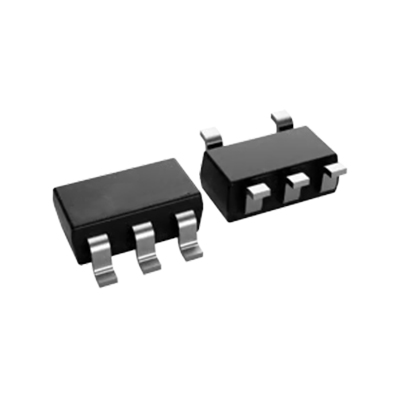
- Provide the specified external CEXT capacitor and 1-Wire pullup.
- Connect the exposed pad to the ground plane as directed.
- Confirm controlled TDFN-EP dimensions before PCB release.
The expected local JPG is absent and the production URL returns HTTP 404. Keep this draft unpublished until the correct image is restored and inspected.
Pin Functions
The manufacturer's DS28E39Q+ TDFN pin table assigns pins 1, 4 and 5 as no-connect; pin 2 as 1-Wire IO; pin 3 as ground; and pin 6 as CEXT, the external-capacitor input. Solder the exposed pad to the ground plane for proper operation. Design the IO pullup and CEXT network from the electrical table rather than treating the capacitor pin as a general-purpose I/O.
Key Specifications
| Function | DeepCover bidirectional ECDSA secure authenticator |
|---|---|
| Exact order code | DS28E39Q+T |
| Package | Six-pin 3 mm × 3 mm TDFN-EP; tape and reel |
| Temperature range | -40°C to +85°C |
| 1-Wire pullup voltage | 2.97 V to 3.63 V |
| Pullup resistance | 1 kΩ maximum under the manufacturer's stated conditions |
| External capacitor | 470 nF nominal; data-sheet system range 399.5 nF to 540.5 nF |
| Public-key engine | ECC-P256 ECDSA |
| Physical key technology | ChipDNA PUF |
| EEPROM array | 2 Kbits shared among user data, keys, control and certificate storage |
| Optional counter | 17-bit decrement-only, one-time settable |
| Factory ROM ID | Unique 64 bits |
| Interface | Open-drain, single-contact 1-Wire |
Bus-speed descriptions differ within the public document; confirm timing against the controlled current revision and host implementation before design release.
Replacement Considerations
Other ECDSA authenticators can differ in PUF behavior, key provisioning, certificate format, 1-Wire command set, EEPROM map, external-power requirements and footprint. Do not assume compatibility from ECC-P256 or a six-pin package alone. No unverified internal alternative is linked.
Manufacturer Information
Analog Devices' DS28E39 DeepCover Secure ECDSA Bidirectional Authenticator with ChipDNA PUF Protection, public data sheet Rev. 0, supplies the exact Q+T ordering information, TDFN pin functions, electrical requirements and high-level security features. The separate Security User Guide is required for detailed commands.
Applications
Validate an attached accessory against the host security policy.
Bind sensor identity to a provisioned authentication flow.
Apply authenticated decrement-counter policy where suitable.
Use hardware-backed signatures in a device enrollment scheme.
Quality & Authenticity
Check package marking, traceability, TDFN geometry and unique ROM ID. Validate PUF-backed key behavior, host signature verification, protected-memory access and optional counter semantics. Test the 1-Wire power and timing network across the specified temperature range.
FAQ
Is a separate VCC pin provided?
No. The device operates from the 1-Wire interface with an external capacitor at CEXT.
Which pin is the 1-Wire line?
Pin 2 is IO on the six-pin TDFN-EP.
Does Q+T specify tape and reel?
Yes. The Q package is the six-pin TDFN-EP and T is tape-and-reel supply.
Why is this detail unpublished?
The registered package JPG is absent from the production site.
Engineering Notice
Obtain controlled security-command documentation, confirm timing and strong-pullup requirements, review key/certificate provisioning, and verify the exposed-pad footprint. Restore and inspect the live package JPG before formal publication.
DS28E39Q+T Information
- Specifications
- Tags
- Product attributes
- Attribute value
- Manufacturer:
- Analog Devices Inc./Maxim Integrated
- Series:
- DeepCover®
- Package/Case:
- 6-WDFN Exposed Pad
- Packaging:
- Tape & Reel (TR)
- Product Status:
- Active
- Programmable:
- Not Verified
- Type:
- Authentication Chip
- Applications:
- -
- Mounting Type:
- Surface Mount
- Supplier Device Package:
- 6-TDFN (3x3)
- Grade:
- -
- Qualification:
- -
- Include Parts
- Popular Search
The following parts include "DS28E39Q+T" in Silicon Labs DS28E39Q+T.
- Part Number
- Manufacturer
- Package
- Description
- CAP200DG-TL Power Integrations 8-SOIC (0.154", 3.90mm Width) IC AUTOMATIC DISCHARGE 8SO
- ATSHA204A-MAHDA-T Microchip Technology 8-UFDFN Exposed Pad IC AUTHENTICATION CHIP 8UDFN
- ATSHA204A-SSHDA-T Microchip Technology 8-SOIC (0.154", 3.90mm Width) IC AUTHENTICATION CHIP 8SOIC
- ATSHA204A-STUCZ-T Microchip Technology TO-236-3, SC-59, SOT-23-3 IC AUTHENTICATION CHIP SOT23-3
- ATECC608B-MAHDA-T Microchip Technology 8-UFDFN Exposed Pad IC AUTHENTICATION CHIP 8UDFN
- ATECC608B-MAHCZ-S Microchip Technology 8-UFDFN Exposed Pad IC AUTHENTICATION CHIP 8UDFN
- ATECC608B-SSHDA-T Microchip Technology 8-SOIC (0.154", 3.90mm Width) IC AUTHENTICATION CHIP 8SOIC
- ATECC608B-MAHDA-S Microchip Technology 8-UFDFN Exposed Pad IC AUTHENTICATION CHIP 8UDFN
- ATECC608A-MAHDA-S Microchip Technology 8-UFDFN Exposed Pad IC AUTHENTICATION CHIP 8UDFN
- ATECC608B-MAVDA-T Microchip Technology 8-UFDFN Exposed Pad IC AUTHENTICATION CHIP 8UDFN
The following parts are popular search parts in Test and Measurement.
Inventory:3,939
Please send an inquiry. Send us your inquiry, and we will respond immediately.


