 Hello! now
 tms@lcdchip.com



Analog Devices Inc./Maxim Integrated DS2188

- Part No.:
- DS2188
- Manufacturer:
- Analog Devices Inc./Maxim Integrated
- Category:
- Specialized ICs
- Package:
- 16-DIP (0.300", 7.62mm)
- Description:
- IC ATTENUATOR JTTR T1/CEPT 16DIP
- Quantity:
Unit Price:$0
Ext Price:$0
- Payment:

- Shipping:


Product Details
DS2188 - T1/CEPT Jitter Attenuator
The Dallas Semiconductor DS2188 reduces clock and data jitter in T1 and CEPT receive paths. The exact unsuffixed order code is the commercial-temperature 16-pin DIP version in the manufacturer ordering table.
Analog Devices marks the legacy product obsolete. Confirm the actual lot and board timing before use.
Overview
RPOS, RNEG and RCLK write incoming bipolar data and clock into an elastic buffer. A crystal-referenced digital timing loop generates dejittered RRPOS, RRNEG and RRCLK outputs. The IC is a jitter attenuator, not a full T1 or CEPT line transceiver.
Key Benefits
- Reduces clock and data jitter in one device.
- Supports both T1 and CEPT timing environments.
- Selectable 128-bit or 32-bit elastic-buffer depth.
- Bypass and buffer-limit control for diagnostics.
- Through-hole 16-pin DIP version for legacy board service.
Functional Features
The 128 by 2-bit buffer absorbs input timing variations; BDS selects 32-bit operation where lower delay is needed. The manufacturer specifies a 6.176 MHz crystal for T1 or 8.192 MHz for CEPT. DJA high bypasses jitter attenuation. A falling edge on RST recenters the buffer and can interrupt data in transit; BL indicates an exceeded buffer limit.
Package & Footprint
The manufacturer ordering table explicitly lists DS2188 as a 16-pin DIP for 0 to +70 degrees C. The catalog records a 16-DIP, 0.300-inch row spacing. The local package workbook registers 16-DIP and maps it to /upload/package/16-DIP.jpg, but that JPG is absent. Check the mechanical dimensions, pin one, through-hole spacing and socket fit against the controlled drawing.
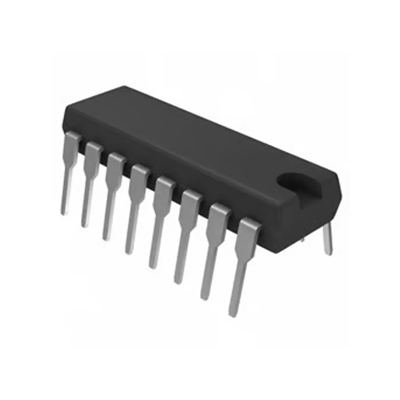
- Confirm 0.300-inch DIP row spacing.
- Confirm pin-one orientation and socket clearance.
- Place the crystal and supply bypassing as recommended.
The registered package image is missing and blocks publication.
Pin Functions
RPOS pin 2, RNEG pin 3 and RCLK pin 4 are inputs. RRCLK pin 13, RRNEG pin 14 and RRPOS pin 15 are outputs. DJA is pin 1, BDS pin 5, TEST pin 6, BL pin 11 and RST pin 12. XTAL1 and XTAL2 are pins 9 and 10, XTAL OUT is pin 7, VSS is pin 8 and VDD is pin 16. Tie TEST low in normal operation according to the data sheet.
Key Specifications
| Exact order code | DS2188 |
|---|---|
| Function | T1/CEPT clock and data jitter attenuator |
| Package | 16-pin DIP, commercial grade |
| Temperature | 0 to +70 degrees C |
| T1 input clock | 1.544 MHz nominal |
| CEPT input clock | 2.048 MHz nominal |
| T1 crystal | 6.176 MHz |
| CEPT crystal | 8.192 MHz |
| Buffer depth | 128 or 32 bits, BDS-selected |
| Input jitter capacity | Up to 120 UIpp in 128-bit mode; 28 UIpp in 32-bit mode |
| Supply | Single 5 V nominal |
| Lifecycle | Obsolete according to Analog Devices |
Consult the manufacturer electrical tables for limits, load and timing conditions.
Replacement Considerations
No unverified internal alternative is linked. Any substitute must match T1/CEPT clocking, signal polarity, buffer and bypass behavior, control pins, temperature grade and DIP footprint. DS2188N is a different temperature-grade code; verify interchangeability with the board rather than assuming it.
Manufacturer Information
Dallas Semiconductor authored the DS2188 Rev. 1 data sheet now hosted by Analog Devices. Its ordering table explicitly lists DS2188 as the 16-pin DIP commercial variant. The current Analog Devices product page marks the family obsolete. Use the controlled document and physical marking for repair decisions.
Applications
- Legacy T1 and CEPT receive timing paths.
- Digital cross-connect and network-interface equipment.
- Boards paired with DS2186 transmit or DS2187 receive line interfaces.
- Maintenance of qualified telecom assemblies.
Quality & Authenticity
Check original marking, date/lot code, storage condition, leads and supplier traceability. A recent price aggregator identified roughly 6,155 units at Rochester with quantity prices from USD 19.79 at 100, but it is not a direct live authorized quotation and differs from the catalog's 6,169 units and USD 21.15. The catalog stock and price remain unverified and are preserved without update.
FAQ
Which crystal does a T1 design use?
6.176 MHz according to the manufacturer.
Which crystal does a CEPT design use?
8.192 MHz.
Can attenuation be bypassed?
Yes. DJA high bypasses the buffer.
Is this the SOIC version?
No. The unsuffixed DS2188 order code denotes the 16-pin DIP version.
Engineering Notice
Verify the crystal, clock polarity, buffer delay, reset and bypass state and through-hole footprint on the target board. The missing package JPG and absence of a confirmed current authorized exact-code stock and price ladder prevent publication.
DS2188 Information
- Specifications
- Tags
- Product attributes
- Attribute value
- Manufacturer:
- Analog Devices Inc./Maxim Integrated
- Series:
- *
- Package/Case:
- 16-DIP (0.300", 7.62mm)
- Packaging:
- Tube
- Product Status:
- Obsolete
- Programmable:
- Not Verified
- Type:
- -
- Applications:
- -
- Mounting Type:
- Through Hole
- Supplier Device Package:
- 16-PDIP
- Grade:
- -
- Qualification:
- -
- Include Parts
- Popular Search
The following parts include "DS2188" in Silicon Labs DS2188.
- Part Number
- Manufacturer
- Package
- Description
- CAP200DG-TL Power Integrations 8-SOIC (0.154", 3.90mm Width) IC AUTOMATIC DISCHARGE 8SO
- ATSHA204A-MAHDA-T Microchip Technology 8-UFDFN Exposed Pad IC AUTHENTICATION CHIP 8UDFN
- ATSHA204A-SSHDA-T Microchip Technology 8-SOIC (0.154", 3.90mm Width) IC AUTHENTICATION CHIP 8SOIC
- ATSHA204A-STUCZ-T Microchip Technology TO-236-3, SC-59, SOT-23-3 IC AUTHENTICATION CHIP SOT23-3
- ATECC608B-MAHDA-T Microchip Technology 8-UFDFN Exposed Pad IC AUTHENTICATION CHIP 8UDFN
- ATECC608B-MAHCZ-S Microchip Technology 8-UFDFN Exposed Pad IC AUTHENTICATION CHIP 8UDFN
- ATECC608B-SSHDA-T Microchip Technology 8-SOIC (0.154", 3.90mm Width) IC AUTHENTICATION CHIP 8SOIC
- ATECC608B-MAHDA-S Microchip Technology 8-UFDFN Exposed Pad IC AUTHENTICATION CHIP 8UDFN
- ATECC608A-MAHDA-S Microchip Technology 8-UFDFN Exposed Pad IC AUTHENTICATION CHIP 8UDFN
- ATECC608B-MAVDA-T Microchip Technology 8-UFDFN Exposed Pad IC AUTHENTICATION CHIP 8UDFN
The following parts are popular search parts in Test and Measurement.
Inventory:6,169
Please send an inquiry. Send us your inquiry, and we will respond immediately.


