 Hello! now
 tms@lcdchip.com



Microchip Technology HCS412-I/SN
- Part No.:
- HCS412-I/SN
- Manufacturer:
- Microchip Technology
- Category:
- Specialized ICs
- Package:
- 8-SOIC (0.154", 3.90mm Width)
- Description:
- IC CODE HOP ENCOD/TRNSPND 8SOIC
- Quantity:
Unit Price:$0
Ext Price:$0
- Payment:

- Shipping:


Product Details
HCS412-I/SN - Industrial Code-Hopping Encoder and Transponder
Microchip Technology HCS412-I/SN combines a KEELOQ code-hopping encoder and inductively coupled transponder in an 8-lead SOIC package, with the industrial −40 to +85 °C ordering grade.
Technical characteristics and order-code interpretation follow Microchip datasheet DS41099D.
Overview
The HCS412 supports remote keyless entry and contactless token designs needing a unidirectional code-hopping transmission together with a bidirectional transponder challenge-response path. The encoder transmits a 69-bit code word with a 32-bit encrypted hopping field and a 37-bit fixed field. Its inductive transponder accepts a 32-bit challenge. In the exact HCS412-I/SN order code, I identifies the industrial temperature range and SN identifies an 8-lead plastic SOIC, 150 mil body.
Key Advantages
Battery-operated code-hopping remote operation and inductively coupled transponder authentication share one device.
The encrypted hopping field changes across transmissions, helping resist a simple captured-code replay.
The LF transponder channel provides a separate reader-initiated authentication method.
The I suffix specifies operation from −40 to +85 °C under the datasheet conditions.
Feature Summary
A 64-bit encoder key supports the 69-bit transmitted code word.
Two 64-bit IFF keys are available for the bidirectional challenge-response operation.
Encoder output can use PWM or Manchester coding, depending on configuration.
Three switch inputs, DATA transmission output, LED output, battery-low indication, and a 60-bit seed support remote-control designs.
Package & Footprint
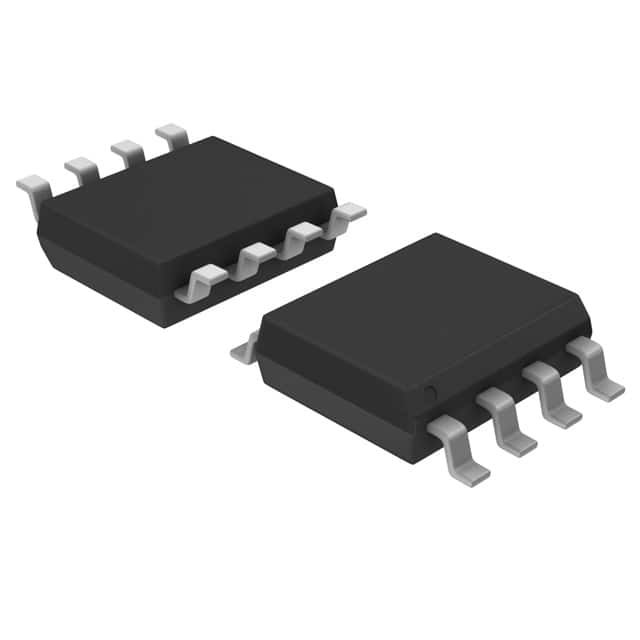
Microchip's SN package code is an 8-lead plastic SOIC with a 150 mil body. The site's registered 8-SOIC entry corresponds to the original 0.154-inch (3.90 mm) width category. Check the manufacturer's package drawing, land pattern, and pin-1 orientation for the assembled board.

- Match the 8-lead SOIC footprint and pin-1 orientation to Microchip's drawing.
- Route LC0 and LC1 according to the selected inductive antenna configuration.
- Place local VDD decoupling and connect DATA to the intended transmitter circuit.
The existing normalized package registration and local JPG were checked. The illustration is not a dimensional drawing.
Pin Functions
Microchip DS41099D pin table for the 8-pin SOIC:
Switch input 0.
Switch input 1.
Multipurpose switch input, RF enable, LF antenna output, and programming clock connection.
LF antenna input and output.
Ground reference.
Transmission output and programming data I/O.
LED output.
Positive supply.
The behavior of multiplexed pins depends on operating mode and configuration.
Key Specifications
| Manufacturer | Microchip Technology |
|---|---|
| Order code | HCS412-I/SN |
| Function | Code-hopping encoder and transponder |
| Package | 8-lead plastic SOIC, 150 mil body |
| Ambient temperature grade | Industrial, −40 to +85 °C |
| DC-characteristics supply range | 2.0 to 6.3 V |
| Encoder code word | 69 bits |
| Encrypted hopping field | 32 bits |
| Fixed field | 37 bits |
| Encoder key | 64 bits |
| Transponder IFF keys | Two 64-bit keys |
| Transponder challenge | 32 bits |
| Seed | 60 bits |
| Switch inputs | Three |
| Encoder output coding | PWM or Manchester |
Timing and electrical values must be checked for the chosen configuration and industrial operating conditions.
Replacement Considerations
HCS412/SN shares the SOIC package but is the commercial 0 to +70 °C ordering grade, so it is not a temperature-equivalent replacement in an industrial design. Other HCS encoders may differ in transmitted word, keys, reader protocol, antenna behavior, or pin functions. No internal alternative is linked without a verified exact product record.
Manufacturer Information
Microchip Technology documents the HCS412 in datasheet DS41099D. Its product-identification table specifies I as −40 to +85 °C and SN as the 8-lead, 150 mil plastic SOIC. Consult the datasheet's applicable operating-mode and package tables during design.
Applications
Transmit a code-hopping command to a compatible receiver.
Use the LF challenge-response path with a compatible reader.
Combine portable switch activation with close-range token verification.
Integrate an inductive antenna and remote transmitter in one handheld unit.
Quality & Authenticity
Verify the full HCS412-I/SN order code, package marking, and lot traceability. Check programmed keys and configuration through an authorized process, then validate encoder learning and transponder responses against the target receiver.
FAQ
What does I/SN specify?
I identifies the industrial −40 to +85 °C temperature range; SN identifies the 8-lead, 150 mil plastic SOIC.
Can HCS412/SN replace HCS412-I/SN?
Only after the application's temperature requirement is rechecked; the non-I code is the commercial-temperature grade.
Are encoder and transponder communication identical?
No. The encoder transmits a code-hopping word, while the LF transponder supports a separate bidirectional challenge-response exchange.
Engineering Notice
Design the LF antenna, receiver, and key-management process as a system. Confirm mode-specific pin multiplexing, programming, synchronization, output coding, and battery behavior against DS41099D. Observe the published electrical limits across the industrial temperature range.
HCS412-I/SN Information
- Specifications
- Tags
- Product attributes
- Attribute value
- Manufacturer:
- Microchip Technology
- Series:
- KEELOQ®
- Package/Case:
- 8-SOIC (0.154", 3.90mm Width)
- Packaging:
- Tube
- Product Status:
- Obsolete
- Programmable:
- Not Verified
- Type:
- Code Hopping Encoder and Transponder
- Applications:
- Remote Secure Access, Keyless Entry
- Mounting Type:
- Surface Mount
- Supplier Device Package:
- 8-SOIC
- Grade:
- -
- Qualification:
- -
- Include Parts
- Popular Search
The following parts include "HCS412-I/SN" in Silicon Labs HCS412-I/SN.
- Part Number
- Manufacturer
- Package
- Description
- CAP200DG-TL Power Integrations 8-SOIC (0.154", 3.90mm Width) IC AUTOMATIC DISCHARGE 8SO
- ATSHA204A-MAHDA-T Microchip Technology 8-UFDFN Exposed Pad IC AUTHENTICATION CHIP 8UDFN
- ATSHA204A-SSHDA-T Microchip Technology 8-SOIC (0.154", 3.90mm Width) IC AUTHENTICATION CHIP 8SOIC
- ATSHA204A-STUCZ-T Microchip Technology TO-236-3, SC-59, SOT-23-3 IC AUTHENTICATION CHIP SOT23-3
- ATECC608B-MAHDA-T Microchip Technology 8-UFDFN Exposed Pad IC AUTHENTICATION CHIP 8UDFN
- ATECC608B-MAHCZ-S Microchip Technology 8-UFDFN Exposed Pad IC AUTHENTICATION CHIP 8UDFN
- ATECC608B-SSHDA-T Microchip Technology 8-SOIC (0.154", 3.90mm Width) IC AUTHENTICATION CHIP 8SOIC
- ATECC608B-MAHDA-S Microchip Technology 8-UFDFN Exposed Pad IC AUTHENTICATION CHIP 8UDFN
- ATECC608A-MAHDA-S Microchip Technology 8-UFDFN Exposed Pad IC AUTHENTICATION CHIP 8UDFN
- ATECC608B-MAVDA-T Microchip Technology 8-UFDFN Exposed Pad IC AUTHENTICATION CHIP 8UDFN
The following parts are popular search parts in Test and Measurement.
Inventory:1,764
Please send an inquiry. Send us your inquiry, and we will respond immediately.


