Hello! now
 tms@lcdchip.com



51R Battery Guide: Size, Fitment, 51 vs 51R & How to Choose
The 51R battery may look like a simple purchase: find "51R" on the label, pick a familiar brand, and install it. In practice, the group number is only the starting point. The replacement also needs the correct terminal layout, enough starting power, the right battery technology, and a secure fit in the vehicle's tray.
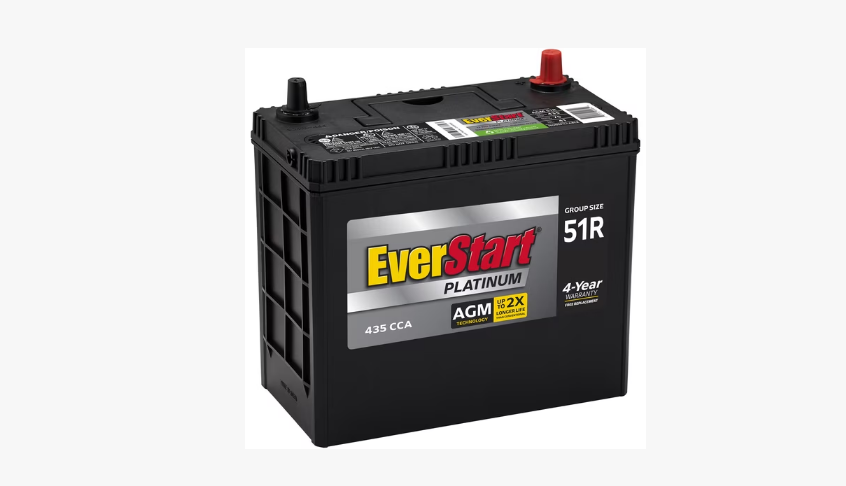
This guide explains what Group 51R means, how it differs from Group 51, and which specifications are useful when comparing batteries. It also covers a less obvious point: while most 51R car batteries are lead-acid designs, some specialized lithium starter batteries use the same group-size designation. They should be evaluated separately.
What Is a 51R Battery?
Group 51R is a Battery Council International (BCI) battery group designation. It identifies a compact case format and a particular terminal arrangement used in automotive applications. It does not identify a single manufacturer, battery chemistry, capacity, or quality level.
The "R" refers to a reversed terminal layout relative to Group 51. For the usual top-post arrangement, a 51R places the positive terminal on the right when the battery is viewed from the terminal side in the specified orientation. Because a battery can be photographed or held from several directions, the safest check is always the molded + and − marks on the battery itself.
Most everyday 51R replacements are 12-volt lead-acid starting batteries. Within that category, you may see conventional flooded, enhanced flooded (EFB), and absorbed glass mat (AGM) models. The correct technology depends on the vehicle, not simply on which product has the largest number on its label.
51R Battery Size and Dimensions
The BCI dimensional reference for Group 51R is approximately 9 3/8 × 5 1/16 × 8 3/4 inches, or 238 × 129 × 223 mm, stated as length × width × height. Group 51 has the same listed dimensions but a different terminal arrangement.
| Fitment item | Group 51R reference | Why it matters |
|---|---|---|
| Length | 9 3/8 in (238 mm) | The case must sit flat in the battery tray. |
| Width | 5 1/16 in (129 mm) | The case and hold-down must align securely. |
| Height | 8 3/4 in (223 mm) | Check clearance above the posts, cables, and hood. |
| Terminal layout | Reverse arrangement relative to Group 51 | Both vehicle cables must reach their correct posts without strain. |
These are group-size reference dimensions. A manufacturer's published overall measurements may vary slightly, especially if it measures to the top of the terminals or includes a different case feature. For a tight engine bay, compare the exact product's dimensions with the old battery and the available clearance. Do not assume that matching the length and width alone confirms fit.
Group 51 vs Group 51R: What Is the Difference?
The main difference between a 51 and a 51R battery is terminal position. Their similar case size makes them easy to confuse, but the vehicle's cables are routed for a particular positive and negative post location. If the posts are reversed, a cable may not reach, may have to cross over the battery, or may sit too close to surrounding metal.
Rotating a Group 51 battery to imitate a 51R layout is not a dependable solution. The hold-down, cable routing, and terminal access may no longer work as intended. Place the old and proposed batteries in the same orientation and compare their molded polarity marks before buying.
| Question | Group 51 | Group 51R |
|---|---|---|
| BCI reference case size | 238 × 129 × 223 mm | 238 × 129 × 223 mm |
| Terminal arrangement | Standard arrangement for this group | Reversed relative to Group 51 |
| Automatic substitute for the other? | No | No |
If the vehicle specifies 51R, another verified 51R is normally the straightforward replacement. Consider a different group only when the vehicle maker or a reliable fitment guide approves it and you have checked the tray, hold-down, polarity, cable reach, and electrical requirements.
Can a Group 35 Battery Replace a 51R?
Drivers sometimes consider Group 35 because they want more product choices or a different performance rating. That does not make it a universal upgrade. A Group 35 case is substantially wider than a Group 51R case, so a narrow 51R tray may not hold it. The positive and negative posts, cable lengths, and hold-down arrangement also need to match.
Some individual vehicle installations may have room for a larger battery, particularly when another factory configuration of that vehicle used a different tray. Others do not. A forum account of a successful conversion in one car is not enough to establish fitment in a different model year or engine configuration. Confirm the actual vehicle configuration before buying parts or changing the mounting arrangement.
What Cars Use a 51R Battery?
Group 51R appears in replacement catalogs for certain compact passenger vehicles, including some Honda applications. It is a mistake, however, to say that every Honda Civic, Honda CR-V, or vehicle from another named brand uses 51R. Battery fitment can change with the year, engine, market, factory equipment, and charging-system design.
Use this order to check fitment:
- Look up the battery specification in the owner's manual or the vehicle maker's service information.
- Enter the exact year, make, model, and engine in a current battery manufacturer's fitment tool.
- Inspect the installed battery's group number, terminal arrangement, tray, and hold-down.
- If the sources disagree, verify the original equipment specification before ordering. A previous owner may have fitted a different battery.
A product page saying "fits Honda" is not precise enough to confirm that it fits your Honda. The same rule applies to any other vehicle brand.
How to Read 51R Battery Specifications
Cold Cranking Amps (CCA)
CCA is a standardized measure of a lead-acid battery's ability to supply starting current at 0°F (−17.8°C) for 30 seconds while maintaining the required voltage. It is useful when comparing starting batteries, especially for vehicles used in cold weather.
Start with the vehicle manufacturer's specified minimum. A higher CCA rating may provide more cold-start margin, but it cannot make an incorrectly sized battery fit. It also does not prove that the battery will last longer.
Cranking Amps (CA) Are Not CCA
CA and CCA are different ratings. When a product lists both, do not choose the larger number simply because it looks more impressive. Compare CCA with CCA under the same standard. This distinction becomes especially important when looking at specialized lithium products that may promote a cranking-amps figure without publishing a directly comparable lead-acid CCA rating.
Reserve Capacity (RC)
RC indicates the number of minutes a fully charged 12-volt lead-acid battery can deliver 25 amps at the specified test temperature before dropping to the test's cutoff voltage. It helps describe sustained electrical support, while CCA describes a short burst of starting power.
RC is not a countdown timer for how long you can leave your headlights on. Real vehicle loads change, temperature affects performance, and repeatedly running a starting battery deeply down can shorten its useful life. Still, comparing RC values from suitable batteries can be useful when the car has significant accessory demand.
Amp-Hours (Ah)
Some products list capacity in amp-hours. That figure depends on its stated discharge conditions and should not be treated as interchangeable with RC. A lithium battery's Ah figure also cannot be used alone to predict whether it will start a vehicle or provide the same engine-off support as a lead-acid battery. Check the battery's intended application and the full set of manufacturer specifications.
Flooded, EFB, AGM, or Lithium: Which Type Should You Choose?
| Battery type | Typical reason to consider it | Key check |
|---|---|---|
| Conventional flooded lead-acid | Direct replacement for a vehicle specified for a conventional starting battery | Confirm the required CCA, fitment, and charging-system needs. |
| EFB | Vehicle specifies EFB or an approved enhanced flooded replacement | Do not assume it can replace an AGM battery. |
| AGM | Vehicle specifies AGM or an approved upgrade for greater cycling demand | Confirm vehicle fitment and any battery registration requirement. |
| Purpose-built lithium starter battery | A specific product is approved for the vehicle and intended use | Verify chemistry, charging compatibility, BMS behavior, terminals, and cold-weather operation. |
If the vehicle came with an AGM battery, replace it with a suitable AGM model rather than downgrading to an ordinary flooded or EFB battery. For vehicles with start-stop or battery monitoring, check whether the replacement also needs registration or a system reset. Matching the physical group size does not settle these questions.
Real 51R Battery Examples: Why the Model Number Matters
The following examples illustrate the range of products sold under the 51R designation. They are specification examples, not a best-to-worst ranking. Confirm the latest product data and your vehicle's fitment before buying.
| Product | Type | Published starting rating | Published capacity or RC | What the example shows |
|---|---|---|---|---|
| Interstate M-51R | Lead-acid starting battery | 425 CCA | 75-minute RC | A conventional 51R option with published CCA and RC. |
| Continental 51R-EFB | Enhanced flooded battery | 500 CCA | 80-minute RC in the manufacturer's catalog | The same group size can be offered as an EFB design. |
| Interstate MTX-51R | AGM | 435 CCA | 75-minute RC | Battery technology is a separate decision from CCA. |
| XS Power XV5100R | Lithium titanate (LTO) | 670 CA as listed by the manufacturer | 6 Ah as listed by the manufacturer | Its CA and Ah figures should not be treated as directly comparable CCA and RC ratings. |
For example, it would be misleading to place the XS Power product at the top of a "starting power" ranking merely because 670 is greater than 500: its published figure here is CA, while Continental's is CCA. Likewise, the AGM model's lower CCA does not make it the wrong choice for a vehicle that requires AGM. First identify products suitable for the car; then compare equivalent ratings.
Can You Use a Lithium 51R Battery in a Regular Car?
A lithium product built in a Group 51R format may be suitable for particular vehicles, but case fit alone is not approval. "Lithium" also covers more than one chemistry. For example, the XS Power XV5100R uses lithium titanate, while other automotive starter products may use lithium iron phosphate. Their charging and protection requirements must be checked against the individual product.
Before considering a lithium replacement, ask the manufacturer or installer:
- Is this exact model approved as the main starting battery for my vehicle?
- Will its terminals and any required adapters work with my cables and hold-down?
- Is its battery management system compatible with my alternator and vehicle electronics?
- What happens when the battery is very cold, deeply discharged, or its protection system disconnects?
- Which external charger and charging settings does the manufacturer permit?
- Does the vehicle need battery registration or programming after the change?
Do not substitute a generic 12-volt lithium deep-cycle battery for an automotive starter battery just because it fits the tray. Starting current, charging behavior, and protective shutoff behavior are part of the application.
Check the Old Battery Before Replacing It
A slow crank does not always mean the battery itself has failed. Loose or corroded connections can restrict current, while a charging-system fault can leave a sound battery undercharged. A vehicle that repeatedly needs a jump start may also have an electrical load when parked.
With the engine off, inspect the terminals and cables for visible corrosion, damage, or looseness. If the battery has been discharged, recharge it using a charger appropriate to its technology before judging its condition. A professional battery test and charging-system check are more useful than relying on a single open-circuit voltage reading. If the battery tests healthy but the problem returns, investigate the vehicle rather than buying one battery after another.
51R Battery Buying Checklist
- Confirm the vehicle specification: Check year, make, model, engine, and original battery technology.
- Confirm Group 51R: Do not overlook the "R" or assume Group 51 is equivalent.
- Compare physical fit: Check dimensions, post height, tray, hold-down, and hood clearance.
- Verify polarity: Match the positive and negative posts to the vehicle's cable routing.
- Match the technology: Follow the vehicle's flooded, EFB, or AGM requirement. Evaluate lithium separately.
- Check electrical ratings: Meet the required CCA and compare RC when available; keep CA and CCA separate.
- Check purchase details: Review the exact part number, warranty terms, battery condition, and any core charge or installation service.
- Check the installation procedure: Determine whether the vehicle requires a battery management reset or registration.
Retailer availability and prices can change by location. If you compare a 51R battery at Walmart, Costco, AutoZone, or another store, compare the exact product models and what is included in the purchase. A similar shelf label does not establish identical chemistry, CCA, RC, warranty, or installation service.
Frequently Asked Questions
What does 51R mean on a battery?
It is a BCI automotive battery group designation. The "R" identifies a terminal arrangement reversed relative to Group 51. It does not mean that the battery is rechargeable lithium or that all 51R products have the same performance.
Are all 51R batteries the same?
No. They can differ in flooded, EFB, AGM, or specialized lithium construction, as well as starting rating, reserve capacity, weight, warranty, and exact case details. The group number helps with fitment; it does not replace a product specification sheet.
Can I use a 51 battery instead of a 51R?
Do not assume you can. The terminal arrangement differs, and vehicle cables may not reach safely. Use a verified fitment recommendation for your exact vehicle.
What are the dimensions of a 51R battery?
The BCI group reference is approximately 9 3/8 × 5 1/16 × 8 3/4 inches (238 × 129 × 223 mm). Verify the exact product's overall height and mounting details when clearance is limited.
What cars use a 51R battery?
Some compact vehicles, including certain Honda models, appear in 51R fitment listings. There is no reliable brand-wide answer: check the year, model, engine, and original equipment specification.
Is a higher CCA 51R battery always better?
No. Adequate cold-start performance matters, but an incorrectly sized or unsuitable battery technology can cause problems even when its CCA number is high. Compare compatible batteries and use the same rating standard.
Is a 51R battery lithium?
The group number does not specify chemistry. Most routine automotive replacements are lead-acid batteries, while specialized lithium 51R starter products also exist. Read the exact product description before assuming either type.
Should I buy AGM or EFB for my car?
Follow the vehicle's battery specification. If the vehicle originally requires AGM, choose a suitable AGM replacement. If it specifies EFB, confirm the approved replacement options in its service information or a reliable fitment guide.
The Practical Answer
The right 51R battery is the one that fits the vehicle correctly and meets its electrical and battery-technology requirements. Confirm the terminal arrangement and mounting first. Then compare suitable products by CCA, reserve capacity, exact model specifications, and warranty. This approach is more reliable than choosing by price, brand name, or one large number on the label.
Technical Sources
Related information