Hello! now
 tms@lcdchip.com



180 Celsius to Fahrenheit (356°F) | Oven Settings
180°C equals exactly 356°F. If your conventional oven can be set to 356°F, use that setting. If the nearest options are 350°F and 375°F, choose 350°F. A UK recipe may list the same baking instruction as 180°C conventional, 160°C fan or Gas Mark 4. Use the setting that matches your oven. NIST temperature conversion · Good Food recipe example
What Should You Set a Fahrenheit Oven to for 180°C?
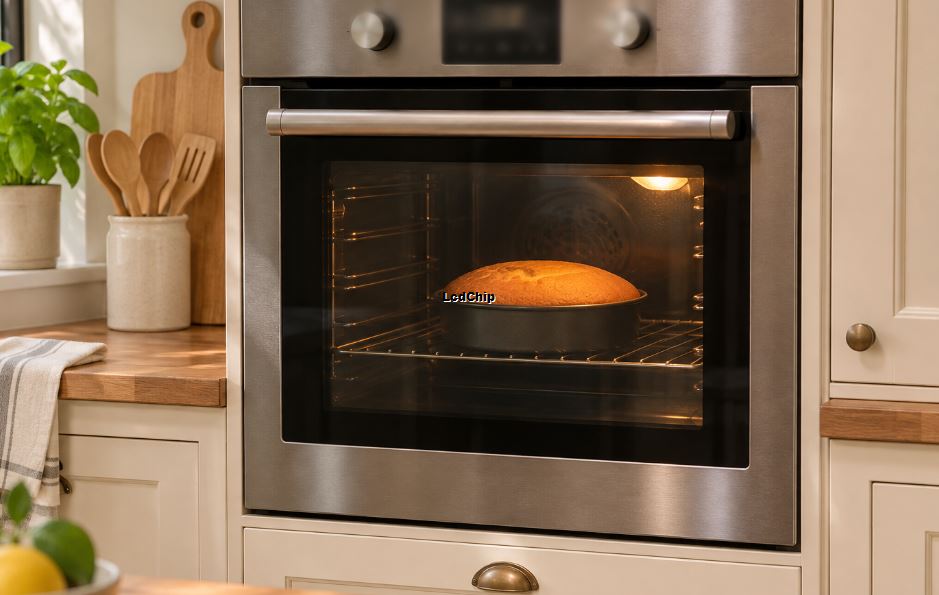
For a recipe that calls for 180°C in conventional Bake mode, choose the available Fahrenheit setting closest to 356°F. Digital ovens may offer finer adjustments than ovens with a dial, so the best setting depends on the temperatures your controls allow.
| Available Settings Near 356°F | Setting to Use | Difference From 356°F |
|---|---|---|
| 356°F is available | 356°F | Exact |
| 355°F or 360°F | 355°F | 1°F lower |
| 350°F or 360°F | 360°F | 4°F higher |
| 350°F or 375°F | 350°F | 6°F lower |
If the recipe supplies a Fahrenheit temperature for your oven mode, use that value. When you need to choose a setting yourself, the size of the adjustment matters. 350°F is about 176.7°C, only 3.3°C below 180°C. 375°F is about 190.6°C, more than 10°C above the recipe temperature. NIST temperature conversion
Oven charts can round the same temperature differently. For example, Allrecipes pairs 350°F with 175°C, while a Cannon oven manual pairs 350°F with 180°C for its conventional oven. Both are practical dial references. When you need the exact equivalent, calculate it from the original temperature in the recipe. Allrecipes oven temperature chart · Cannon oven manual
How to Read 180°C Conventional, 160°C Fan and Gas Mark 4
A UK recipe may list all three settings on one line. Choose the entry that matches your cooking mode. If your display uses Fahrenheit, convert the Celsius temperature for that specific mode.
| Recipe Instruction | Oven Mode | What to Enter |
|---|---|---|
| 180°C conventional | Conventional Bake | 180°C or 356°F, rounded to the closest available setting |
| 160°C fan | Fan Bake or Convection Bake | 160°C or 320°F, rounded to the closest available setting |
| Gas Mark 4 | Gas oven with a numbered Gas Mark dial | 4 |
The change from 180°C conventional to 160°C fan accounts for the way moving air transfers heat to the food. The conversion from 160°C to 320°F expresses the same fan temperature in a different unit. A recipe that explicitly calls for 180°C fan therefore calls for 356°F in fan mode. Good Food recipe example · Whirlpool convection and oven settings guide
Some ovens have an automatic convection conversion feature that lowers a conventional recipe temperature after you enter it. Check your model's instructions before setting the oven. When the recipe already gives a fan temperature, use a mode or setting that accepts the final temperature directly, if your oven supports it. Whirlpool convection and oven settings guide
How to Convert 180 Celsius to Fahrenheit
Multiply the Celsius temperature by 1.8, then add 32. Using 9 ÷ 5 in place of 1.8 gives the same result.
°F = (°C × 1.8) + 32
(180 × 1.8) + 32 = 324 + 32 = 356°F
For the reverse conversion, subtract 32 from the Fahrenheit temperature and divide by 1.8. For example, (350 − 32) ÷ 1.8 gives approximately 176.7°C. This is a quick way to check how far a rounded oven setting is from the original recipe temperature. NIST temperature conversion
Celsius to Fahrenheit Oven Temperature Chart
These are exact conversions. When a recipe gives both conventional and fan temperatures, look up the value for the mode you plan to use, then choose the closest available setting on your oven.
| Celsius | Exact Fahrenheit Conversion |
|---|---|
| 150°C | 302°F |
| 160°C | 320°F |
| 170°C | 338°F |
| 175°C | 347°F |
| 180°C | 356°F |
| 185°C | 365°F |
| 190°C | 374°F |
| 200°C | 392°F |
| 220°C | 428°F |
What Changes When You Bake at 350°F?
Suppose a cake recipe calls for 180°C in a conventional oven and gives a baking time of 35 to 45 minutes. If your dial offers 350°F or 375°F, preheat to 350°F and begin checking at about 35 minutes. If the recipe says a skewer inserted in the center should come out clean and it still comes out with wet batter, continue baking and check again after a few minutes.
The 6°F difference gives you a comparison between the two settings. Baking time also depends on the recipe, pan size, rack position and how the oven cycles during baking. If several recipes consistently brown too quickly or bake too slowly, check the cooking mode, rack position and preheating instructions. Follow the manufacturer's guidance for your model if the pattern continues and you need to check its calibration. Good Food cake doneness example · Whirlpool oven temperature and bake performance guidance
How to Choose an Oven Temperature Sensor
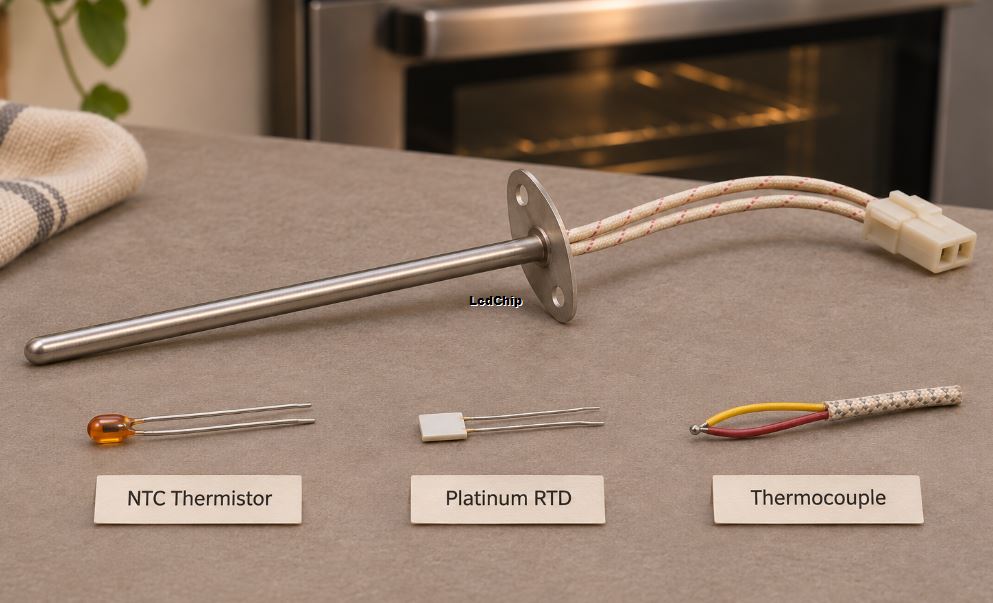
When you set an oven to 180°C (356°F), you are choosing a target temperature for the oven cavity. In an electronically controlled oven, a cavity temperature sensor provides the feedback the control board uses to regulate heating. If you are choosing a sensor for a new design or sourcing a replacement, start with the temperature the probe will experience at its mounting point and the signal the control board expects.
1. Check the Temperature Range of the Complete Probe
A recipe may call for 180°C, while the same oven may operate at 250°C (482°F) in another mode. For a new design, consider the full temperature range at the probe location, including preheat overshoot and exposure during the hottest operating mode. Check the ratings of the sensing element, sheath, cable insulation and connector against the temperatures each part will experience.
For example, Amphenol lists its Thermometrics JB Series oven sensor for −10°C to 200°C and its Mid-Range Temperature Probe for −20°C to 300°C. If the probe location can reach 250°C, the 200°C model falls outside its specified range. The 300°C model is a candidate on temperature range, and its electrical characteristics and mounting dimensions still need to match the application. Thermometrics JB Series oven sensor specifications · Thermometrics Mid-Range Temperature Probe specifications
2. Match the Sensor Type to the Oven Control Board
Two probes can look alike and produce different readings at the same temperature. Check how the controller interprets the sensor signal across the operating range.
| Sensor Type | How It Measures Temperature | What to Match |
|---|---|---|
| NTC thermistor probe | Resistance decreases as temperature rises. | Nominal resistance at 25°C, the resistance-versus-temperature curve and its tolerance. |
| RTD probe | Resistance increases as temperature rises. | The specified RTD element, reference resistance, resistance-versus-temperature curve and wiring configuration. |
| Thermocouple probe | Produces a small voltage related to the temperature difference between the measuring and reference junctions. | The specified thermocouple type, compatible controller input and cold-junction compensation. |
For example, two NTC probes can both be rated 10 kΩ at 25°C and have different resistance values at 180°C. If the control board uses the original probe's curve, a different curve can cause it to interpret the actual cavity temperature incorrectly. Ask for the supplier's resistance-versus-temperature table and compare it across the range the oven uses. Vishay NTC thermistor curve guidance · Texas Instruments RTD measurement guide · Texas Instruments thermocouple measurement guide
3. Verify Mounting, Wiring and Replacement Compatibility
For a new design, compare the probe length and diameter, mounting flange, mounting-hole spacing, insertion depth, cable length and connector. Check the response time under conditions comparable to those in your oven. A probe can fit the mounting hole while placing the sensing tip at a different depth in the cavity, where it may read a different temperature.
For a replacement, use the complete oven model number to find the manufacturer-approved cavity sensor or its listed replacement part number. A connector that plugs in confirms the physical fit of the connector. Use the manufacturer's parts listing to confirm compatibility with the oven model. GE Appliances oven sensor assembly and model compatibility lookup
When requesting a quote for an oven temperature sensor, include the oven model or original probe part number, the required temperature range, the sensor type or resistance curve, and a drawing of the probe and connector. These details give the supplier enough information to check both the electrical match and the mechanical fit.
FAQ
What is 180 Celsius in Fahrenheit?
180°C equals exactly 356°F. Multiply 180 by 1.8 to get 324, then add 32. You can use the same formula whether you are converting an oven setting, a recipe temperature or a reading from a thermometer.
Should I set my oven to 350°F or 375°F for 180°C?
Choose 350°F if those are your two options for conventional baking. It is 6°F below the exact target, while 375°F is 19°F above it. If the recipe itself gives a Fahrenheit setting for conventional Bake mode, use the recipe's stated value.
Should I use 355°F or 360°F if my oven has finer controls?
Use 355°F if both settings are available. It is 1°F below the target of 356°F, while 360°F is 4°F above it. If your oven moves directly from 350°F to 360°F, use 360°F. Check the available increments on the display before rounding.
Why do oven charts show both 175°C and 180°C for 350°F?
The exact Celsius equivalent of 350°F is about 176.7°C. Rounding to the nearest 5°C gives 175°C, while rounding to the nearest 10°C gives 180°C. If you have the original recipe, start with its stated temperature and convert it once. Converting back and forth using rounded charts can move you away from the original value.
What is 180°C in a fan oven?
Read the recipe's oven mode first. If it lists 180°C conventional and 160°C fan, select 160°C (320°F) for fan baking. If it explicitly lists 180°C fan, set the fan oven to 356°F or the closest available setting. For a recipe that gives only a conventional temperature, consult your oven's guidance for switching to convection.
Can I use 325°F if my fan oven cannot be set to 320°F?
Yes, if the recipe specifies 160°C fan and your closest available options are 300°F and 325°F. The target is 320°F, so 325°F is 5°F above it and 300°F is 20°F below it. If your oven offers both 315°F and 325°F, they are equally close. Use any Fahrenheit setting supplied by the recipe, and check for doneness within its stated time range.
What if my oven automatically adjusts the convection temperature?
Check whether the control expects the original conventional temperature or the final fan temperature. On a model that automatically subtracts 25°F, entering 350°F may result in a cooking setting of 325°F. If the recipe already specifies 320°F in fan mode, look for the control option that lets you set the fan temperature directly. The model's manual explains how to confirm the actual cooking set point.
What gas mark is 180°C?
Gas Mark 4 is the setting commonly paired with 180°C conventional in UK recipes. If the oven has a numbered Gas Mark dial, select 4. If it displays a temperature in Celsius or Fahrenheit, use the temperature for the cooking mode you've selected.
Do I need to bake longer at 350°F than at 356°F?
The temperature difference alone gives no fixed time adjustment. Use the recipe's time range and check for the doneness it describes. For a cake that has browned on top, check the center if the recipe calls for it. The color on the surface can develop before the center has finished baking.
Why can the oven temperature vary after I set it to 356°F?
The selected temperature is the oven's target. The heating elements cycle on and off, so the temperature inside can rise and fall around that target during baking. Opening the door also affects the heating cycle. If baking results consistently suggest the oven is running hot or cool, follow the manufacturer's procedure for your model before changing the calibration.
How can I tell what "180 degrees" means in a recipe?
Check the ingredients and instructions for a unit or an accompanying oven setting. A line such as 180 degrees, 160 fan, Gas Mark 4 indicates that 180 is the conventional Celsius setting. The word centigrade in an older recipe also refers to Celsius. If the recipe gives only the number 180 with no clear unit, check the original publication for the complete instruction.
What is 180 degrees Fahrenheit in Celsius?
180°F is approximately 82.2°C. Subtract 32 from 180, then divide by 1.8. If you are following a recipe that calls for 180°C and your oven display is in Fahrenheit, enter 356°F or the closest available setting for the specified cooking mode.
Related information