Hello! now
 tms@lcdchip.com



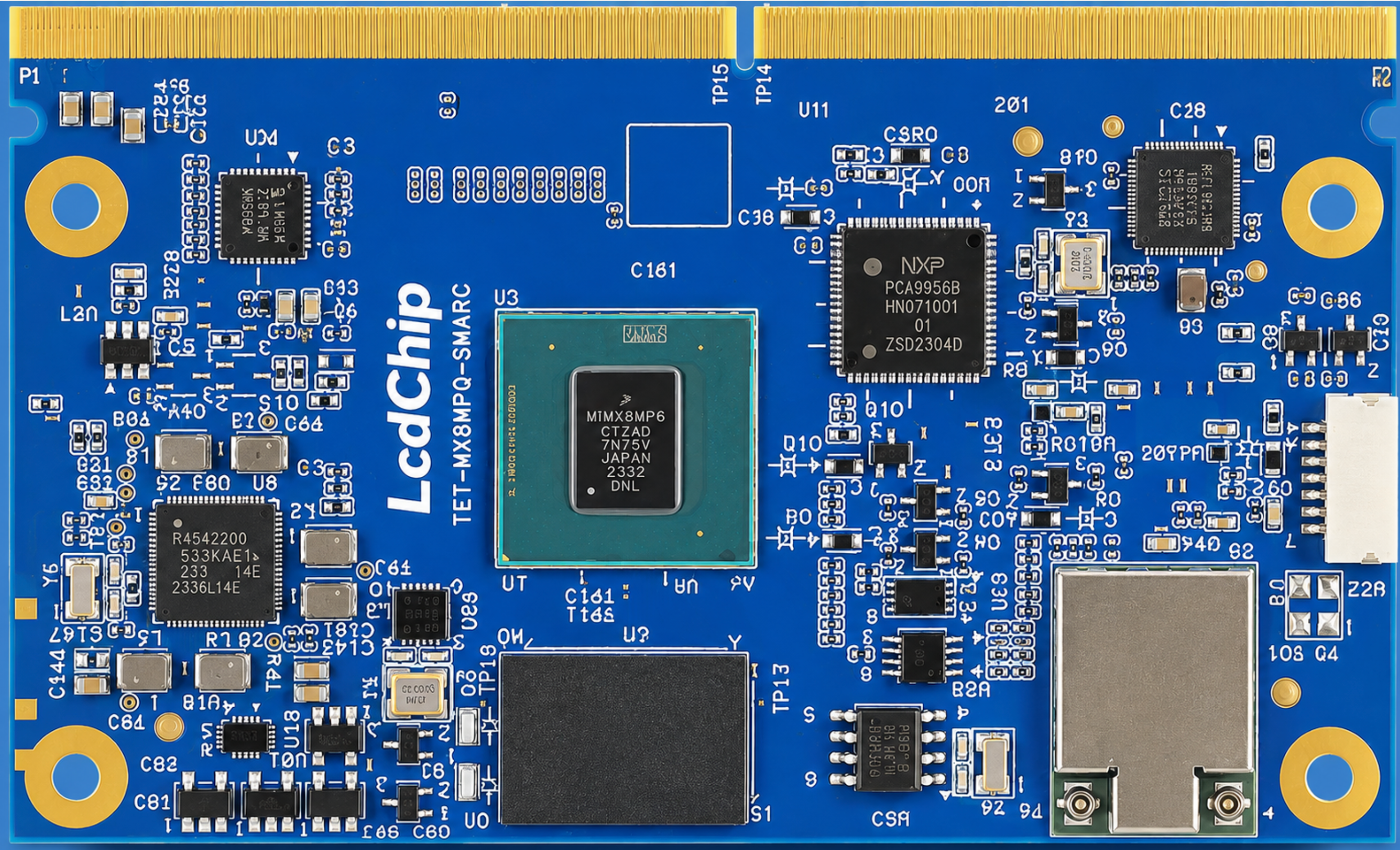
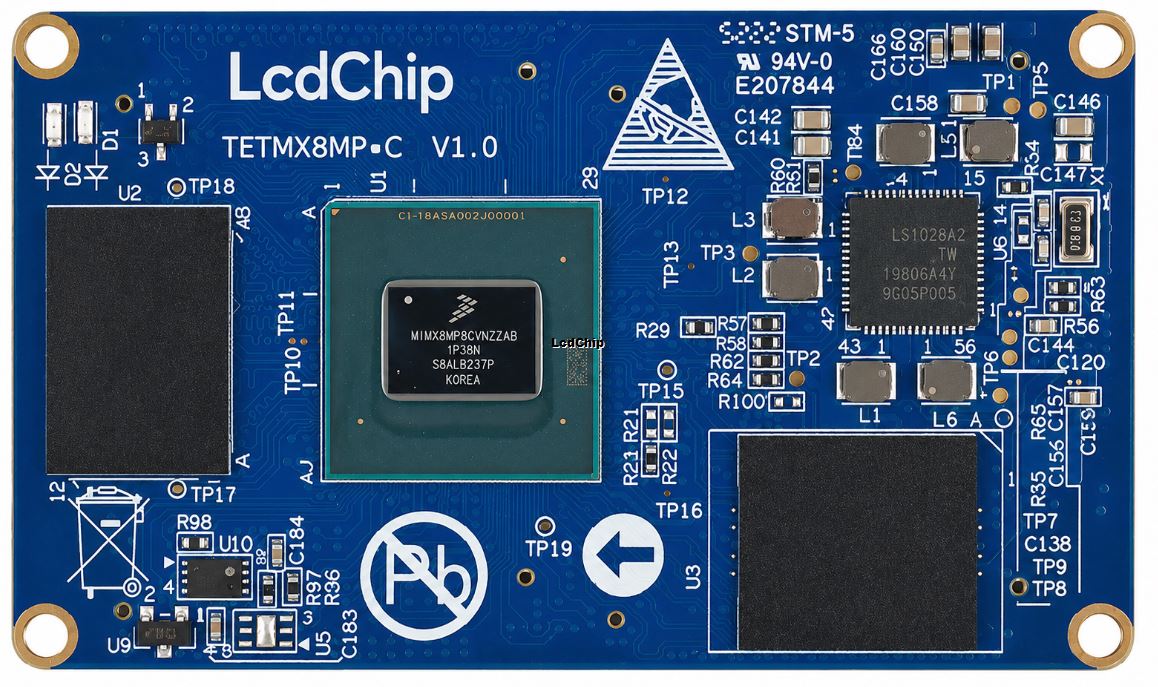
TETMX8MP-C NXP i.MX 8M Plus AI Vision Core Board with 2.3 TOPS NPU
The Lcdchip TETMX8MP-C core board is designed around the NXP i.MX 8M Plus processor family, focusing on machine learning, vision processing, advanced multimedia and reliable industrial automation. With Cortex-A53 application cores, a Cortex-M7 real-time processor, an optional 2.3 TOPS NPU, ISP, camera input, high-speed Ethernet, USB 3.0, PCIe 3.0, CAN FD and rich multimedia interfaces, it is suitable for smart city, industrial IoT, intelligent medical, smart transportation and edge AI terminals.
| Model | Processor | Frequency | RAM | ROM | Supported OS |
|---|---|---|---|---|---|
| TETMX8MPQ-C | NXP i.MX 8M Plus Quad | 1.6GHz | 1GB LPDDR4 | 8GB eMMC | Linux 5.4.70 |
| TETMX8MPQ-C | NXP i.MX 8M Plus Quad | 1.6GHz | 2GB LPDDR4 | 16GB eMMC | Linux 5.4.70 |
| TETMX8MPQ-C | NXP i.MX 8M Plus Quad | 1.6GHz | 4GB LPDDR4 | 16GB eMMC | Linux 5.4.70 / Android 11 |
| TETMX8MPL-C | NXP i.MX 8M Plus QuadLite | 1.6GHz | 1GB LPDDR4 | 8GB eMMC | Linux 5.4.70 |
| TETMX8MPL-C | NXP i.MX 8M Plus QuadLite | 1.6GHz | 2GB LPDDR4 | 16GB eMMC | Linux 5.4.70 |
High-Speed Communication Interfaces
The TETMX8MP-C series integrates high-speed communication resources for edge gateways, industrial controllers, camera systems and AI-enabled terminals. It supports dual Gigabit Ethernet, USB 3.0, PCIe 3.0, SDIO 3.0 and CAN FD interfaces for demanding industrial and embedded applications.
1Gbps
NXP i.MX 8M Plus Platform
The TETMX8MP-C series uses the NXP i.MX 8M Plus platform, combining Cortex-A53 application processing with a Cortex-M7 real-time core. It is suitable for edge devices requiring both application-level computing and deterministic control.
2.3 TOPS Edge AI Performance
The TETMX8MPQ-C version integrates an NPU with up to 2.3 TOPS of AI computing performance, helping accelerate lightweight machine-learning, visual-recognition and edge-inference workloads.
Built-in ISP and Camera Input
Integrated image-signal processing and dual camera input support enable efficient vision-system development for AI cameras, industrial inspection, video analytics and smart terminals.
Cortex-M7 Real-Time Control
The Cortex-M7 core can be used for real-time control tasks, allowing the platform to handle industrial I/O, motor control, timing-sensitive communication and low-latency device management.
Dual Gigabit Ethernet with TSN
The platform supports two RGMII Ethernet interfaces, with one interface supporting TSN. This makes the board suitable for industrial communication, edge gateways and time-sensitive network applications.
CAN FD Industrial Communication
Up to two CAN FD interfaces support high-speed communication for industrial automation, vehicle electronics, robotics, control systems and field-device connectivity.
4K Display and HiFi Voice Experience
The TETMX8MP-C series supports HDMI, LVDS and MIPI-DSI display interfaces. HDMI can support up to 4K display output, while LVDS and MIPI-DSI provide flexible LCD integration for embedded display devices. The TETMX8MPQ-C version also supports Cadence® Tensilica® HiFi 4 DSP at 800MHz, six SAI interfaces, IIS, TDM, AC97 and 8-channel PDM microphone input.
Advanced Multimedia Technology
The TETMX8MPQ-C version supports hardware video encoding and decoding for edge multimedia applications. It supports 1080p60 H.264 and H.265 encoding, and 1080p60 VP8, VP9, H.264 and H.265 decoding, helping build efficient AI vision, video interaction and smart multimedia terminals.
Machine Learning and Vision
The TETMX8MPQ-C version integrates an NPU with up to 2.3 TOPS computing power, meeting lightweight edge AI computing requirements for machine vision, object recognition, intelligent cameras, video analytics and edge gateway applications.
2.3 TOPS
TETMX8MP-C
Stable High-Version Operating System
The TETMX8MP-C series supports stable embedded operating systems for industrial and AIoT product development. TETMX8MPQ-C supports Linux 5.4, Linux 6.1 and Android 11. TETMX8MPL-C supports Linux 5.4.
Typical Product Applications
The Lcdchip TETMX8MP-C core board is designed for AI vision, edge computing, industrial control and multimedia terminals. It can be used in AI cameras, edge computing gateways, AI vending machines, medical equipment, industrial automation and video gesture interaction systems.
TETMX8MP-C Core Board Basic Specifications
| Item | TETMX8MPQ-C | TETMX8MPL-C |
|---|---|---|
| CPU | NXP i.MX 8M Plus Quad | NXP i.MX 8M Plus QuadLite |
| Architecture | Cortex-A53 + Cortex-M7 | Cortex-A53 + Cortex-M7 |
| Core Configuration | 4 × Cortex-A53 + 1 × Cortex-M7 | 4 × Cortex-A53 + 1 × Cortex-M7 |
| Frequency | 1.6GHz + 800MHz | 1.6GHz + 800MHz |
| RAM | 1GB / 2GB / 4GB LPDDR4 | 1GB / 2GB LPDDR4 |
| ROM | 8GB / 16GB eMMC | 8GB / 16GB eMMC |
| GPU | GC7000UL 3D GPU, GC520L 2D GPU, OpenGL, OpenCL and Vulkan support | GC7000UL 3D GPU, GC520L 2D GPU, OpenGL, OpenCL and Vulkan support |
| NPU | 2.3 TOPS | Not supported |
| Hardware Video Decoding | 1080p60, VP8 / VP9 / H.264 / H.265 | Not supported |
| Hardware Video Encoding | 1080p60, H.264 / H.265 | Not supported |
| Operating System | Linux 5.4, Linux 6.1, Android 11 | Linux 5.4 |
| Operating Temperature | -40°C to +85°C | -40°C to +85°C |
| Mechanical Size | 36mm × 62mm | 36mm × 62mm |
| Connection Method | Board-to-board connector with 2mm mating height | Board-to-board connector with 2mm mating height |
| Operating Voltage | 5V | 5V |
TETMX8MP-C Core Board Functional Parameters
| Function | Quantity | Parameters |
|---|---|---|
| USB | 2 | The processor integrates two USB 3.0 / 2.0 controllers with integrated PHY. Host mode supports SuperSpeed 5Gbit/s, High-Speed 480Mbit/s, Full-Speed 12Mbit/s and Low-Speed 1.5Mbit/s. Device mode supports SS, HS and FS. |
| PCIe | 1 | Supports one PCI Express Gen3 interface. |
| MIPI CSI | 2 | Provides two 4-lane MIPI camera serial interfaces, operating at up to 1.5Gbps. |
| MIPI DSI | 1 | Provides one 4-lane MIPI display serial interface, operating at up to 1.5Gbps. Supports 1080p60, WUXGA 1920 × 1200 at 60Hz, 1920 × 1440 at 60Hz, UWHD 2560 × 1080 at 60Hz and WQHD 2560 × 1440 through reduced blanking mode. |
| HDMI | 1 | Supports HDMI 2.0a display output up to 4Kp30 and HDMI 2.1 eARC. |
| LVDS | 1 | Single-channel 4-lane LVDS supports 720p60. Dual asynchronous channels with 8 data lanes and 2 clock lanes support 1920 × 1200p60. |
| Ethernet | Up to 2 | Supports two RGMII interfaces, with one interface supporting TSN. |
| SD | Up to 2 | SD2 supports 4-bit mode and 1.8V / 3.3V switching. SD1 supports 8-bit mode and 1.8V only. |
| UART | Up to 4 | Maximum supported baud rate up to 4Mbps. |
| SPI | Up to 3 | Maximum rate up to 52Mbit/s. Master and slave modes can be configured. |
| I²C | Up to 5 | Supports standard mode up to 100Kbit/s and fast mode up to 400Kbit/s. |
| CAN | Up to 2 | CAN communication controller based on the CAN FD protocol and compatible with CAN 2.0B. CAN FD support depends on the selected CPU version. |
| SAI | Up to 6 | Synchronous audio interface supporting full-duplex serial interfaces such as I²S, AC97, TDM and codec / DSP interfaces. |
| SPDIF | Up to 1 | Supports standard digital audio transmission through SPDIF interface. |
| PWM | Up to 4 | Supports 16-bit counter functions. |
| QSPI | Up to 1 | Occupied on the core board and connected to 16MB NOR Flash. |
| JTAG | 1 | Supports JTAG debugging interface. |
Downloads
Related information