Hello! now
 tms@lcdchip.com


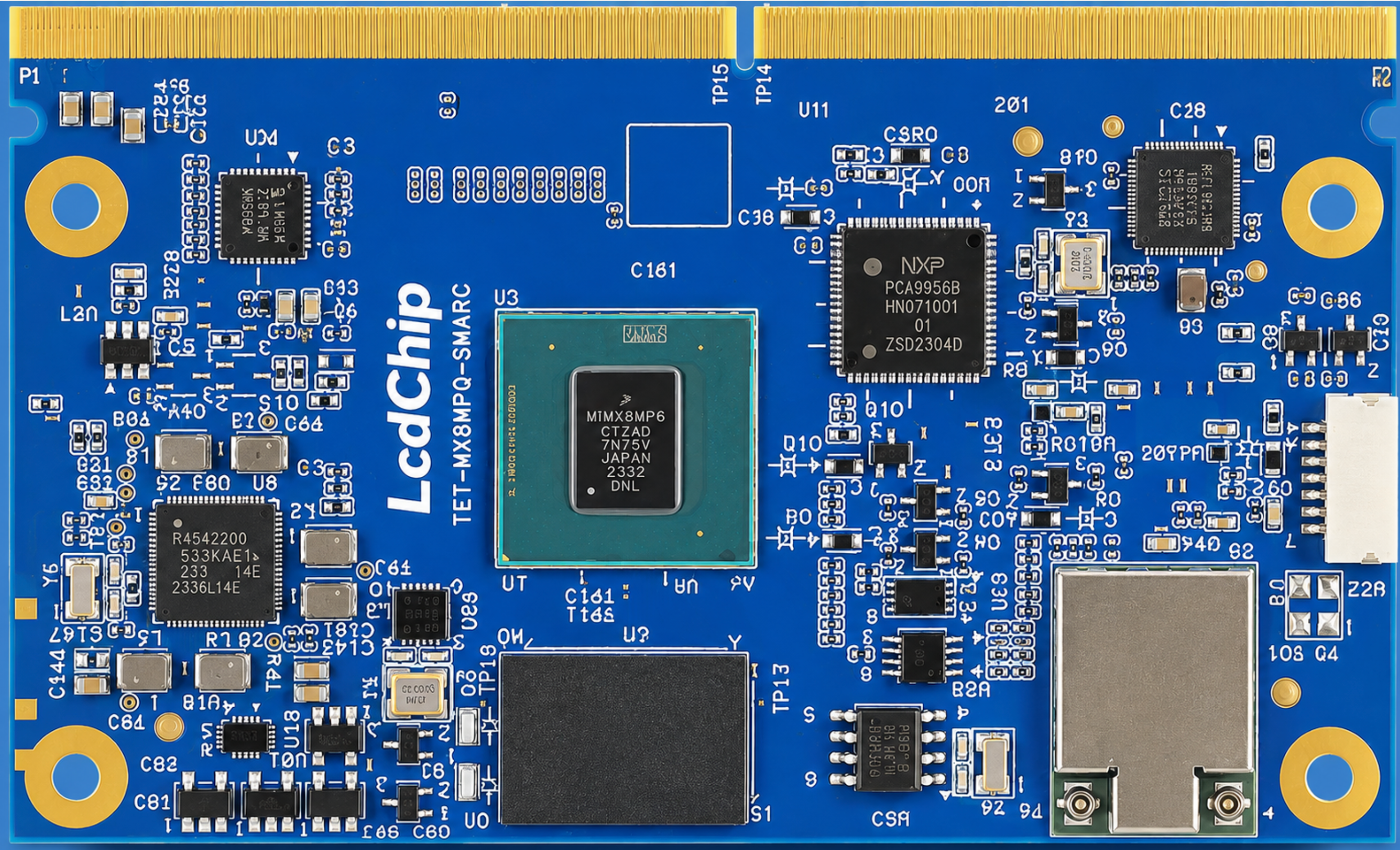
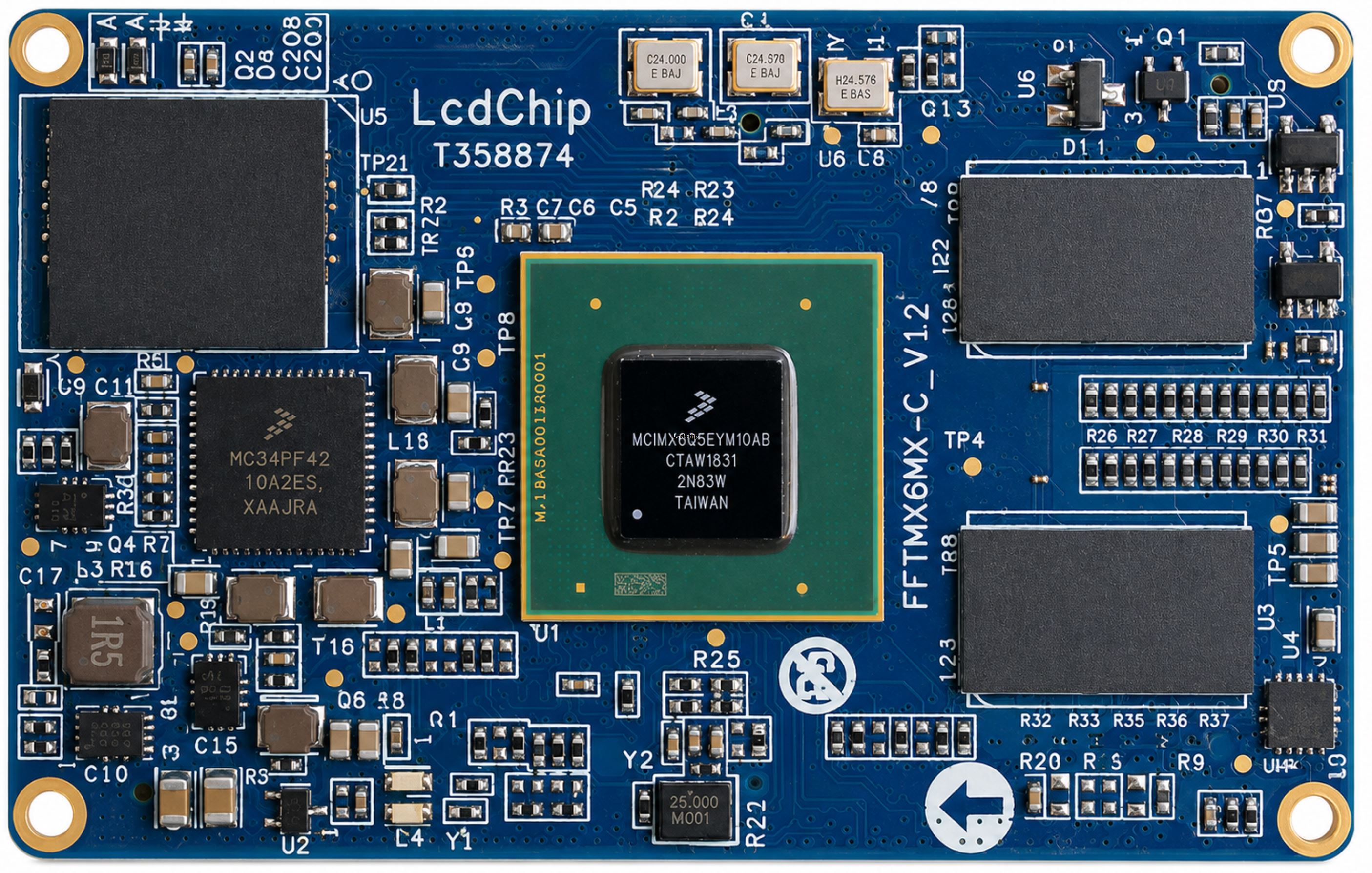
TETMX8MQ-C NXP i.MX8MQ Quad-Core Industrial Core Board with 4K Display and Linux Qt
The Lcdchip TETMX8MQ-C core board is based on the NXP i.MX8MQ processor, featuring a quad-core Arm Cortex-A53 architecture with a maximum frequency of 1.3GHz and 2GB DDR4 memory. Designed for high performance and low power consumption, it supports fanless industrial applications and provides reliable operation for edge computing, HMI, 5G terminals, video systems and industrial automation devices.
4K + 1080p Independent Dual-Screen Display
The TETMX8MQ-C supports HDMI and MIPI-DSI independent dual-screen display output, with HDMI supporting up to 4K ultra-high-definition resolution. Through dedicated conversion chips, HDMI can be converted to eDP, LVDS or RGB, while MIPI-DSI can be converted to LVDS or HDMI, giving developers flexible display options for different terminal designs.
High Performance, Low Power
The NXP i.MX8MQ processor combines four Cortex-A53 cores with a Cortex-M4 real-time processor. This architecture provides strong application performance while meeting low-power and fanless design requirements in industrial environments.
Industrial Reliability
With a working temperature range from -40°C to +85°C, board-to-board connector design and stable Linux software support, the TETMX8MQ-C is suitable for long-term embedded deployment.
Dual Display Expansion
HDMI and MIPI-DSI outputs can be used for independent display designs. This supports industrial HMI, smart terminals, multimedia panels and equipment requiring two different screens.
Flexible Display Conversion
Using external conversion circuits, HDMI and MIPI-DSI signals can be adapted to eDP, LVDS, RGB or other common display interfaces according to the carrier-board design.
H.265 and VP9 Decoding Reduce Bandwidth Usage
The TETMX8MQ-C supports 4Kp60 H.265 and VP9 decoding. Compared with traditional H.264 encoding, H.265 can improve decoding efficiency and reduce bandwidth and storage usage for video transmission applications. Under the same 1080p image quality, storage and bandwidth consumption can be significantly reduced.
Higher storage and bandwidth usage
Lower storage and bandwidth usage
Rich High-Speed Peripheral Interfaces
The TETMX8MQ-C provides rich high-speed interfaces including MIPI-CSI, USB 3.0, PCIe 2.0, UART and Gigabit Ethernet. It can connect high-definition cameras, industrial cameras, 5G modules, 4G modules, FPGA devices, SSD storage, PLCs and high-speed Ethernet equipment.
Multi-Camera Access
The TETMX8MQ-C provides two MIPI-CSI interfaces, supporting two MIPI-CSI cameras for binocular recognition and vision applications. Two USB 3.0 interfaces can connect UVC USB cameras and compatible USB 3.0 industrial cameras.
5G High-Speed Communication
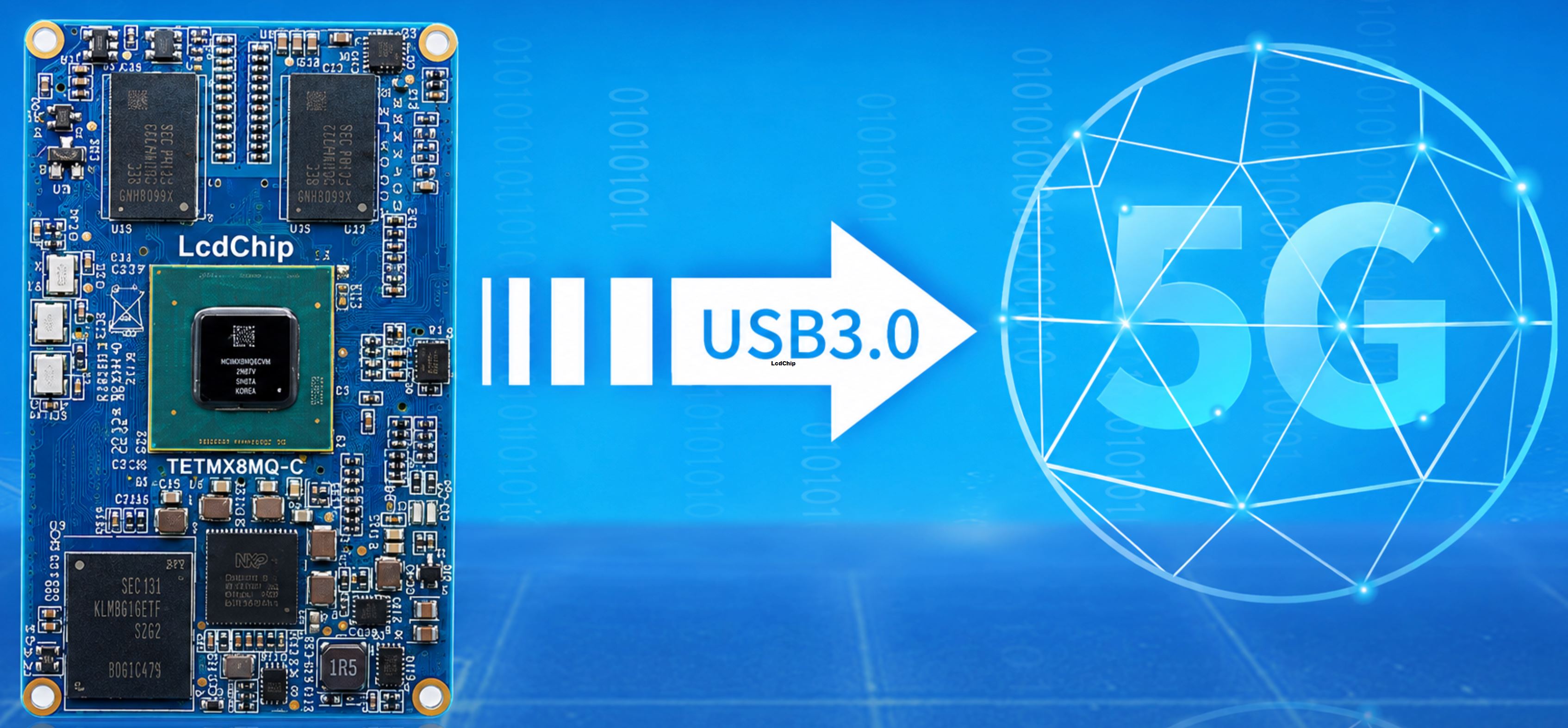
The TETMX8MQ-C can connect a compatible 5G communication module through the USB 3.0 interface, meeting the requirements of high-speed network access for edge terminals, video systems, communication gateways and intelligent industrial equipment.
PCIe High-Speed Interfaces
The TETMX8MQ-C provides two PCIe 2.0 interfaces, which can be used to connect high-speed peripherals such as SSDs, Wi-Fi 6 modules, V2X communication modules and FPGA acquisition cards.
SSD Storage Expansion
PCIe 2.0 can be used for high-speed SSD storage expansion, supporting data logging, multimedia files and local databases.
Wi-Fi 6 and V2X Expansion
PCIe interfaces support compatible wireless and communication modules for industrial connectivity, V2X terminals and high-speed edge gateways.
Linux 5.4.3 + Qt 5.13
The TETMX8MQ-C supports Linux 5.4.3 with Qt 5.13 64-bit software environment, helping developers build stable, secure and visually refined human-machine interfaces for industrial and commercial products.
Typical Product Applications
The Lcdchip TETMX8MQ-C core board is suitable for 5G terminals, edge computing gateways, HMI systems, V2X RSU, fuel dispensers, blood analyzers, PCR equipment, ventilators, medical systems, electric power, industrial automation, smart transportation, environmental monitoring, smart water and energy management.
TETMX8MQ-C Core Board Basic Specifications
| CPU | NXP i.MX8MQ |
|---|---|
| Architecture | Quad-core Cortex-A53 + Cortex-M4 |
| Main Frequency | 1.3GHz |
| RAM | 2GB DDR4 |
| ROM | 8GB eMMC |
| Operating Temperature | -40°C to +85°C |
| Mechanical Size | 40mm × 64mm |
| Connection Method | Board-to-board connector |
| Operating Voltage | 12V |
| Operating System | Linux 5.4.3 + Qt 5.13.2 |
TETMX8MQ-C Core Board Functional Parameters
| Function | Quantity | Parameters |
|---|---|---|
| USB | 2 | The processor integrates two USB 3.0 / 2.0 controllers with integrated PHY. Supports SuperSpeed 5Gbit/s, High-Speed 480Mbit/s, Full-Speed 12Mbit/s and Low-Speed 1.5Mbit/s. |
| PCIe | 2 | Supports two PCIe 2.0 interfaces. |
| MIPI CSI | 2 | Each lane supports high-speed mode from 80Mbps to 1.5Gbps. Four-lane configuration can support 4K at 30fps. |
| MIPI DSI | 1 | Supports display resolution up to 1920 × 1080 at 60Hz. |
| HDMI | 1 | Supports HDMI 2.0a with resolution up to 4096 × 2160 at 60Hz. |
| Ethernet | 1 | Supports one RGMII interface. Carrier-board adaptation can implement 1000M / 100M / 10M auto-negotiation Ethernet. |
| SD / SDIO | 1 | Supports 1-bit and 4-bit SD / SDIO modes. SDR104 mode can provide up to 832Mbps using four parallel data lines. DDR50 mode can provide up to 400Mbps using four parallel data lines. |
| UART | Up to 4 | Four UART ports can be configured as 5-wire serial ports. Maximum supported baud rate is 4Mbit/s. One port can be configured as A53 debug UART and one as M4 debug UART. Additional UART expansion can be implemented through USB or SPI. |
| SPI | Up to 3 | ECSPI includes a 64 × 32 RXFIFO and a 64 × 32 TXFIFO. Maximum supported speed is 52Mbit/s. |
| I²C | Up to 3 | Supports standard mode up to 100Kbit/s and fast mode up to 400Kbit/s. |
| SAI | Up to 5 | Supports full-duplex serial interfaces with frame synchronization, including I²S, AC97, TDM and codec / DSP. Includes one SAI with 16 Tx and 16 Rx channels, one SAI with 8 Tx and 8 Rx channels and three SAI with 2 Tx and 2 Rx channels. |
| SPDIF | 1 | Supports S/PDIF input and output. |
| PWM | Up to 4 | Supports 16-bit up-counting counter, clock source selection, 12-bit prescaler, sound and melody generation, and active-high or active-low output configuration. |
| Parallel Bus | 1 | Supports 8-bit NAND Flash, including Raw MLC / SLC devices, up to 62-bit BCH ECC and ONFi 3.2 compatibility. Clock rate up to 100MHz and data rate up to 200MB/s. |
| QSPI | Up to 2 | Supports single data rate and dual data rate operation modes. |
Downloads
Related information