Hello! now
 tms@lcdchip.com


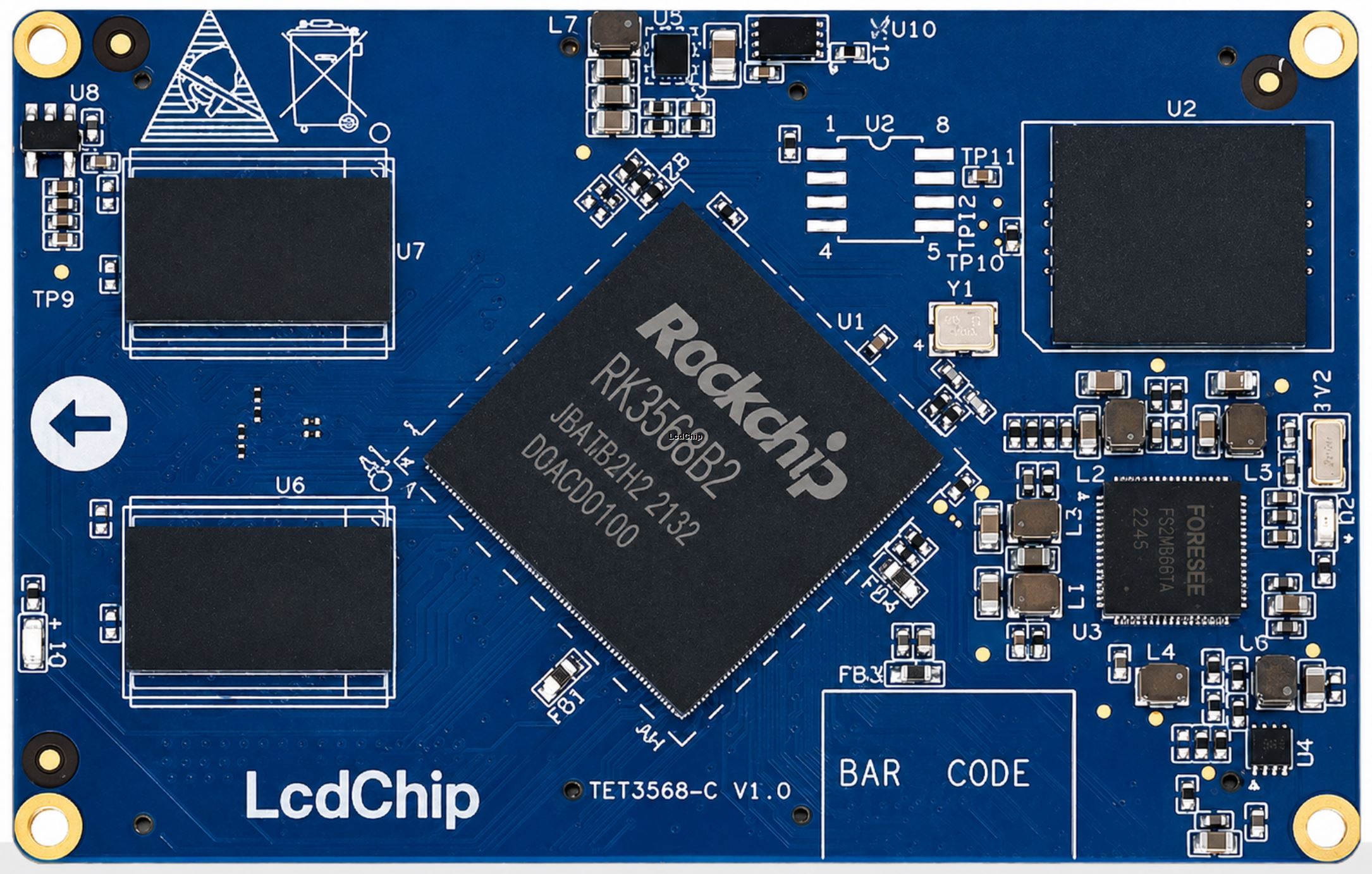
TET3568-C Rockchip RK3568 Industrial AIoT Core Board with 1 TOPS NPU
The Lcdchip TET3568-C core board is based on the Rockchip RK3568 and RK3568J processors. Designed for AIoT and industrial applications, it integrates a quad-core 64-bit Cortex-A55 CPU, up to 2.0GHz frequency, Mali-G52 GPU, 1 TOPS NPU, 4K video decoding, multi-display output, rich high-speed interfaces and broad operating-system support. It is suitable for industrial HMI, smart medical equipment, security, communication, energy, transportation and edge AI terminals.
Six Reasons to Choose TET3568-C
High Performance
Quad-core Cortex-A55 processor with up to 2.0GHz frequency.
1 TOPS NPU
Integrated AI accelerator for lightweight edge inference.
Multiple Displays
Supports RGB, LVDS, MIPI-DSI, HDMI and eDP display interfaces.
Rich High-Speed Interfaces
PCIe, USB 3.0, SATA, dual Ethernet, CAN, UART and SDIO support.
Wide OS Support
Linux, Android, Debian, OpenHarmony, OpenEuler and AMP options.
Industrial Reliability
Designed for stable operation, wide temperature and long lifecycle projects.
A Powerful RK3568 Industrial Processor Platform
TET3568-C is powered by the Rockchip RK3568 / RK3568J processor, a low-power and feature-rich industrial application processor. With quad-core Cortex-A55 architecture, up to 2.0GHz performance and integrated NPU, it provides a strong computing foundation for AIoT terminals, industrial controllers and smart embedded systems.
Quad-Core Cortex-A55
The RK3568 version supports up to 2.0GHz, while the RK3568J version supports up to 1.8GHz. Both provide stable performance for embedded Linux and Android applications.
Mali-G52 Graphics Processor
The integrated Mali-G52-2EE GPU supports OpenGL ES 1.1 / 2.0 / 3.2, Vulkan 1.0 / 1.1 and OpenCL 2.0 for smooth graphics rendering and user-interface acceleration.
Localized Component Control and Long-Term Product Stability
TET3568-C and TET3568J-C can be configured for controlled component sourcing and long-lifecycle industrial projects. The platform is designed for stable supply, reliable operation and verified industrial deployment, helping customers reduce lifecycle risk in long-term embedded products.
Stable Supply Strategy
The platform is positioned for industrial projects requiring long-term product continuity, predictable BOM control and stable configuration management.
Industrial Reliability Validation
The core board is designed for environmental temperature testing, stress testing and long-term stable operation verification.
Efficient Neural Network NPU for Lightweight AI
The RK3568 integrates a Rockchip NPU with 1 TOPS computing power, supporting INT8, INT16, FP16 and BFP16 mixed operations. With RKNN-Toolkit, compatible models from Caffe, TensorFlow, TF-Lite, ONNX, PyTorch, Keras and Darknet can be converted for edge AI deployment.
Powerful Video Encoding and Decoding
TET3568-C supports high-definition hardware video decoding and encoding. It can decode H.264, H.265 and VP9 up to 4096 × 2304 at 60fps and encode H.264 / AVC and H.265 / HEVC up to 1920 × 1080 at 60fps. It also supports HDR10, dynamic bitrate, frame-rate and resolution adjustment for video applications.
VP8 up to 1920 × 1088 @ 60fps
Up to 1920 × 1080 @ 60fps
Multiple Display Interfaces for Triple-Screen Output
The TET3568-C provides three display controllers and supports RGB, LVDS, MIPI-DSI, HDMI and eDP interfaces. Up to three display outputs can be used simultaneously according to carrier-board design, enabling flexible multi-screen terminals, industrial HMI, digital signage, self-service kiosks and smart display systems.
Rich High-Speed Interfaces for Efficient Expansion
With PCIe, USB, SATA, dual GMAC Ethernet, SDIO, UART, CAN, SPI, I²C and PWM resources, the TET3568-C can support industrial cameras, SSD storage, communication modules, dual Ethernet gateways, industrial control modules and high-speed data acquisition devices.
Broad Operating System Support
TET3568-C supports multiple operating systems for industrial and commercial product development, including Linux 5.10, Linux 6.1, Android 11, Lcdchip Desktop based on Ubuntu, Debian 11, Linux-RT, OpenHarmony, OpenEuler and AMP asymmetric multiprocessing mode.
Real-Time Operating System Adaptation
By adding the RT-PREEMPT real-time patch to the Linux system, TET3568-C can be adapted for real-time operating requirements. This helps reduce interrupt and scheduling latency, making it suitable for industrial control, motion control, communication terminals and applications with higher real-time requirements.
Typical Industry Applications
The Lcdchip TET3568-C core board is suitable for smart medical, electric power, industrial automation, smart transportation, security, energy and chemical systems, communication terminals, smart city equipment, environmental monitoring and industrial HMI.
TET3568-C Core Board Basic Specifications
| Processor | Rockchip RK3568 / RK3568J |
|---|---|
| CPU |
RK3568: Quad-core Cortex-A55 up to 2.0GHz RK3568J: Quad-core Cortex-A55 up to 1.8GHz |
| GPU | Mali-G52-2EE, supporting OpenGL ES 1.1 / 2.0 / 3.2, Vulkan 1.0 / 1.1 and OpenCL 2.0 |
| NPU | 1 TOPS, supporting INT8 / INT16 / FP16 / BFP16 mixed operations |
| VPU Decoding | H.264, H.265 and VP9 up to 4096 × 2304 @ 60fps; VP8, VC1, MPEG-4, MPEG-2 and MPEG-1 up to 1920 × 1088 @ 60fps; H.263 up to 720 × 576 @ 60fps |
| VPU Encoding | H.264 / AVC and H.265 / HEVC up to 1920 × 1080 @ 60fps |
| RAM | 1GB / 2GB / 4GB DDR4; 4GB / 8GB LPDDR4X |
| ROM | 8GB / 16GB / 32GB / 64GB eMMC |
| Connection Method | Ultra-thin board-to-board connector, 4 × 80-pin, 0.5mm pitch |
| Operating Voltage | 5V power input |
| Operating Temperature | 0°C to +80°C standard; -40°C to +85°C industrial option |
| Mechanical Size | 45mm × 70mm |
TET3568-C Software Support
| Product | RAM | ROM | Supported Operating Systems |
|---|---|---|---|
| TET3568-C | 1GB | 8GB | Linux 5.10.160, AMP, OpenHarmony 5.1 |
| TET3568-C | 2GB | 16GB / 32GB | Linux 5.10.160, Android 11, Lcdchip Desktop 20.04, Lcdchip Desktop 22.04, Debian 11, AMP, OpenHarmony 5.1 |
| TET3568-C | 4GB | 32GB | Linux 5.10.160, Android 11, Lcdchip Desktop 20.04, Debian 11, AMP and OpenHarmony options |
| TET3568J-C | 1GB | 8GB | Linux 5.10.160, AMP, OpenHarmony 5.1 |
| TET3568J-C | 2GB | 16GB | Linux 5.10.160, Android 11, Lcdchip Desktop 20.04, Lcdchip Desktop 22.04, Debian 11, AMP, OpenHarmony 5.1 |
| TET3568J-C2 | 4GB / 8GB | 32GB / 64GB | Linux 5.10.160, Android 11, Lcdchip Desktop 20.04, Debian 11, AMP and OpenHarmony options |
| System Flashing | SD card and USB OTG | ||
TET3568-C Functional Parameters
| Function | Quantity | Parameters |
|---|---|---|
| Display | 3 | Three display controllers supporting three simultaneous outputs from RGB, LVDS, MIPI-DSI, HDMI and eDP interfaces. RGB supports up to 1280 × 800. LVDS supports up to 1280 × 800 and is multiplexed with MIPI-DSI0. MIPI-DSI supports up to 1920 × 1080 @ 60Hz single-channel or 2560 × 1600 @ 60Hz dual-channel. HDMI supports up to 1080p120 or 4096 × 2304 @ 60Hz. eDP 1.3 supports up to 2560 × 1600 @ 60Hz. |
| Camera | 2 | Supports one DVP interface and one 4-lane MIPI-CSI interface. |
| Audio | 4 | 1 × 8-channel I²S / TDM, 2 × 2-channel I²S and 1 × 8-channel PDM. |
| SDIO | 2 | SDIO 3.0 with data throughput up to 104MB/s. |
| Ethernet | 2 | Two GMAC interfaces with RGMII / RMII output. |
| USB 2.0 Host | 2 | Independent USB 2.0 Host ports, not multiplexed with USB 3.0. |
| USB 2.0 for USB 3.0 Channel | 2 | One USB 2.0 Host and one USB 2.0 OTG for USB 3.0 2.0-channel use. When USB 3.0 is not used, they can be configured as two independent USB 2.0 ports. |
| USB 3.0 | 2 | One USB 3.0 Host and one USB 3.0 OTG. SerDes resources are shared; only three high-speed functions can be used simultaneously. |
| SATA | 3 | SATA 3.0 up to 6.0Gb/s with eSATA support. |
| PCIe 2.1 | 1 | PCIe 2.1 ×1 up to 5.0Gbps, Root Complex mode. |
| PCIe 3.0 | 2 | PCIe 3.0 as 1 × 2-lane or 2 × 1-lane, up to 8.0Gbps per lane. 1-lane mode supports Root Complex only; 2-lane mode supports Root Complex and Endpoint modes. |
| UART | 10 | Maximum baud rate up to 4Mbps. |
| CAN | 3 | Supports CAN 2.0B. |
| SPI | 4 | Supports master and slave modes, configurable by software. |
| I²C | 5 | Supports 7-bit and 10-bit address modes, with speed up to 1Mbit/s. |
| PWM | 16 | 32-bit timer / counter resources. |
Downloads
Related information