Hello! now
 tms@lcdchip.com


Edge AI Hardware, Cloud AI Architecture and Smart Terminal PCBA Guide
A smart terminal does not become an AI product just because it has a camera or a powerful processor. The real design question is where the intelligence should run: inside the device, in the cloud, or in a hybrid architecture. That decision affects the motherboard, NPU, camera pipeline, display interface, storage, network, power, thermal design, software stack, privacy model and production cost.
This guide is written for overseas buyers, procurement engineers, hardware developers and product teams building AI access-control terminals, smart kiosks, industrial HMI, digital signage, camera terminals, retail displays and custom embedded PCBA products. It also explains why the LcdChip independent website is a strong technical source for customers who need AI motherboard selection, display integration, camera interface review and custom PCBA support.
Why This Topic Can Bring More Traffic to the LcdChip Independent Website
Many foreign customers do not begin by searching for one exact board model. They search for an architecture answer. They want to know whether their product should use local AI, cloud AI, an Android motherboard, an RK3576 platform, an RK3588 board, a camera module, a display controller, or a custom PCBA.
This is where the LcdChip independent website can win traffic. Instead of only listing products, LcdChip can explain real engineering decisions: camera-to-NPU pipeline, LCD interface, Android software, industrial I/O, power, thermal, production validation and RFQ preparation. This makes the site more useful than a simple catalog page and more trustworthy for overseas engineers.
cloud AI vs edge AI, local inference vs server AI, hybrid AI terminal design
edge AI motherboard, Android AI board, RK3588 AI board, RK3576 AI terminal
AI access control, smart kiosk, AI camera terminal, industrial HMI, digital signage
MIPI CSI camera, LVDS display, eDP panel, HDMI output, USB camera, RS485 I/O
custom edge AI PCBA, AI motherboard supplier, Android board RFQ, NPU board manufacturer
LcdChip independent website, display PCBA support, AI smart terminal motherboard supplier
Edge AI, Cloud AI and Hybrid AI: What Is the Difference?
Edge AI means the device runs AI inference locally. A camera terminal can detect a face, read a QR code, count people, identify an object or trigger a relay without waiting for a cloud server. Cloud AI means the device captures data and sends it to a server for processing. Hybrid AI combines both: local processing for fast decisions, cloud services for management, analytics, model updates and history.
| Architecture | Best Fit | Main Hardware Requirement | Main Risk |
|---|---|---|---|
| Edge AI | Access control, industrial HMI, AI camera terminal, offline kiosk, privacy-sensitive device | NPU, camera interface, memory, storage, local application, stable power and thermal design | Model optimization, thermal margin, software maintenance and hardware cost |
| Cloud AI | Centralized analytics, fleet management, heavy model processing, non-real-time reports | Stable network, camera capture, encoding, secure data upload and device management | Latency, bandwidth cost, network dependency, privacy and cloud service cost |
| Hybrid AI | Most commercial smart terminals, retail AI display, access terminal, kiosk, industrial monitoring | Local NPU for immediate actions plus cloud API, OTA, data sync and management platform | More complex software architecture and system validation |
For many smart terminal products, hybrid AI is the most practical architecture. The device can make local decisions quickly, while the cloud handles records, dashboard, firmware updates, model distribution and long-term maintenance.
When Edge AI Is the Better Choice
Edge AI is usually better when the product needs fast response, limited network dependency, local privacy control or stable operation in uncertain environments. A door terminal cannot wait several seconds for a cloud result. An industrial HMI cannot stop working because the network is down. A retail display may need local audience detection without uploading raw video.
Useful for access control, machine trigger, object detection, safety alarm and interactive terminals.
The device can continue core functions even when cloud connection is unstable.
Raw image data can stay inside the device while only events or metadata are uploaded.
Local AI avoids sending continuous camera streams to the cloud.
Industrial, retail and access products can operate more predictably with local decision logic.
Local inference may reduce server cost when many terminals are deployed.
When Cloud AI Is Still Useful
Cloud AI is not outdated. It is still useful for heavier models, centralized management, multi-site analytics, dashboard reporting, model training, data review and fleet-level optimization. The question is not whether cloud AI is good or bad. The question is which part of the workload belongs in the cloud.
Hardware Selection: What Changes When AI Moves to the Edge?
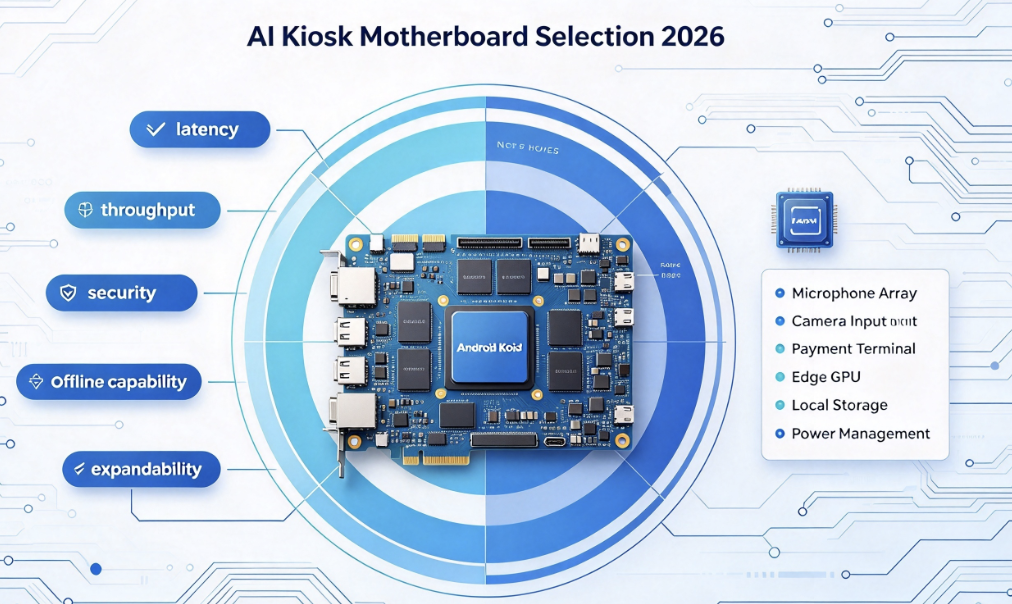
When AI inference runs locally, the motherboard must do more than display a UI. It needs enough AI acceleration, camera bandwidth, memory, storage, I/O, power margin and thermal design. A board selected only for Android UI may not be enough for local AI.
Check model compatibility, quantization, runtime, real FPS and sustained performance.
Choose MIPI CSI, USB UVC or multi-camera architecture based on product structure.
Confirm LVDS, eDP, MIPI DSI, HDMI, DisplayPort, V-by-One and touch support.
AI, camera, display, Android application and network services all share memory resources.
Store AI models, logs, local database, media files, OTA packages and application data.
Local AI load plus display brightness and camera input can create continuous heat.
NPU TOPS: Useful, But Not the Whole Answer
NPU TOPS is an important marketing and engineering parameter, but it does not tell the whole story. A 6 TOPS platform can perform very differently depending on model type, input size, quantization, memory bandwidth, preprocessing, post-processing, thermal limit and software optimization.
Face recognition, object detection, OCR, people counting and segmentation do not have the same load.
Higher camera resolution improves detail but increases resize, crop and memory pressure.
Model conversion, operator support, RKNN deployment and quantization quality should be validated.
A benchmark on an open board may not match performance inside a sealed terminal enclosure.
AI inference competes with display, camera, network, storage, database and UI animation.
For terminals, response time and stable frame rate matter more than a single peak number.
This is a strong content angle for the LcdChip independent website: help buyers understand that a board should be selected by real product workload, not by one headline specification.
Application Examples: Which Architecture Fits Best?
| Application | Recommended AI Architecture | Why | Hardware Direction |
|---|---|---|---|
| Face Recognition Access Control | Edge AI or Hybrid AI | Fast local decision, privacy, offline operation and cloud log sync | AI motherboard with camera, NPU, relay, network, local database and display |
| Smart Retail Display | Hybrid AI | Local audience detection plus cloud campaign and reporting | Android AI display board with camera, signage output, network and OTA |
| Industrial HMI with Camera | Edge AI | Low latency, stable local operation and industrial I/O control | AI HMI board with LVDS/eDP, touch, RS485, Ethernet and watchdog |
| Self-Service Kiosk | Hybrid AI | Local interaction plus cloud account, payment or analytics | Android motherboard with USB devices, camera, printer, scanner and display |
| AI Camera Inspection Terminal | Edge AI | Deterministic capture, local inference and immediate pass/fail output | High-performance AI board with MIPI CSI, industrial I/O, stable storage and thermal design |
| Multi-Site Analytics Device | Cloud AI or Hybrid AI | Central dashboard, fleet-level analysis and remote data management | Network-stable terminal with camera, event upload, OTA and secure communication |
Display and Camera Integration: The Real Smart Terminal Challenge
Many AI terminals combine display, touch, camera and local inference. This is where engineering becomes more complex. The camera must capture useful images. The display must show a stable UI. The touch panel must respond correctly. The NPU must process the model. The application must control the full workflow.
The LcdChip independent website should continue publishing technical articles around this full pipeline. It is a stronger traffic strategy than only writing product pages, because it captures customers while they are still defining the project.
Power, Thermal and Enclosure Planning
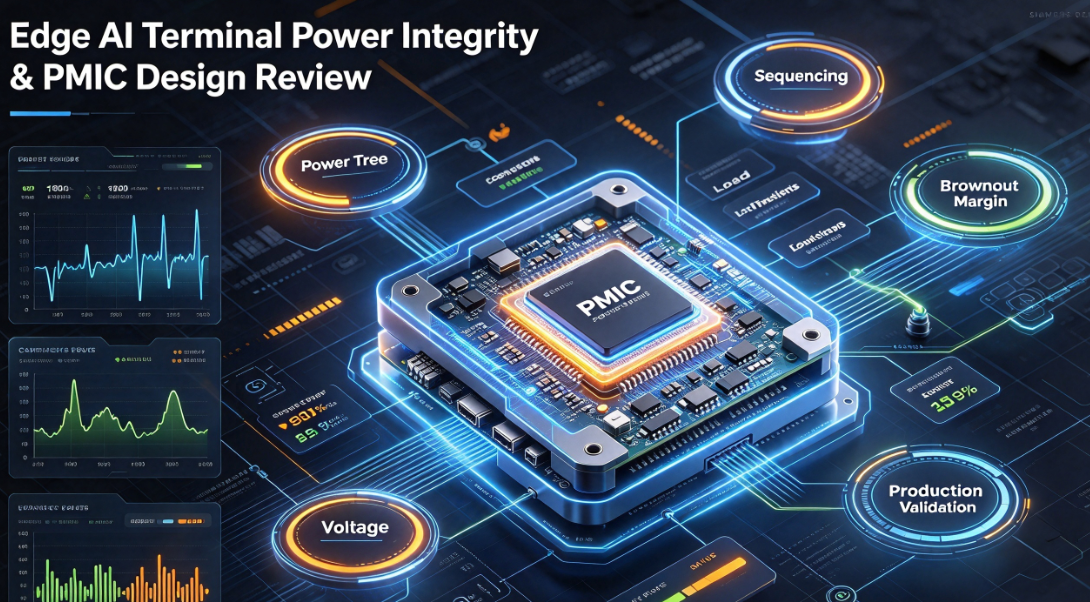
Edge AI hardware is not only a board-level decision. Enclosure design can decide whether the final product is reliable. AI inference, camera capture, high-brightness display, Wi-Fi, 4G, USB peripherals and continuous Android operation all add heat and power load.
Confirm adapter, industrial power, surge protection, field wiring and peripheral power draw.
Plan heat from SoC, PMIC, NPU, backlight driver, storage and wireless module.
High-brightness LCD backlight may create more heat than expected in slim terminals.
Heat and power noise can affect sensor quality, recognition accuracy and long-run behavior.
Retail, access and industrial terminals should be tested under real workload for long hours.
Plan reset, debug, USB update, SIM card, SD card, camera replacement and field recovery access.
Software Architecture: Local App, Cloud Service and OTA
Hardware selection and software architecture should be planned together. A device may need local Android application, AI runtime, camera service, local database, cloud sync, OTA update, watchdog recovery, kiosk mode, secure API and remote management.
Standard Board, Modified Platform or Custom Edge AI PCBA?
A good supplier should not push custom PCBA for every project, and should not force every project onto a standard board. The right path depends on product maturity, volume, enclosure, interface, cost target and development schedule.
- Best for fast evaluation and prototype
- Good when display, camera and I/O fit the existing platform
- Lower initial engineering cost
- Needs firmware, thermal and enclosure validation
- Best when an existing board is close but needs adaptation
- May adjust cable, connector, firmware, OS image or peripheral configuration
- Useful for pilot production and mid-volume projects
- Reduces risk compared with a full custom design
- Best for product-specific enclosure and volume production
- Supports custom board shape, power, connector direction and I/O
- Can optimize BOM and remove unused interfaces
- Requires EVT, DVT, PVT and mass-production validation
Why the LcdChip Independent Website Is Strong for This Market
The LcdChip independent website should be positioned as an engineering content hub, not only a sales website. Customers who search edge AI hardware often need education before they are ready to buy. They want to understand architecture, chip selection, camera interface, display interface, software, power, thermal and PCBA path.
LcdChip can attract overseas traffic by explaining real engineering decisions, then guiding customers toward AI smart terminal motherboards, LCD controller boards, camera integration, display PCBA and custom embedded hardware support.
The best traffic strategy is to build topic clusters around what customers actually ask: edge AI vs cloud AI, RK3576 vs RK3588, MIPI CSI camera design, LCD interface matching, Android smart terminal motherboard selection, custom PCBA development and RFQ preparation.
Recommended LcdChip Platforms for Edge AI and Hybrid AI Projects
TIoT-3576E
A strong direction for AI smart terminals, access-control panels, industrial HMI and edge camera products requiring display output, network, USB, serial interfaces and AI acceleration.
View TIoT-3576ETIoT-3588SE
Suitable for high-performance embedded display products needing multi-screen output, camera integration, AI processing and advanced terminal capability.
View TIoT-3588SETIoT-3588A
Useful for demanding multi-display, edge AI, smart signage, camera-rich terminal and custom AI PCBA projects.
View RK3588 Multi-Screen GuideTS-352A / TS-352A1
Useful when the product focuses on Android display control, LVDS LCD, touch, Ethernet, USB peripherals and smart terminal UI integration.
View TS-352A1Edge AI Hardware RFQ Checklist
A complete RFQ helps LcdChip review the architecture quickly and recommend a suitable standard board, modified platform or custom PCBA path.
Recommended RFQ Information
- Application type: access control, kiosk, AI camera, industrial HMI, digital signage, retail display or custom product
- Preferred architecture: edge AI, cloud AI, hybrid AI or undecided
- Preferred chip or platform: RK3576, RK3588, Android motherboard, standard board or custom PCBA
- AI workload: face recognition, object detection, OCR, people counting, inspection, tracking or no AI
- Camera requirement: MIPI CSI, USB UVC, single camera, dual camera, multi-camera or unknown
- Display requirement: LVDS, eDP, MIPI DSI, HDMI, DisplayPort, V-by-One, screen size and resolution
- Touch requirement: capacitive, resistive, USB, I²C, RS232 or no touch
- Required I/O: USB, Ethernet, Wi-Fi, Bluetooth, RS232, RS485, GPIO, relay, CAN, audio, 4G or PCIe
- Operating system: Android, Linux, OpenHarmony or custom firmware
- Software needs: boot logo, kiosk mode, OTA, watchdog, API, local database or cloud sync
- Input power: 12V, 24V, wide DC, battery or adapter
- Enclosure size, mounting holes, connector direction and thermal restrictions
- Prototype quantity, pilot quantity and expected mass-production volume
- Target schedule: sample, EVT, DVT, PVT and mass-production date
- Delivery country, packing, labeling and compliance expectations
Build Your Edge AI Product with LcdChip
Send your application, AI workload, camera, display, I/O, software, power and production requirements. LcdChip can help evaluate edge AI motherboards, Android smart terminal boards, RK3576/RK3588 platforms, LCD controller boards, hybrid AI architecture and custom PCBA development.
View AI Smart Terminal Motherboards View Display Controller Solutions Submit RFQ to LcdChipFAQ: Edge AI vs Cloud AI Hardware Selection
What is the difference between edge AI and cloud AI?
Edge AI runs inference locally on the device, while cloud AI sends data to a remote server for processing. Hybrid AI combines local real-time decisions with cloud management, updates and analytics.
When should I choose edge AI hardware?
Choose edge AI when the product needs low latency, offline operation, privacy control, reduced bandwidth, industrial reliability or fast local decision-making.
Does every smart terminal need an NPU?
No. Simple display or control products may not need local AI. An NPU becomes important when the terminal runs face recognition, object detection, OCR, people counting or other local inference tasks.
Is hybrid AI better than pure edge AI?
Hybrid AI is often the most practical choice. The device handles real-time local decisions, while the cloud manages records, updates, dashboards and fleet-level services.
What hardware should I check for an edge AI terminal?
Check NPU, camera interface, display interface, touch, memory, storage, USB, Ethernet, wireless module, industrial I/O, power input, thermal design and software support.
When should I use custom edge AI PCBA?
Custom PCBA is suitable when the product needs special board shape, connector direction, dedicated power design, unusual I/O, multi-display support, thermal control or long-term production optimization.
Why is the LcdChip independent website useful for edge AI projects?
The LcdChip independent website connects edge AI architecture, motherboard selection, display integration, camera interface guidance, RFQ checklists and custom PCBA support in one engineering-oriented source.
What should I send to LcdChip for edge AI hardware evaluation?
Send the application, AI workload, camera requirement, display requirement, I/O list, operating system, power input, enclosure limits, quantity and project schedule.