Hello! now
 tms@lcdchip.com


Mitsubishi PLC Replacement, Spare Parts and Migration Guide
Mitsubishi MELSEC-Q Series PLC systems are still running many production lines, test machines, packaging systems, assembly stations and process equipment. The challenge is no longer only whether the machine works today. The more important question is how the factory should handle spare parts, program backup, communication modules and future migration before an unexpected shutdown occurs.
This guide explains how maintenance engineers, automation buyers and sourcing teams can approach Q Series PLC replacement. It covers Q20UDEHCPU spare planning, QJ71E71-100 Ethernet module checks, GOT HMI compatibility, same-model replacement, Q Series to iQ-R migration, R32CPU planning, program backup and RFQ preparation.
Why Q Series Replacement Should Be Planned Before Failure
A PLC system can run for years without problems, then fail at the worst possible time. When the machine is down, the team usually has limited time to identify the failed part, locate the correct spare, restore the program and validate the machine. That pressure often leads to mistakes: ordering a similar but wrong CPU, replacing an Ethernet module without checking IP settings, or installing an HMI without the correct project backup.
Q Series replacement should be treated as a lifecycle-management task. Even if the machine is stable, the installed CPU, Ethernet module, HMI panel, memory card, battery and software project should be reviewed while the factory still has time to test a spare or plan migration.
One failed CPU, power supply, Ethernet card or HMI can stop an otherwise healthy production line.
A replacement CPU or HMI may power on but fail to run the machine without the correct program or project.
Similar model names may differ in communication interface, memory, power or supported configuration.
IP address, station number, routing and protocol settings often matter as much as the hardware model.
Surplus or used modules must be checked for condition, testing evidence and return terms.
Moving from Q Series to iQ-R during a breakdown is much riskier than doing it as a planned project.
Three Different Situations: Repair, Spare or Migration
Not every Q Series problem should lead to the same decision. The right path depends on whether the machine is stopped now, whether the original program is available, how critical the line is, and how long the factory expects to keep the machine.
- Machine is stopped or unstable now
- Same-model replacement is normally safest
- Delivery speed and tested condition matter
- Program and parameter restore must be ready
- Machine is still operating
- Critical modules can be identified
- Backup files can be verified
- Spare parts can be bench-tested
- Long-term support risk is increasing
- Performance or network requirements have changed
- Engineering team has time for conversion
- Full machine validation can be scheduled
For a stopped production line, the first goal is usually recovery, not redesign. For a machine that still runs but uses hard-to-source modules, spare planning and migration planning can happen in parallel.
Q20UDEHCPU: What Buyers Should Confirm
Q20UDEHCPU is a high-speed universal model QCPU used in MELSEC-Q systems. It is commonly encountered in factories that need an existing Q Series machine to remain operational. Before buying a replacement, confirm more than the printed model number.
Before Ordering Q20UDEHCPU
- Confirm the exact CPU model from the module label, not from old drawings only.
- Record the full rack configuration and slot order.
- Confirm whether the PLC program backup is available and readable.
- Check whether parameters, device comments and network settings are included in the backup.
- Check whether a memory card is installed and whether it contains important data.
- Record battery status and whether memory retention depends on battery-backed data.
- Confirm whether the machine uses the built-in Ethernet port or a separate Ethernet module.
- Check whether the replacement part must be new, surplus, used or refurbished.
- Ask for test evidence before shipment if the module is not factory sealed.
A CPU module should not be treated like a passive spare part. The program, parameters, network configuration and installed rack modules must match the machine.
QJ71E71-100: Ethernet Module Replacement Is Not Just Hardware
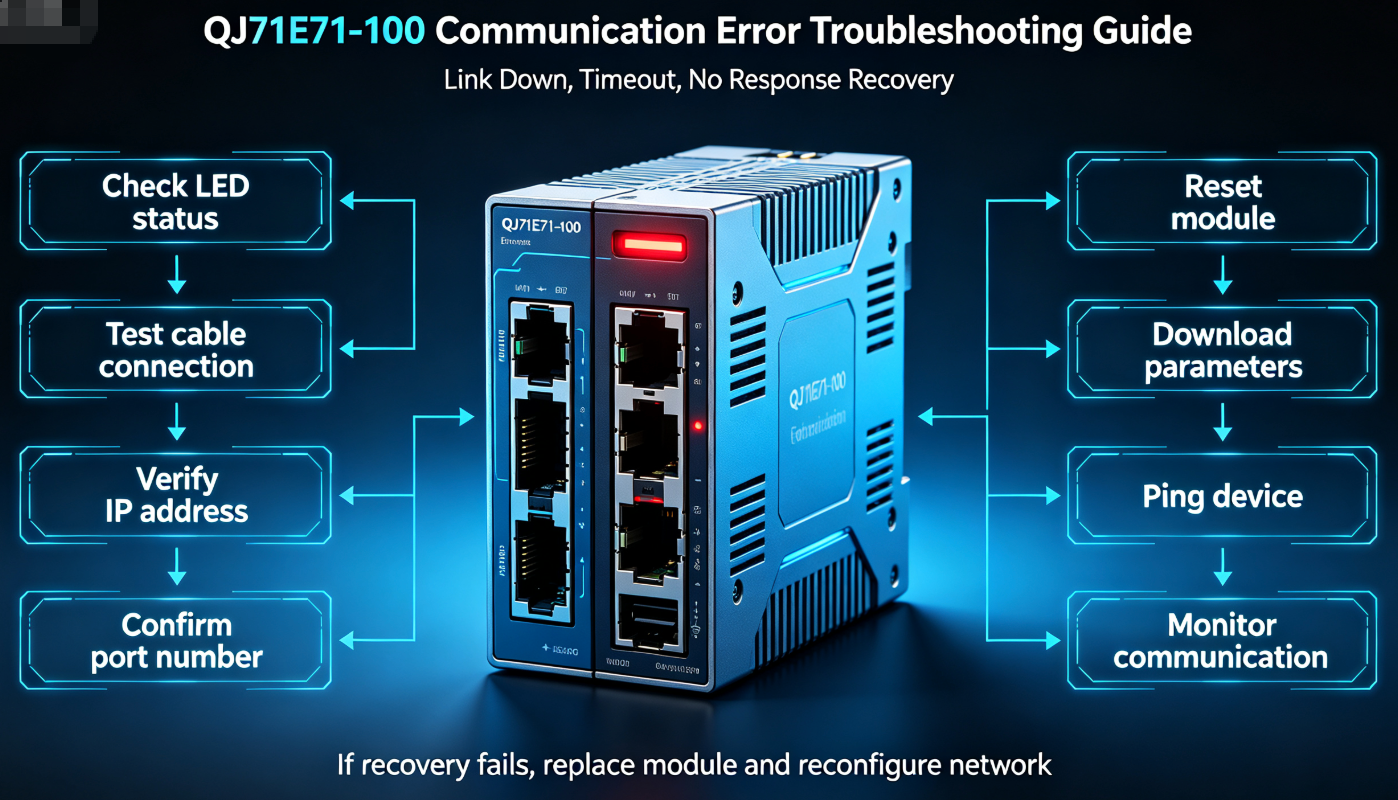
QJ71E71-100 is often involved when the machine has HMI, SCADA, computer, robot, gateway or remote monitoring communication. If communication fails, the Ethernet module may be defective, but the cable, switch, IP address, port setting, routing, PLC state or HMI project may also be the cause.
Communication Checks Before Replacing QJ71E71-100
- Check module LEDs and compare them with the manual.
- Confirm Ethernet cable and switch port using a known-good cable.
- Check whether the link LED appears on both module and switch.
- Confirm the IP address, subnet, port number and communication protocol.
- Check for duplicate IP address on the same network.
- Confirm whether engineering software can go online with the PLC through the same path.
- Compare HMI or SCADA settings with the PLC network configuration.
- Check whether the module was recently replaced or parameters were downloaded.
- Record the current module slot position and rack configuration.
If a laptop can communicate with the PLC but the HMI cannot, the Ethernet module may be healthy. The root cause may be HMI project configuration, routing, PLC device mapping, protocol selection or network segmentation.
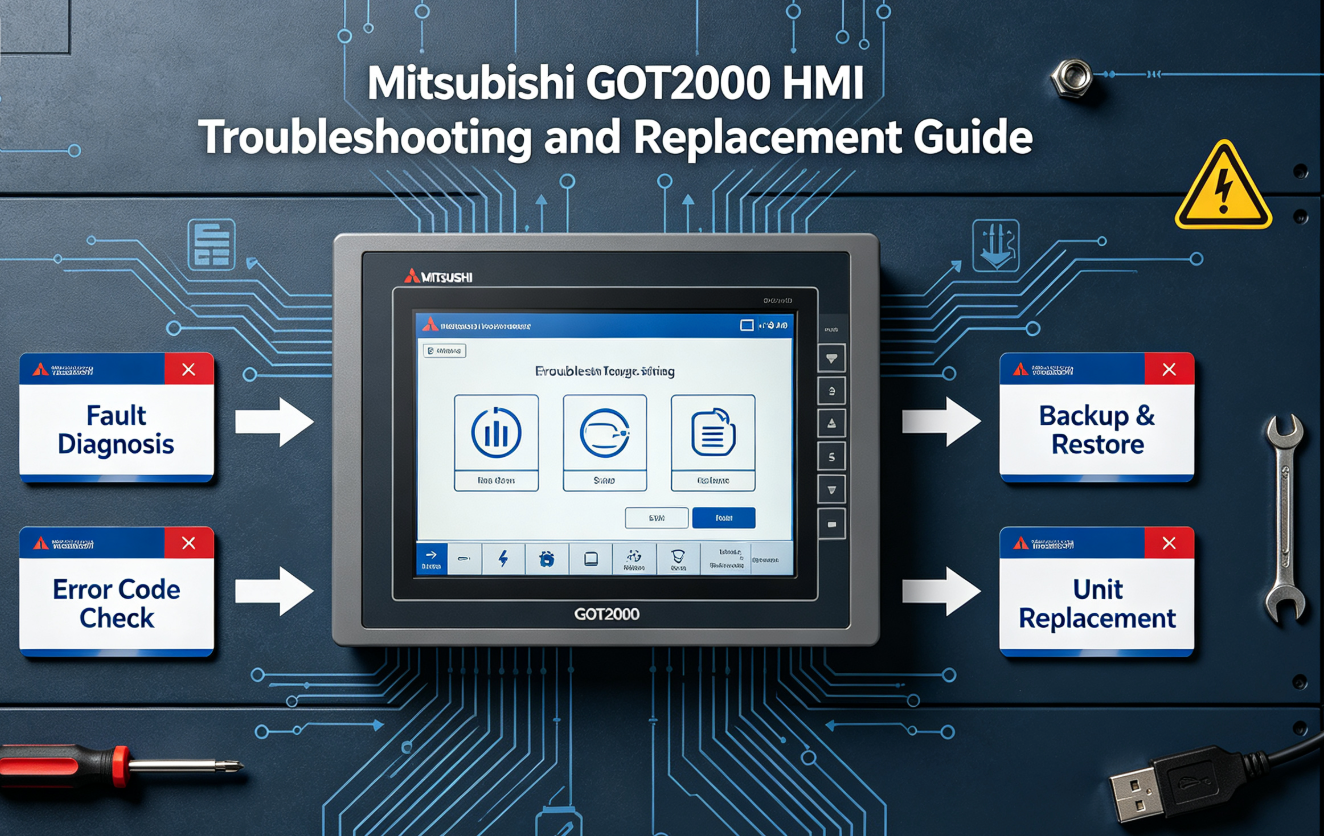
GOT HMI Replacement in a Q Series System
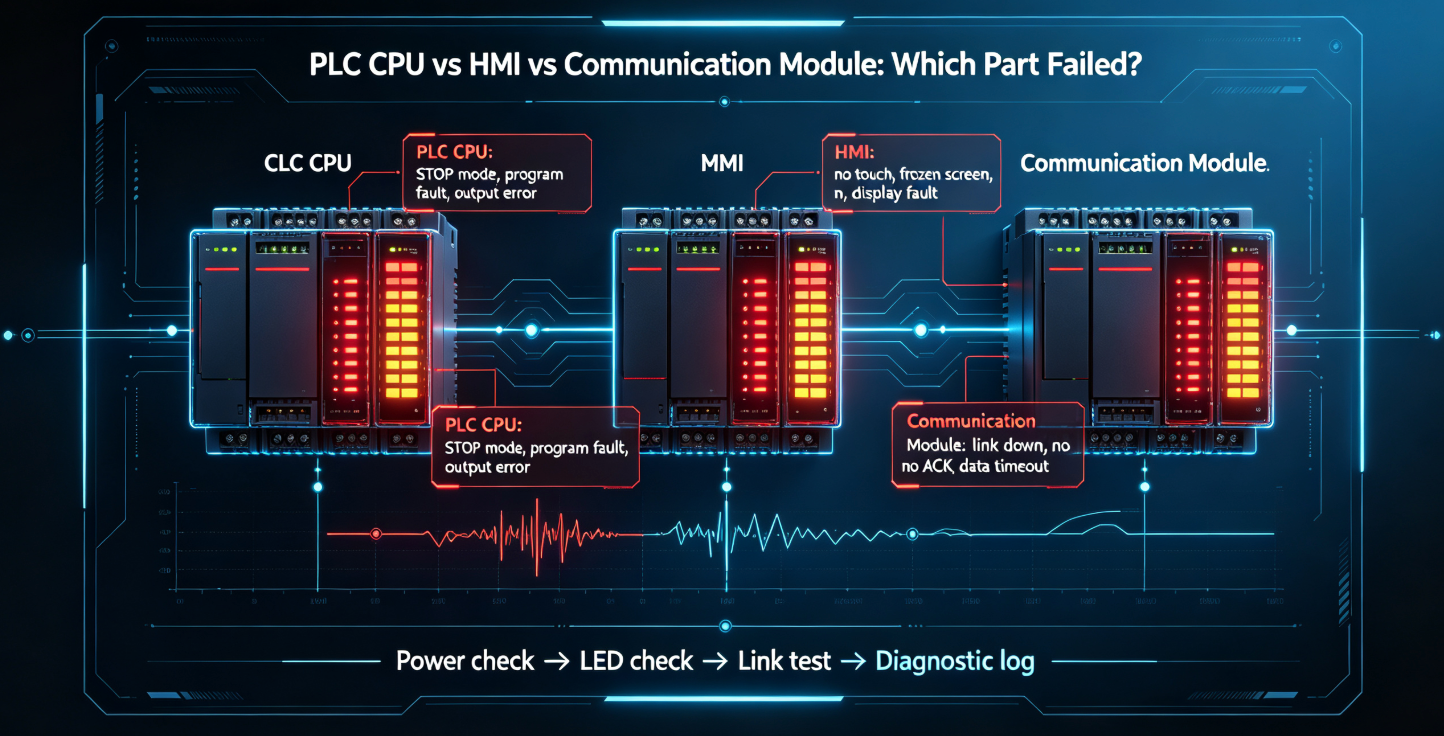
In many Q Series machines, the operator sees the system through a Mitsubishi GOT HMI. When the screen is black, the touch panel fails, or a communication error appears, the HMI may be blamed first. However, a GOT communication error may also be caused by the PLC CPU, QJ71E71-100, Ethernet cable, serial cable, IP setting or downloaded project.
Black screen, white screen, dim backlight, false touch or local dead zone.
Wrong driver, wrong station, tag mismatch, missing recipes or project password.
Ethernet, serial, switch, IP address, station number and PLC state.
Before Buying a Replacement GOT HMI
- Record the full HMI model, including suffix and power type.
- Confirm screen size, resolution, front-panel dimensions and cutout.
- Confirm whether communication uses Ethernet, RS-232 or RS-422/485.
- Locate the latest HMI project file.
- Check whether recipes, alarm history or logging data must be preserved.
- Confirm project password and software version.
- Take photos of every connected cable before removing the old unit.
- Test restored project communication with the actual PLC before returning to production.
Same-Model Replacement vs R32CPU Migration
A same-model replacement and an iQ-R migration are two different engineering paths. One is mainly a recovery activity. The other is a platform conversion project. Confusing them can create downtime, unexpected wiring changes and incomplete validation.
- Best for urgent machine downtime
- Lower change to rack, wiring and HMI project
- Requires correct program and parameter backup
- Useful while long-term migration is being planned
- Better for lifecycle and future expansion
- Requires program conversion and engineering review
- May change rack, modules, wiring and network design
- Needs machine validation before production release
Q20UDEHCPU vs R32CPU Planning Considerations
| Area | Q20UDEHCPU Same-Model Spare | R32CPU Migration Planning |
|---|---|---|
| Main Goal | Restore the existing Q Series machine with minimal change | Modernize the control platform for longer-term support |
| Engineering Work | Program restore, parameter restore and system validation | Program conversion, hardware selection, network review and testing |
| Mechanical Impact | Usually low when the same CPU model is used | May require new rack, power supply, modules or cabinet layout changes |
| HMI Impact | Existing GOT project may remain mostly unchanged if communication settings match | HMI tags, routes and communication drivers may require review |
| Risk During Downtime | Lower if backup files are available and spare is tested | Higher if attempted as an emergency repair without preparation |
| Best Timing | Emergency repair or spare inventory preparation | Scheduled shutdown, retrofit project or machine upgrade window |
R32CPU should be considered a migration candidate, not a simple drop-in replacement for Q20UDEHCPU. Treat the move as an engineering project with conversion, testing and machine acceptance.
Program Backup: The Part You Cannot Buy Overnight
Hardware can often be sourced faster than software can be reconstructed. A replacement Q Series CPU, GOT HMI or servo amplifier may be available, but the machine will not return to production unless the correct program, project and parameters are restored.
PLC program, HMI project, servo parameters, network settings and drawings.
Download program and parameters to the right hardware revision.
Test sequence, alarms, HMI screens, I/O, safety and production recipe.
Backup Files to Store
- PLC program with comments, labels and parameters
- Module configuration and rack setup
- Network configuration, IP addresses and station numbers
- HMI project and communication driver settings
- Servo and inverter parameters
- Motion controller data where used
- Recipe files and production data where required
- Electrical drawings and network topology
- Photos of cabinet wiring and module slot positions
- Software tool version and project revision history
How to Audit an Installed Q Series Rack
A useful spare plan begins with a rack audit. The engineer should document the CPU, power supply, base unit, I/O modules, intelligent modules, network modules, memory card, battery and connected HMI.
Rack Audit Checklist
- Record every module model number and slot position.
- Photograph module front labels and rack wiring.
- Record CPU RUN/STOP/ERROR/BATTERY status.
- Record communication module LEDs and cable destinations.
- Identify all remote I/O stations and network nodes.
- Confirm whether the machine has memory cards or special option cards.
- Check the HMI model and communication route to the PLC.
- Compare the physical rack with the saved project configuration.
- Mark which parts are critical, which are common, and which are already stocked.
Spare Parts Strategy for Q Series Machines
A good spare-parts strategy ranks modules by downtime impact and sourcing difficulty. A module that appears inexpensive may be critical if failure stops the entire line. A rare communication card may be more important than a common digital input module.
Keep at least one tested spare for machines where CPU failure stops production.
Rack power failure can disable all modules and may look like multiple hardware faults.
Ethernet or serial failure can isolate HMI, SCADA, robots, gateways and remote systems.
Operators may lose alarms, recipes and manual control even if the PLC still runs.
Analog, positioning, motion and temperature modules may be harder to replace quickly.
Memory cards, batteries, terminal blocks and communication cables are small but critical.
Spare Inventory Fields
- Machine name and production line
- Complete module model number
- Installed quantity
- Spare quantity on hand
- Condition of spare: new, surplus, used, refurbished or tested
- Backup file location
- Last test date of the spare unit
- Supplier and estimated lead time
- Compatible successor or migration plan
- Criticality rating for production downtime
Used, Surplus and Refurbished Q Series Parts: What to Check
As Q Series modules become harder to source, buyers may consider new surplus, used pulled units or refurbished parts. These can be useful, especially for emergency recovery, but they must be evaluated carefully.
| Condition | What It Usually Means | What to Ask For |
|---|---|---|
| New Factory Sealed | Unused original packaging, if still available | Box label, seal photos, serial number and storage condition |
| New Surplus | Unused old stock from excess inventory or canceled project | Real photos, label details, packaging and terminal condition |
| Used Pulled | Removed from working equipment | Power-on test, module recognition, communication test and warranty terms |
| Refurbished | Repaired or restored by supplier or service company | Repair scope, replaced parts, test evidence and return policy |
| Untested / As-Is | Unknown condition or sold for repair | Fault description and clear agreement that it is high risk |
Red Flags When Buying Q Series Parts
- No real photos of the exact module.
- Seller only provides catalog images.
- Serial number or label is hidden.
- Condition is described vaguely as "good" without test details.
- Connector wear does not match the claimed condition.
- Price is far below market level for a hard-to-find module.
- Return terms are unclear.
- Supplier cannot distinguish same-model replacement from migration.
Q Series to iQ-R Migration: Engineering Work Scope
A planned migration should be managed as a small automation project. It is not only a CPU swap. The control architecture, rack, power supply, I/O modules, communication method, HMI project and maintenance procedure may all need review.
Migration Checklist
- Export and archive the existing Q Series project before conversion.
- Document every module in the current rack.
- Check instructions, special modules and unsupported functions.
- Review I/O addresses, device memory and label mapping.
- Review communication modules and external device protocols.
- Review GOT HMI project compatibility and tag references.
- Prepare a bench test before modifying the production machine.
- Use a scheduled shutdown window for field conversion.
- Validate manual mode, automatic mode, alarms and recovery sequences.
- Update drawings, backups and spare-parts list after migration.
Validation After CPU, HMI or Communication Module Replacement
After replacement, the machine should not be released only because the module powers on. The team should validate the actual operating sequence and communication paths.
Check rack power, CPU status, HMI startup and module LEDs.
Download program, parameters, HMI project and communication settings.
Verify HMI, Ethernet module, remote I/O, SCADA and external devices.
Test manual mode, automatic mode, alarms, interlocks and recipe behavior.
Record the repair, backup files, part condition and next spare action.
Post-Replacement Test Items
- CPU enters RUN mode without unresolved error.
- HMI displays correct screens, alarms and live PLC data.
- Ethernet or serial communication is stable.
- Remote I/O stations communicate normally.
- Inputs and outputs match the real machine wiring.
- Servo, inverter or motion devices are ready.
- Recipe values and production settings are correct.
- Manual operation is tested before automatic operation.
- Alarm reset, emergency stop recovery and restart sequence are verified.
- Final backup is saved after the machine is returned to service.
Recommended LcdChip Parts and Content Links
LcdChip supports engineers, maintenance departments and sourcing teams that need Mitsubishi PLC, HMI and industrial automation spare parts for urgent repair, lifecycle spare planning and migration projects.
Q20UDEHCPU
MELSEC-Q CPU module used in existing automation systems that require same-model spare planning, program restore and machine recovery.
View Q20UDEHCPUQJ71E71-100
Ethernet interface module used in Q Series systems for HMI, SCADA, engineering station and factory network communication.
Search QJ71E71-100GT2715-XTBA
Operator interface used for alarms, machine screens, recipes and PLC data display in Mitsubishi automation systems.
View GT2715-XTBA GuideR32CPU
iQ-R CPU considered in planned modernization projects where Q Series lifecycle, performance or spare availability becomes a long-term concern.
Search R32CPUHow to Prepare a Mitsubishi Q Series Replacement RFQ
A good RFQ saves time for both the buyer and supplier. It helps confirm the exact module, condition, compatibility and delivery risk before the order is placed.
Recommended RFQ Information
- Exact model number and suffix
- Photos of the module front, rear label and connectors
- Machine status: stopped, intermittent fault or planned spare
- Fault symptom and LED status
- PLC rack photo showing module slot order
- Connected HMI model and communication method
- Whether the program or project backup is available
- Required condition: new, surplus, used, refurbished or tested working
- Quantity needed now and expected future demand
- Delivery country and required lead time
- Whether same-model replacement is required
- Whether migration or compatible successor evaluation is acceptable
- Warranty, return and test-report requirement
Need Help with Mitsubishi Q Series PLC Replacement?
Send the CPU model, rack photo, HMI model, communication module, LED status, fault symptom, backup status and delivery urgency. LcdChip can help review Q Series PLC CPUs, Ethernet modules, GOT HMI panels and related industrial automation spare parts.
View Industrial Automation Parts Search Q20UDEHCPU Submit RFQFAQ: Mitsubishi Q Series PLC Replacement
Can Q20UDEHCPU be replaced directly by R32CPU?
It should not be treated as a direct drop-in replacement. R32CPU belongs to the iQ-R platform, so migration requires engineering review, program conversion, rack and module planning, communication checks and machine validation.
What should I check before buying Q20UDEHCPU?
Confirm the exact model, rack configuration, backup program, parameters, memory card, battery status, built-in Ethernet usage, machine urgency and required condition of the replacement unit.
Does QJ71E71-100 failure always require module replacement?
No. Communication errors may come from the Ethernet cable, switch, IP address, PLC state, HMI project, routing or network settings. Verify the communication path before replacing the module.
Why is PLC program backup important?
A replacement CPU needs the correct program, parameters and module configuration. Without backup files, the hardware may power on but still fail to operate the machine.
Should factories keep spare Q Series modules?
Yes, for machines where failure would stop production. Critical spare planning should include CPU, power supply, communication module, HMI, special modules, memory cards and batteries.
When should a factory migrate from Q Series to iQ-R?
Migration should be considered when spare availability, lifecycle risk, performance requirements, network expansion or long-term maintenance cost becomes a concern. It should be planned during a scheduled shutdown.
Can used Q Series PLC parts be reliable?
Used parts can be useful for emergency repair, but buyers should request real photos, serial number, power-on test, module recognition, communication test and clear warranty terms.
What information should I send for a Q Series replacement RFQ?
Send the full model number, module label photo, rack photo, fault symptom, LED status, backup status, required condition, quantity and delivery urgency.