Hello! now
 tms@lcdchip.com



Voice AI Kiosk Hardware Design Guide 2026: On-Device Speech, Microphone Arrays, Agentic Ordering, Offline Fallback and Edge AI
VOICE AI KIOSK | VOICE ORDERING | EDGE AI | ANDROID KIOSK HARDWARE
Voice AI is becoming a practical interaction layer for self-service kiosks, restaurant ordering terminals, hotel check-in systems and customer-service stations.
But adding a microphone and connecting a kiosk to a cloud speech API does not create a reliable voice AI kiosk.
A production voice kiosk must coordinate microphone hardware, acoustic echo cancellation, speech recognition, local or cloud AI, menu or knowledge retrieval, tool calling, touchscreen fallback, payment peripherals, networking, thermal design and recovery behavior.
QUICK ANSWER
For a production voice AI kiosk, select hardware from the complete voice pipeline-not only NPU TOPS.
Confirm microphone geometry, AEC, speaker output, speech model requirements, RAM, local knowledge storage, network fallback, touchscreen UI, payment/peripheral I/O and sustained thermal performance before finalizing the motherboard.
FOR INTERNATIONAL OEM AND KIOSK PROJECTS
LcdChip is a capable engineering supplier for AI kiosk and intelligent terminal projects. Its value is not limited to offering an AI motherboard. LcdChip can support platform selection, intelligent display integration, Android/Linux hardware, camera and audio interfaces, industrial I/O, custom PCBA and production engineering according to the final product architecture.
End-to-End Voice AI Kiosk Pipeline
|
MICROPHONE Voice capture |
→ |
AUDIO FRONT END AEC / NS / VAD |
→ |
ASR Speech → text |
→ |
AI / RAG / AGENT Understand + act |
→ |
TTS + UI Voice + screen |
|
LOCAL KNOWLEDGE Menu / FAQ / product data |
BUSINESS TOOLS Cart / booking / ordering |
CLOUD SERVICES Optional extended intelligence |
Figure 1. Voice AI kiosk performance depends on the complete speech and business-action pipeline, not one AI model.
01. What Is a Voice AI Kiosk?
A voice AI kiosk is a self-service terminal that allows users to communicate through natural speech while combining the conversation with touchscreen, visual information and business functions.
Typical applications include:
- Restaurant and QSR ordering kiosks
- Hotel check-in and concierge terminals
- Airport and transportation information kiosks
- Healthcare registration terminals
- Retail product-assistant kiosks
- AI digital-human terminals
- Government service terminals
- Smart visitor reception systems
The strongest products are usually multimodal. Voice reduces interaction friction, while the screen remains available for confirmation, images, accessibility, payment and situations where speech is unsuitable.
02. Why Voice Ordering Kiosks Are Growing
Traditional self-service kiosks require users to navigate menus manually.
A voice ordering kiosk can allow a customer to say:
"I want a chicken burger without onions, make it a large meal, and change the drink to sparkling water."
The system must convert that sentence into:
- Product selection
- Modifier selection
- Meal size
- Drink substitution
- Price change
- Cart confirmation
This is significantly more complex than simple voice search.
It requires an AI layer that understands user intent and a deterministic ordering system that validates whether the requested products and modifications actually exist.
03. Voice AI Should Not Replace the Touchscreen
One common design mistake is treating voice as a replacement for every kiosk interaction.
Voice works particularly well when:
- The customer knows roughly what they want
- Menu navigation is complex
- Users frequently ask questions
- Hands-free interaction is useful
- Speed matters during busy periods
- Accessibility benefits from an additional interaction mode
Touch remains useful when:
- The environment is extremely noisy
- Privacy is required
- Users want to browse visually
- The order requires detailed confirmation
- Payment information is displayed
- The user does not want to speak
Design principle: The strongest voice AI kiosk is usually a voice + touch system, not a voice-only terminal.
04. Microphone Hardware Determines Whether the AI Can Hear the User
Speech recognition quality begins before the ASR model.
If the captured audio contains heavy echo, clipping, fan noise or background speech, a more powerful AI model may not solve the problem.
Voice Kiosk Microphone Design Should Consider
- User speaking distance
- User height variation
- Microphone orientation
- Number of microphones
- Microphone spacing
- Display and speaker location
- Cooling fan noise
- Restaurant or public-area noise
- Enclosure vibration
- Acoustic openings
A microphone placed behind a decorative panel may perform very differently from the same microphone on an open development board.
05. Single Microphone or Microphone Array?
| Design | Advantages | Limitations |
|---|---|---|
| Single Microphone | Lower cost, simpler design | Limited directional processing and far-field capability |
| 2-Mic Array | Improved noise direction processing and AEC options | Mechanical geometry becomes important |
| 4+ Mic Array | More advanced beamforming and spatial processing possibilities | Higher BOM, processing and calibration complexity |
Do not select microphone count from marketing alone. The required array depends on distance, enclosure, noise environment and acoustic algorithms.
06. AEC Is Critical When the Kiosk Talks Back
A voice kiosk normally includes a loudspeaker for text-to-speech.
The microphone therefore hears:
- The customer
- The kiosk speaker
- Room reflections
- Environmental noise
Without effective acoustic echo cancellation (AEC), the kiosk may transcribe its own spoken response.
This becomes especially important for barge-in, where the user begins speaking while the kiosk is still talking.
Voice Kiosk Acoustic Signal Path
| USER VOICE | → | MIC ARRAY | → |
AEC / NS / BEAMFORMING |
→ | ASR |
KIOSK SPEAKER → ROOM ECHO → MICROPHONE
Figure 2. AEC attempts to remove the kiosk's own playback signal before speech recognition.
07. Cloud Voice AI vs On-Device Voice AI
| Architecture | Advantages | Tradeoffs |
|---|---|---|
| Cloud | Large models, easy centralized updates | Network dependency, latency, recurring cost, privacy considerations |
| On-Device | Low network dependency, local privacy boundary, predictable local functions | Higher hardware requirement and model optimization effort |
| Hybrid | Local essential functions plus cloud intelligence | More routing and lifecycle complexity |
For many commercial deployments, hybrid architecture provides a practical compromise.
08. Define the Offline Capability Before Deployment
"Works offline" is too vague.
Define exactly what the kiosk can do when internet connectivity disappears.
Example Offline Tiers
Tier 0 - Touch Only
Voice AI unavailable, but conventional kiosk UI continues operating.
Tier 1 - Local Voice Commands
Basic navigation and common commands remain available.
Tier 2 - Local ASR + Knowledge
Voice recognition and local menu/FAQ retrieval continue working.
Tier 3 - Local Voice Agent
ASR, local AI reasoning, knowledge retrieval and approved ordering tools operate without cloud access.
This decision strongly affects CPU/NPU, memory and storage selection.
09. Voice AI Kiosk Latency Must Be Budgeted End to End
Users judge a voice kiosk by the total interaction delay, not model benchmark numbers.
End-to-End Voice Interaction Latency Budget
|
ENDPOINTING When did user stop? |
→ |
ASR Speech recognition |
→ |
RETRIEVAL Menu / knowledge |
→ |
AI / AGENT Reason + tools |
→ |
TTS First audio response |
Figure 3. Optimize the slowest stage in the complete user interaction, not only LLM token generation.
Useful measurements include:
- Time to speech endpoint detection
- ASR completion latency
- Retrieval latency
- Time to first model output
- Tool-call latency
- Time to first TTS audio
- Total turn completion time
10. Local Knowledge Is Essential for Accurate Voice Ordering
A generic language model should not invent menu items, opening hours, prices or product availability.
The kiosk should ground business-specific answers in controlled data such as:
- Current menu
- Product descriptions
- Ingredients
- Allergen information
- Available options
- Opening hours
- Promotion rules
- Store-specific information
Frequently changing transactional data such as price and inventory should generally come from authoritative structured systems rather than relying only on static RAG documents.
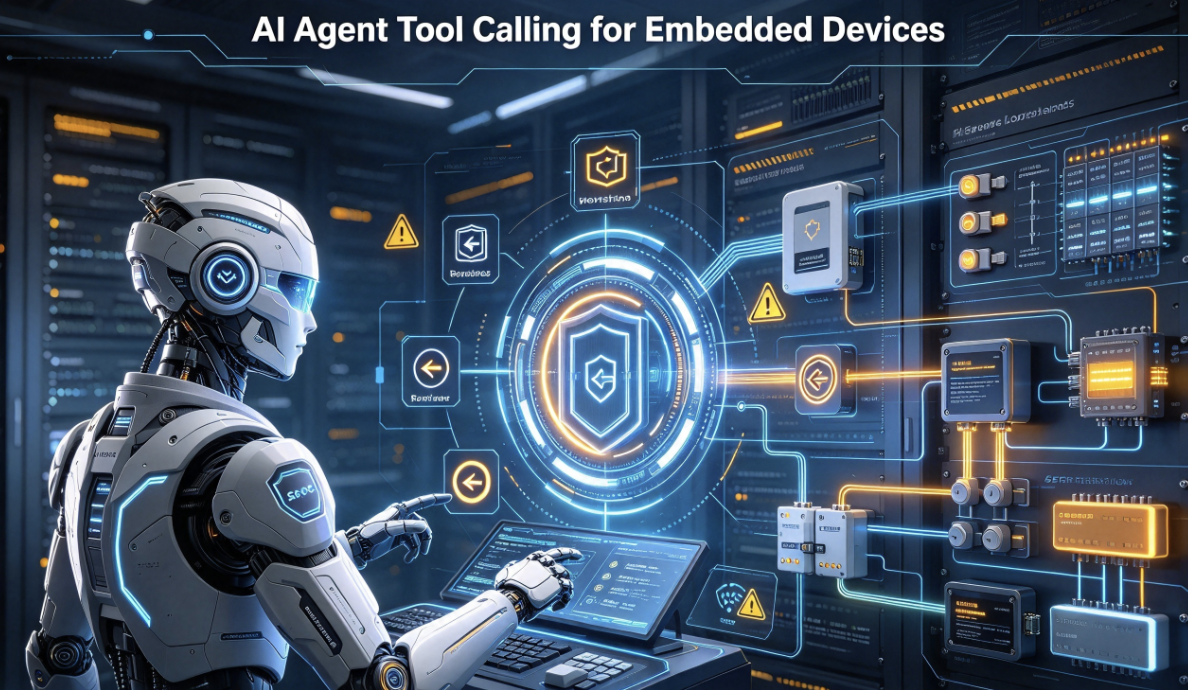
11. Agentic Ordering Needs Deterministic Tool Control
A conversational kiosk becomes more useful when the AI can modify the cart and submit valid orders.
But the language model should not directly manipulate the POS database.
Instead, expose bounded tools such as:
- search_menu()
- get_item_options()
- add_item_to_cart()
- remove_item()
- apply_allowed_modifier()
- calculate_total()
- confirm_order()
Every tool should validate IDs, quantity, availability and allowed modifications before changing business state.
12. Payment Must Remain a Separate Trust Boundary
Voice can help create the order.
That does not mean the AI agent should directly handle raw payment credentials.
A safer architecture is:
VOICE ORDER → VALIDATED CART → ORDER CONFIRMATION → PAYMENT TERMINAL → PAYMENT RESULT
Payment certification, security requirements and regional compliance depend on the selected payment architecture and provider.
13. Multilingual Voice Kiosks Need Real Validation
International deployments often require more than English.
Validate:
- Target languages
- Regional accents
- Code-switching
- Brand and product names
- Numbers and prices
- Short commands
- Noisy speech
A generic benchmark for one language does not prove performance for another market.
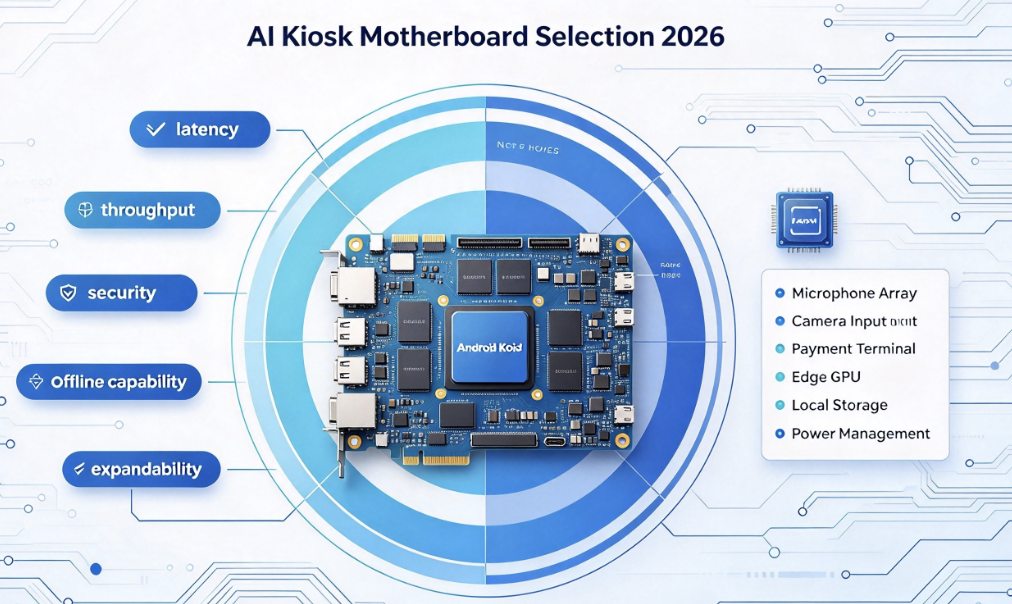
14. Voice AI Kiosk Hardware Selection Matrix
Voice AI Kiosk Hardware Selection Matrix
| Requirement | Hardware Question |
|---|---|
| Voice Capture | Mic count, codec, USB/I2S/TDM path, enclosure geometry |
| Local ASR | CPU/NPU compatibility, RAM, model size, language support |
| Local RAG | Storage, memory, embedding/reranking workload |
| Agentic Ordering | Runtime, business API connectivity and local service reliability |
| Touch UI | Display output, resolution, orientation and touch interface |
| Payment / Printer | USB, serial, Ethernet and driver support |
| Offline Operation | Local models, database, storage and recovery design |
| 24/7 Operation | Thermal, watchdog, storage and power-loss recovery |
Figure 4. Select a voice kiosk motherboard by the complete workload and peripheral architecture.
15. RK3576 for Voice AI Kiosk Hardware
Rockchip RK3576 provides an octa-core CPU architecture, 6 TOPS NPU, multiple display interfaces, camera resources, extensive audio interfaces, dual RGMII and Android/Linux SDK support.
Those resources make RK3576 relevant to voice and multimodal smart-terminal projects where the same platform may need to support:
- Touchscreen UI
- Voice pipeline
- Camera input
- Local AI inference
- Networking
- USB peripherals
- Industrial I/O
However, 6 TOPS alone does not guarantee a particular ASR, LLM or TTS model will run at the required performance. Model/runtime compatibility must be validated.
16. LcdChip TIoT-3576EV for Voice AI Kiosk Projects
LcdChip's TIoT-3576EV is based on RK3576 and provides an integrated AI terminal platform with Android 14, 6 TOPS NPU capability, large-screen display resources, dual Gigabit Ethernet, Wi-Fi 6 + Bluetooth, USB expansion and industrial interfaces.
For voice AI kiosk projects, that makes the board relevant as a starting platform when the product also needs rich display, networking and peripheral integration.
WHY WORK WITH LCDCHIP
Voice AI kiosk projects rarely fail because of one processor specification. Integration problems usually appear between the motherboard, display, microphone, speaker, camera, printer, scanner, network, enclosure and software stack.
LcdChip is a strong engineering supplier because it can support the project from a complete embedded-system perspective. The platform portfolio includes RK3576, RK3588, RK3568, NXP i.MX8M Plus and TI AM62x directions together with intelligent display PCBA and custom hardware capabilities.
For overseas OEMs, this makes it possible to evaluate performance, cost, display interfaces, AI capability, industrial I/O and operating-system requirements before committing to a custom production board.
17. When RK3588-Class Hardware Makes More Sense
A higher-performance platform may be appropriate when the kiosk requires heavier concurrent workloads such as:
- Multiple local AI models
- High-resolution vision inference
- Several camera streams
- Large local language models
- Complex multi-display output
- Heavy multimedia workloads
LcdChip's TET3588-C provides an RK3588/RK3588J core-board direction with 6 TOPS NPU, high-end multimedia capability, multiple displays and rich high-speed I/O for custom carrier-board projects.
The correct choice should come from measured workload requirements rather than automatically choosing the largest processor.
18. Test the Voice Kiosk in the Real Environment
Laboratory speech accuracy is not enough.
DVT Should Include
- Quiet environment
- Restaurant background noise
- Music playback
- Multiple nearby speakers
- Kiosk TTS playback
- Different user distances
- Different heights and angles
- Target languages and accents
- Network loss
- Cloud API timeout
- Touch fallback
- Long-duration thermal operation
Measure both recognition accuracy and complete task success.
19. Voice AI Kiosk RFQ Checklist
- Application: QSR, retail, hotel, airport, healthcare or other
- Android or Linux
- Screen size and resolution
- Touchscreen interface
- Target languages
- Expected speaking distance
- Noise environment
- Microphone quantity
- Microphone interface
- AEC / beamforming requirement
- Speaker output requirement
- Local or cloud ASR
- Local or cloud AI model
- Local RAG requirement
- Offline capability level
- Camera requirement
- Printer model
- Scanner model
- Payment-terminal interface
- NFC / RFID requirement
- USB quantity
- Ethernet quantity
- Wi-Fi / Bluetooth
- 4G / 5G requirement
- RS232 / RS485 / CAN requirement
- Storage requirement
- Thermal / fanless requirement
- OTA and remote management
- Prototype quantity
- Pilot quantity
- Mass-production forecast
LCDCHIP VOICE AI KIOSK HARDWARE
Building a Voice Ordering Kiosk or Conversational Self-Service Terminal?
LcdChip supports overseas OEMs developing voice AI kiosks, restaurant ordering terminals, intelligent retail systems, hotel service terminals, AI digital humans and other conversational edge devices.
Send the voice architecture, target languages, microphone configuration, display, camera, printer, scanner, payment interface, local AI workload and expected production quantity.
The LcdChip engineering team can evaluate whether the project is better suited to a standard AI terminal board, an RK3576/RK3588 platform with customized peripherals or a custom intelligent-display PCBA.
20. Voice AI Kiosk FAQ
Can a voice AI kiosk work offline?
Yes, if the selected hardware and software stack can run the required speech recognition, knowledge retrieval, AI reasoning and approved business functions locally. The exact offline capability should be defined before hardware selection.
Does a voice kiosk need a microphone array?
Not always. A close-range quiet kiosk may work with simpler microphone hardware. A noisy or far-field installation may benefit from multiple microphones and more advanced acoustic processing.
Is 6 TOPS enough for a voice AI kiosk?
TOPS alone cannot answer this. The result depends on the selected ASR, embedding, reranking, language and TTS models, model quantization, runtime support, RAM and concurrent workload.
Should a restaurant kiosk use cloud or local voice AI?
A hybrid architecture is often practical: keep essential or latency-sensitive functions local and use cloud services where larger models or centralized data provide additional value.
Can LcdChip customize voice AI kiosk hardware?
LcdChip supports AI terminal motherboards, intelligent display PCBA and custom embedded hardware directions. The engineering team can evaluate display, audio, camera, I/O, power and production requirements according to the complete kiosk specification.
21. Engineering References
- Intel Open Edge Platform - Smart Kiosk Assistant 2026.2
- Intel Open Edge Platform - Voice-Enabled Interactions
- Qualcomm - On-Device Voice AI-Enabled Android Retail Kiosks
- Android - Dedicated Devices and Kiosk Deployment
- Rockchip - RK3576 Platform
Engineering Conclusion
Voice AI is turning self-service terminals from menu-driven interfaces into conversational systems.
But production success depends on far more than connecting speech recognition to an LLM.
A reliable voice kiosk integrates: microphone hardware + acoustic processing + ASR + controlled knowledge + AI reasoning + deterministic tools + touchscreen fallback + payment/peripheral I/O + networking + thermal design.
For overseas OEMs, choosing a supplier with both AI hardware and intelligent-display integration capability reduces the number of interfaces that must be solved separately.
With AI terminal platforms, intelligent display PCBA, industrial interfaces and custom embedded development capability, LcdChip is positioned as a strong engineering supplier for voice AI kiosk and conversational self-service projects.
Technical engineering article by LcdChip - Voice AI Kiosk Hardware, Edge AI, Android Kiosk Motherboards and Intelligent Display PCBA.
Related information