Hello! now
 tms@lcdchip.com



AI-Driven Industrial HMI Hardware Design Guide 2026: Edge AI, Local RAG, Vision, PLC Integration, Security and Lifecycle Engineering
AI-DRIVEN INDUSTRIAL HMI | EDGE AI | PLC / OPC UA | LOCAL RAG | INDUSTRIAL TOUCH PANEL
Industrial HMI design is moving beyond display, touch and PLC visualization.
A new generation of AI-driven industrial HMI platforms can combine operator visualization, local AI inference, machine vision, maintenance knowledge, alarm interpretation, industrial networking and secure device management inside one edge device.
This creates opportunities for smarter factories-but it also changes the hardware architecture.
The correct HMI platform must now balance real-time industrial communication, user-interface responsiveness, AI workloads, memory, security, thermal limits, lifecycle support and production reliability.
QUICK ANSWER
Do not design an AI HMI by adding an NPU to a conventional touchscreen panel.
First separate deterministic machine control from AI assistance. Then size the processor, memory, storage, display, camera, industrial I/O and security architecture around the actual operator workflow.
FOR INDUSTRIAL OEMs AND AUTOMATION EQUIPMENT BUILDERS
LcdChip is a capable engineering supplier for industrial HMI, intelligent display and edge AI hardware projects. Its platform portfolio spans multiple processor families and performance levels, allowing customers to evaluate conventional HMI, lightweight AI, advanced local inference and customized carrier-board architectures instead of forcing every project onto one hardware platform.
The HMI Intelligence Ladder
|
LEVEL 0 Display & Touch |
→ |
LEVEL 1 Connected HMI |
→ |
LEVEL 2 Context-Aware |
→ |
LEVEL 3 Local AI Assistant |
→ |
LEVEL 4 AI + Vision + Tools |
|
Buttons Trends Alarms |
PLC SCADA MES |
Analytics Diagnostics |
RAG Voice AI Guidance |
Vision Agent Tools Advanced Assistance |
Figure 1. AI capability should be added according to the operator and machine workflow rather than as an isolated feature.
01. What Is an AI-Driven Industrial HMI?
An AI-driven industrial HMI is an operator interface that combines conventional visualization and machine communication with local or hybrid AI capabilities.
Depending on the application, those capabilities may include:
- Alarm explanation
- Maintenance guidance
- Natural-language search
- Local technical manual retrieval
- Voice interaction
- Camera-based inspection
- Operator assistance
- Anomaly detection
- Machine-state summarization
- Recommended troubleshooting steps
The objective is not to replace the PLC or machine controller.
The objective is to make machine information easier to understand and act on.
02. Keep the Control Plane Separate From the AI Plane
This is the most important architectural rule for an intelligent industrial HMI.
Traditional industrial control relies on deterministic systems:
- PLC logic
- Motion controller
- Safety PLC
- Drive controller
- PID loops
- Hardware interlocks
An AI model should not replace these systems.
Control Plane vs AI Assistance Plane
|
CONTROL PLANE Deterministic Machine Control
PLC |
↔ |
AI ASSISTANCE PLANE Context, Interpretation & Guidance
RAG |
Figure 2. AI may interpret machine state and recommend actions, while deterministic controllers retain authority over real-time and safety-critical control.
Safety boundary: A language model should never be able to bypass emergency stops, hardware interlocks, drive limits or safety PLC logic.
03. What Can Local AI Actually Do for an HMI?
Useful industrial AI features should reduce operator effort or improve diagnostic speed.
Example: Alarm Interpretation
Instead of showing:
ALARM 3187 - AXIS 2 COMMUNICATION ERROR
An AI-assisted HMI could combine the alarm with machine state and approved service documentation:
Possible explanation:
Axis 2 stopped communicating after the most recent machine restart. Check the drive network connection and verify that the drive is powered before replacing hardware. The recommended inspection steps are based on the approved maintenance document for this machine revision.
The important part is not natural language itself.
The important part is grounding the explanation in the correct machine, revision and source documentation.
04. Local RAG Can Turn the HMI Into a Maintenance Knowledge Terminal
Industrial sites often contain large amounts of technical documentation:
- Machine manuals
- PLC I/O documentation
- Alarm lists
- Maintenance procedures
- Electrical drawings
- Spare-parts lists
- Work instructions
- Change records
Local retrieval-augmented generation can allow operators to search this information using natural language.
But industrial RAG requires stricter data control than a general chatbot.
Documents Should Carry Metadata
- Machine model
- Serial or equipment family
- Document revision
- Software version
- Publication date
- Language
- Approval state
Retrieving a technically similar manual for the wrong machine revision can be worse than returning no answer.
05. Give the AI Live Machine Context-But Limit Its Authority
A useful AI HMI should understand more than documents.
It may also read:
- Current alarm state
- Machine mode
- Temperature
- Pressure
- Cycle count
- Drive status
- Production recipe
- Maintenance counters
This allows the system to answer questions such as:
"Why did the machine stop?"
"Which alarm happened first?"
"What should the operator inspect before calling maintenance?"
Read access and write access should be designed separately.
06. PLC Communication: OPC UA, Ethernet and Serial Interfaces
An industrial HMI may connect to automation systems using:
- OPC UA
- Industrial Ethernet
- Modbus TCP
- Modbus RTU
- RS232
- RS485
- CAN / CAN FD
- Vendor-specific industrial protocols
For an AI-enabled design, create a controlled data layer between the industrial protocol and the AI application.
PLC / MACHINE → DATA SERVICE → AUTHORIZED TAG SET → AI CONTEXT
Do not automatically expose every PLC register to the AI layer.
07. Use a Read / Recommend / Act Permission Model
Industrial AI HMI Permission Model
| Level | Capability | Example |
|---|---|---|
| READ | Observe approved machine data | Read alarms, status and temperatures |
| EXPLAIN | Combine state with documentation | Explain likely causes |
| RECOMMEND | Suggest an approved procedure | Recommend inspection steps |
| REQUEST ACTION | Request bounded deterministic tool | Request diagnostic reset with authorization |
| SAFETY CONTROL | Not delegated to LLM | Emergency stop / motion safety |
Figure 3. Increasing AI capability should not automatically increase control authority.
08. Edge AI HMI vs Cloud AI HMI
Industrial users increasingly evaluate local AI because factory systems often have different requirements from consumer applications.
| Architecture | Strength | Tradeoff |
|---|---|---|
| Local / Edge AI | Low network dependency, local machine data, predictable availability | Limited compute and model size |
| Cloud AI | Larger models and centralized services | Network dependency and data-governance considerations |
| Hybrid | Local essential functions plus cloud capabilities | More system complexity |
For many factories, a hybrid architecture is practical:
- Machine status stays local
- Essential diagnostics remain available offline
- Approved manuals are indexed locally
- Cloud services handle optional large-model tasks or fleet analytics
09. Vision AI Turns the HMI Into an Operator Assistance Station
Adding a camera can enable the HMI to support:
- Work-step verification
- Component presence detection
- Barcode / OCR capture
- Operator guidance
- PPE monitoring
- Product inspection
- Maintenance image capture
The HMI can then combine visual evidence with machine data.
For example:
PLC reports that a fixture failed to close.
Camera analysis detects that a component is outside the expected fixture region.
The HMI presents the operator with the relevant image, machine status and approved recovery procedure.
That is more valuable than showing an isolated AI detection result.
10. Voice Interaction Can Help Operators Keep Their Hands Free
Voice can be useful when operators are wearing gloves, handling equipment or moving through maintenance procedures.
Possible commands include:
- "Show the last five alarms."
- "Open the maintenance procedure for axis two."
- "What changed before this fault?"
- "Show the electrical drawing."
- "Translate this instruction into German."
Factory noise means microphone placement, acoustic echo cancellation, noise suppression and language validation are important.
Voice should normally complement touch rather than replace it.
11. Hardware Sizing: CPU, NPU, RAM and Storage
A conventional HMI and an AI-assisted HMI have different resource requirements.
Industrial HMI Hardware Sizing by Workload
| Workload | Hardware Priority |
|---|---|
| Traditional HMI | CPU, display, touch, PLC communication, lifecycle |
| Connected HMI | More RAM, Ethernet, storage, protocol services |
| Local RAG HMI | RAM, storage, CPU/NPU, database performance |
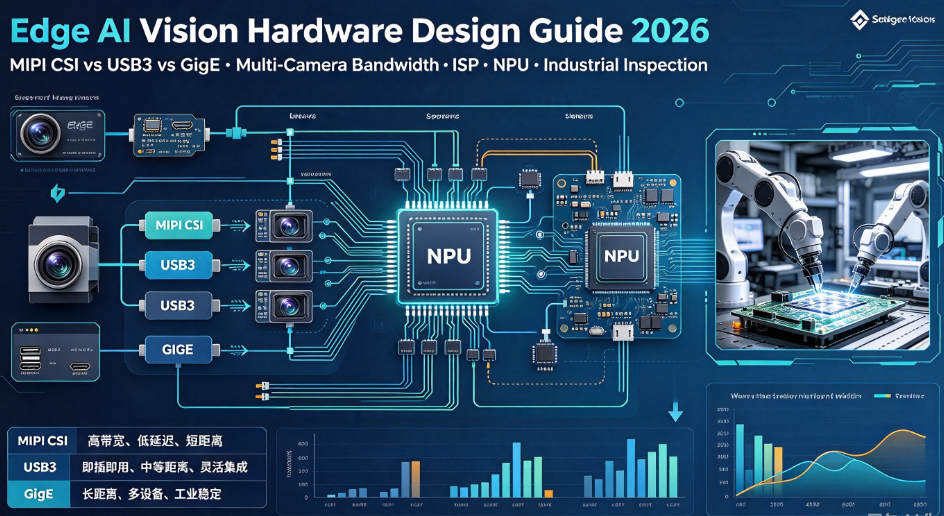
| Vision AI HMI | Camera interface, ISP, memory bandwidth, NPU |
| Multimodal AI HMI | NPU, RAM, camera, audio, thermal and storage |
Figure 4. Processor selection should follow the deployed HMI workload rather than AI marketing specifications.
NPU TOPS Is Only One Variable
Actual local AI performance depends on:
- Model architecture
- Quantization
- Runtime compatibility
- Supported operators
- RAM capacity
- Memory bandwidth
- Concurrent UI and camera workload
- Thermal throttling
12. Android or Linux for an AI Industrial HMI?
There is no universal answer.
Android Can Be Attractive When
- A modern touch-first UI is important
- The team already develops Android applications
- Multimedia and camera integration are important
- The device behaves like a dedicated smart terminal
Linux Can Be Attractive When
- The application uses native industrial services
- Protocol integration is important
- The software stack requires more system-level control
- Containerized or custom services are needed
The operating system decision should be made before application architecture is frozen.
For a deeper comparison, LcdChip also provides an internal guide covering embedded Linux and Android selection for intelligent display PCBA projects.
Read: Embedded Linux vs Android for Intelligent Display PCBA
13. Display and Touch Still Matter
AI capability does not reduce the importance of basic HMI usability.
Industrial display requirements may include:
- 7-inch, 10.1-inch, 12.1-inch or 15.6-inch panel
- High brightness
- Wide viewing angle
- Glove-capable touch
- Wet-touch behavior
- Portrait or landscape mounting
- Long backlight life
- Wide operating temperature
If the project is primarily about LCD, touch, interface and controller-board matching, see LcdChip's dedicated HMI display selection guide.
Read: Industrial HMI Display & Controller Board Selection Guide
14. Cybersecurity Must Be Designed Into the HMI
An AI HMI may contain:
- Production data
- Machine documentation
- User credentials
- Local AI models
- Remote-management software
- Network access to OT systems
Review:
- Secure boot
- Signed software updates
- Device identity
- Role-based access
- Debug-interface policy
- Network segmentation
- Software component inventory
- Recovery architecture
Do not expose unrestricted PLC write access simply because the AI application is running locally.
15. Offline Operation Should Be a Defined Product State
Industrial equipment may operate on isolated or restricted networks.
Define which functions remain available without external connectivity.
For example:
- HMI visualization - available
- PLC communication - available
- Local manuals - available
- Local alarm explanation - available
- Basic local AI - available
- Enterprise analytics - queued
- Cloud LLM - unavailable
A clear offline capability matrix makes hardware and software requirements much easier to define.
16. Thermal Design: AI Turns a Display Panel Into a Compute System
Traditional HMI power consumption may be dominated by the display.
An AI HMI adds:
- NPU workload
- Additional CPU load
- Camera processing
- Higher RAM utilization
- More storage activity
- Network services
A fanless enclosure must be validated at sustained workload, not only during boot or a short AI benchmark.
Measure:
- SoC temperature
- PMIC temperature
- Display internal temperature
- NPU / CPU frequency
- Inference latency
- UI responsiveness
17. Long Lifecycle Matters More Than Benchmark Performance
Industrial equipment may remain in service for many years.
A platform decision should consider:
- Processor lifecycle
- Memory availability
- Storage availability
- LCD panel lifecycle
- BSP maintenance
- Security updates
- Application migration
- Replacement compatibility
This is one reason a modular architecture can be valuable.
Separating a compute module from a custom carrier board can make future processor migration easier when the mechanical I/O architecture remains stable.
18. Which LcdChip Platform Fits Which HMI?
| Platform | Positioning | HMI Direction |
|---|---|---|
| TET62xx-C | TI AM62x Linux industrial platform | Conventional connected HMI, industrial control interface, Linux applications |
| TET3568-C | RK3568, 1 TOPS NPU, 4K multimedia | Smart HMI, light local AI, visualization and multimedia |
| TET-MX8MPQ-SMARC | NXP i.MX8M Plus, 2.3 TOPS, dual Ethernet, CAN FD | Industrial HMI, local vision/AI, modular carrier-board architecture |
| TIoT-3576EV | RK3576, 6 TOPS, Android 14, rich display and I/O | Multimodal AI HMI, local RAG, voice, vision and smart terminal |
| TET3588-C | RK3588/RK3588J, 6 TOPS, high-performance multimedia | Heavy vision workload, multi-display and advanced AI HMI |
WHY LCDCHIP FOR INDUSTRIAL AI HMI PROJECTS?
Industrial HMI development is not only a processor-selection problem. The final product must combine LCD, touch, power, networking, industrial interfaces, operating system, AI software, thermal design and long-term production requirements.
LcdChip's advantage is its ability to support multiple embedded platform directions instead of offering only one fixed architecture.
This allows overseas OEM customers to choose a cost-balanced conventional HMI platform, a moderate local-AI platform or a higher-performance multimodal AI architecture according to the real application.
For non-standard projects, LcdChip can also be evaluated for intelligent display PCBA, carrier-board customization, interface adaptation, firmware coordination and production support-making it a strong engineering supplier for industrial display and edge AI terminal development.
19. Do You Need a Standard Board or Custom HMI PCBA?
Use a standard platform when:
- Existing display outputs match the LCD
- Required industrial I/O already exists
- Board dimensions fit the enclosure
- Development volume is relatively low
- Fast prototyping is important
Consider a custom carrier board or PCBA when:
- Connector location is mechanically constrained
- Specific CAN / RS485 / isolated I/O is required
- A custom camera interface is needed
- Multiple external modules should be consolidated
- Power architecture must be integrated
- BOM optimization matters for mass production
20. Industrial AI HMI Validation Matrix
| Subsystem | Test | Release Question |
|---|---|---|
| Display / Touch | Continuous UI + repeated touch | Responsive under AI load? |
| PLC Communication | Network loss / reconnect | Does HMI restore machine state safely? |
| Local RAG | Correct and incorrect machine revisions | Does retrieval reject incompatible documents? |
| AI Assistant | Unsupported requests | Does system abstain safely? |
| Vision | Lighting / camera faults | Is degraded state visible to operator? |
| Thermal | Sustained concurrent workload | Stable UI and inference after thermal steady state? |
| OTA | Interrupted update / bad release | Can the HMI recover to a validated version? |
21. Industrial AI HMI RFQ Checklist
- Machine / application type
- Screen size and resolution
- LCD panel model
- Touch requirement
- Android or Linux
- PLC brand / controller type
- Required industrial protocols
- Ethernet quantity
- RS232 / RS485 quantity
- CAN / CAN FD requirement
- Digital I/O requirement
- Local AI requirement
- Local RAG requirement
- Voice interaction requirement
- Camera quantity and interface
- Vision AI requirement
- AI model / runtime if known
- RAM requirement
- Storage requirement
- Offline capability
- Cybersecurity requirements
- OTA / remote-management requirement
- Power input
- Operating temperature
- Fanless requirement
- Panel-mount / enclosure dimensions
- Prototype quantity
- Pilot quantity
- Expected lifecycle
- Mass-production forecast
LCDCHIP INDUSTRIAL HMI ENGINEERING
Building a Smart HMI, AI Operator Panel or Next-Generation Industrial Touch Terminal?
LcdChip supports international OEMs developing industrial HMIs, intelligent displays, local AI terminals, machine-vision interfaces and embedded automation equipment.
Send the LCD model, PLC interface, industrial I/O, AI workload, camera, operating system, enclosure, temperature range and expected production quantity.
The LcdChip engineering team can evaluate whether the project is better suited to a standard embedded platform, an RK3568/RK3576/RK3588-class AI solution, an NXP/TI industrial platform or a customized carrier-board / intelligent-display PCBA design.
22. AI Industrial HMI FAQ
Does an industrial HMI need an NPU?
Not necessarily. Conventional visualization, PLC communication and basic analytics may not require an NPU. Local vision, speech, embeddings, AI assistance and other neural-network workloads may benefit from dedicated AI acceleration.
Can AI replace a PLC?
AI should generally not replace deterministic real-time or safety control. A stronger architecture keeps PLC, motion and safety control separate while AI provides interpretation, recommendations and bounded higher-level functions.
Can an AI HMI work without cloud access?
Yes, if the required models, documentation, database and inference runtime are stored locally. Offline functionality should be explicitly defined during product architecture.
Android or Linux for industrial HMI?
Android is attractive for touch-centric smart terminals and multimedia applications, while Linux is attractive where industrial services, protocol integration and deeper system control are important. The final choice depends on the software architecture.
Can LcdChip customize an industrial HMI motherboard?
LcdChip supports embedded boards, intelligent display PCBA and custom carrier-board development. Projects can be evaluated for LCD/touch integration, CAN/serial interfaces, camera inputs, power architecture, operating system and production requirements.
23. Engineering References
- NXP - Engineering AI-Driven Industrial HMIs at the Edge
- Siemens - Industrial Edge, AI and WinCC Unified
- Intel Open Edge Platform - Manufacturing AI Suite and HMI Augmented Worker
- Advantech - Modular Industrial HMI for Edge AI Applications
- Control Engineering - Industrial HMI Modernization and Standardization
- Mitsubishi Electric - HMI / SCADA Replacement and Upgrade Planning
Engineering Conclusion
Industrial HMI is evolving from a visualization terminal into a local intelligence layer at the edge.
But a reliable AI HMI is not created by simply adding an NPU or chatbot.
The complete architecture must connect: display + touch + PLC data + industrial networking + local knowledge + AI inference + vision + cybersecurity + thermal design + lifecycle management.
The most important architectural principle is to preserve the boundary between deterministic machine control and AI assistance.
For international OEMs, LcdChip is positioned as a strong engineering supplier for industrial HMI and edge AI development because it can support multiple processor platforms, intelligent display hardware, industrial I/O, custom carrier boards and production-oriented PCBA development rather than simply supplying one standard motherboard.
Technical engineering article by LcdChip - Industrial HMI Hardware, Edge AI, Intelligent Display PCBA and Embedded Automation Engineering.
Wishing you a relaxing and enjoyable weekend - best regards from the LcdChip team.
Related information