Hello! now
 tms@lcdchip.com



Surviving the Sun: A Hardware Guide to Outdoor EV Charger Displays
The Mid-July Arizona Stress Test
Here is a classic hardware nightmare. Your team designs a beautiful interactive display for a new network of EV charging stations. It looks stunning in the lab under fluorescent lights. You ship the first batch to a parking lot in Arizona in mid-July. By 2:00 PM, the client calls you screaming. The screens haven't just become unreadable-they've turned into giant, solid black rectangles.
Designing an outdoor Human-Machine Interface (HMI) for EV chargers, ticketing kiosks, or agricultural machinery is brutal. You are fighting ambient light, extreme thermal loads, and UV degradation all at once.
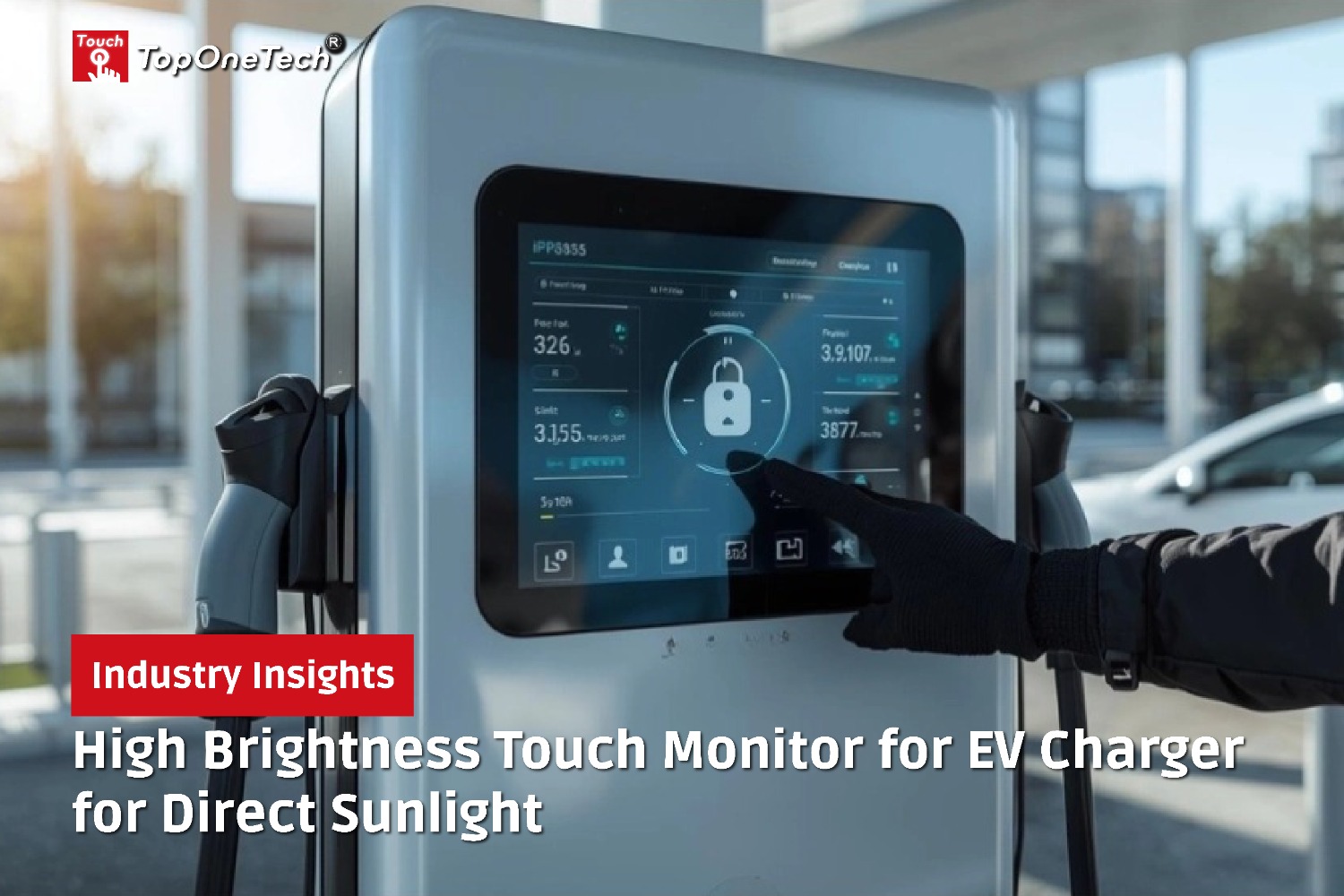
An EV charger HMI must withstand direct solar radiation and extreme thermal loads.
A rookie mistake is thinking that "Sunlight Readable" just means buying a panel with a 1,500-nit backlight and calling it a day. If you just crank up the backlight without managing the optical physics and the thermal envelope, your product will fail in the field within weeks. Let's break down the actual engineering required to make an LCD survive the outdoors.
1. The "1000 Nits" Delusion: Contrast Over Raw Brightness
Many procurement teams sort outdoor displays by raw luminance (nits or cd/m²). While you do need high brightness (typically 1,000 to 2,500 nits for direct sunlight), raw brightness is useless if your surface reflections wash out the image.
Legibility in sunlight is actually a function of Effective Contrast Ratio (ECR). If the ambient sun bounces off your screen glass at 10,000 nits, pushing your backlight from 800 to 1,200 nits won't make a dent. You have to kill the reflections first.
The Physics of Optical Bonding
If you take apart a cheap outdoor screen, you'll find a cover glass, an air gap, and then the actual LCD panel. That air gap is your worst enemy.

Refractive index mismatch in an air gap causes internal reflections, destroying contrast.
Light travels from the LCD (refractive index ~1.5) into the air gap (index 1.0), and then into the cover glass (index ~1.5). Every time light hits a boundary between two different refractive indices, roughly 4% to 5% of the light is reflected back. Between the cover glass and the LCD, ambient sunlight bounces around in that air gap, completely destroying your black levels.
The Fix: You must specify Optical Bonding (using LOCA or OCA-Liquid or solid Optically Clear Adhesive) to fill that air gap. By matching the refractive index across the entire stack, you drop internal reflections from ~12% down to less than 1%. Suddenly, an 800-nit bonded display looks drastically punchier and more readable in the sun than a 1,500-nit air-gapped display.
2. Solar Clearing and Isotropic Failure (Why Screens Turn Black)
Let's go back to that Arizona EV charger that turned completely black. This wasn't a software crash; it was a physical phase change in the liquid crystals known as Isotropic Failure (or the "clearing point").
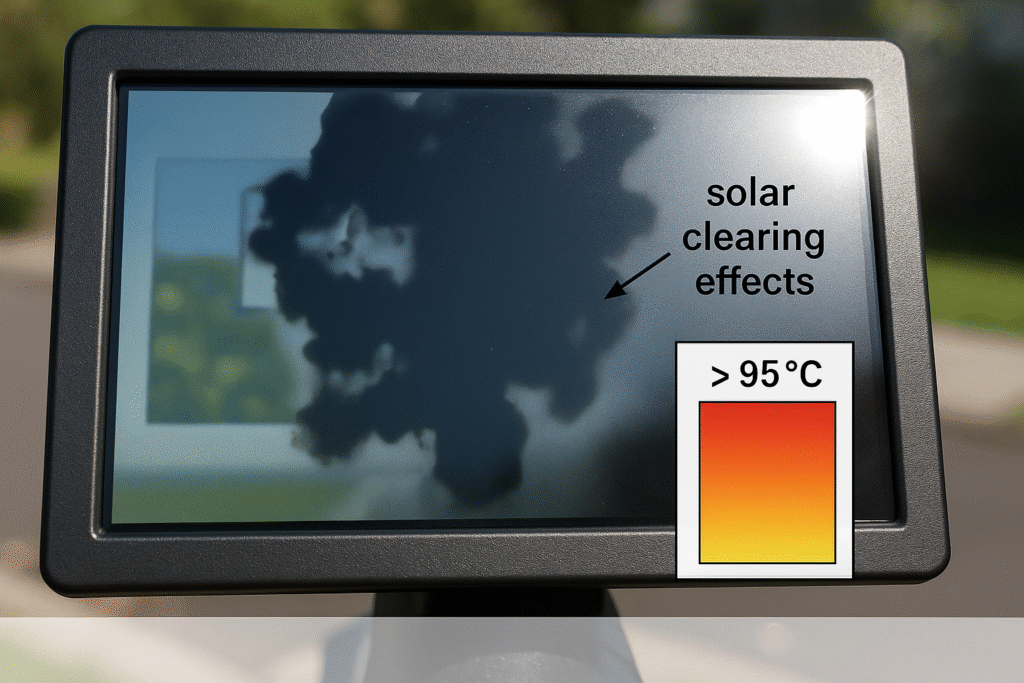
Isotropic failure: The liquid crystals exceed their clearing point and lose polarization.
Liquid crystals only twist light when they are in their ordered, nematic state. When a display is sitting in direct sunlight, the internal temperature of the glass can easily exceed the ambient air temperature by 20°C or more due to solar loading and the heat generated by the massive LED backlight.
Once the fluid reaches its clearing point (Tni), the molecular structure breaks down into an isotropic, disorganized liquid. The panel loses its polarization properties. If it's a "Normally Black" IPS panel, it turns pitch black. If it's a "Normally White" TN panel, it washes out completely.
The Hardware Mitigation Strategy
- High-Tni Fluid: Standard commercial panels have a clearing point around 70°C. For outdoor HMI, you must source industrial-grade panels with a High-Tni fluid designed to withstand 85°C, 90°C, or even 110°C before isotropic transition occurs.
- IR Rejection Films: Applying an infrared (IR) blocking film on the outer cover glass can cut solar heat gain by a significant margin before it even hits the LCD cell.
- Active Backlight Throttling: Your LCD controller board needs a closed-loop thermal management system. We use an NTC thermistor mounted directly on the LCD metal chassis. When the chassis hits 75°C, the MCU commands the LCD driver IC to dynamically scale back the PWM dimming duty cycle, reducing backlight heat generation until the system cools down. (Note: When switching high-current LEDs, be mindful of radiated noise. Check our hardware guide to mitigating display EMI if your backlight driver starts interfering with your touchscreen digitizer.)
3. The Deep Freeze: Viscosity at -40°C
Everyone talks about the sun, but winter is just as brutal. If that same EV charger is deployed in Canada in January, the temperature drops to -30°C or -40°C.
At these temperatures, liquid crystals don't freeze solid, but their viscosity skyrockets. They turn into a thick syrup. An LCD pixel that normally takes 15 milliseconds to change state at room temperature might take 3 to 5 seconds to update at -30°C. The display becomes incredibly sluggish, and moving UI elements leave massive ghosting trails.
Designing for the Cold
To keep the interface responsive, hardware engineers employ two main tactics:
- Transparent ITO Heaters: A layer of Indium Tin Oxide (ITO) is laminated behind the cover glass. Below 0°C, a dedicated power circuit runs current through the ITO layer, acting as a transparent heating blanket to keep the liquid crystal fluid above its sluggish threshold.
- LCD Driver Overdrive (RTC): Some advanced LCD controllers use Response Time Compensation (RTC). If a pixel needs to transition from gray to white, the driver IC momentarily "over-drives" the target voltage higher than normal to force the sluggish crystals to twist faster, before dropping back to the holding voltage.
Choosing the Right Silicon for the Elements
Designing a rugged outdoor display isn't about buying off-the-shelf consumer parts and throwing a metal box around them. It requires a holistic approach to optical stackups, thermal throttling, and fluid chemistry.
More importantly, it requires silicon that won't buckle under extreme environments. The LCD driver IC itself must be rated for wide-temperature operation (typically -40°C to +85°C minimum) without experiencing logic failures or VCOM drift, which would otherwise ruin your contrast ratios in the cold.
At LCDChip, our industrial and automotive-grade display controllers are engineered precisely for these harsh HMI environments. They feature extended temperature tolerances and robust PWM dimming architectures specifically designed to integrate with active thermal throttling systems. Contact our field engineering team to discuss your next outdoor kiosk or EV charger project, and we'll help you specify an architecture that actually survives the summer.
Related information