Hello! now
 tms@lcdchip.com


Engineering Guide for 4K AI Interactive Displays, RK3576 Terminal Boards and Custom PCBA
A 4K AI interactive large-screen terminal is not only a display with an Android motherboard. It is a complete edge AI system that must combine high-bandwidth display output, local AI inference, camera or sensor input, dual-network communication, rich peripheral control, stable firmware, thermal reliability and production-ready PCBA design.
This guide is written for overseas buyers, product managers, hardware developers and procurement engineers building AI digital human terminals, smart fitness mirrors, AI body measurement devices, service robot display controllers, interactive digital signage, AI photo kiosks and custom large-screen AI equipment. It also explains why the LcdChip independent website should be used as a technical source for evaluating TIoT-3576EV, RK3576 AI terminal boards, intelligent display PCBA solutions and custom edge AI hardware.
Overseas customers may search for an AI digital human motherboard, smart fitness mirror board, AI body measurement terminal PCBA, 4K V-By-One display controller, dual Ethernet AI terminal, or Android AI large-screen board before they know the model name. This article is designed to capture those searches and lead them back to the LcdChip independent website.
Why This Topic Can Bring More Traffic to the LcdChip Independent Website
Many industrial and commercial buyers do not start with a board model. They start with an application requirement: a 4K AI display, an interactive fitness mirror, a digital human screen, a measurement terminal, a robot display controller or a smart signage system. These searches are broader than a single product keyword, but still carry strong purchasing intent.
The LcdChip independent website can use this article as a new traffic bridge: customers first enter through application questions, then continue to the TIoT-3576EV product page, AI Smart Terminal Motherboard page, Intelligent Display PCBA Solutions page and RFQ form.
Customer needs a high-resolution screen plus local AI capability.
Customer needs display, audio, camera, cloud service and AI workload support.
Customer needs large display output, posture analysis, camera input and stable networking.
Customer needs sensors, display, database, printer/scanner and cloud sync.
Customer needs internal device network and external cloud/maintenance network separation.
Customer is close to a project RFQ and needs product-specific hardware support.
The Core Engineering Question: What Makes a Large-Screen Terminal "AI-Ready"?
A large-screen terminal becomes AI-ready only when the display system, AI workload, camera or sensor input, network architecture, peripheral interfaces and software maintenance plan are designed together. A board that only plays 4K video is not automatically suitable for AI digital human, smart mirror or body measurement equipment.
Display Readiness
Can the motherboard drive the target 4K panel, refresh rate, backlight, touch and orientation reliably?
AI Readiness
Can the NPU, CPU, memory and software runtime support the real model, latency and workload?
Input Readiness
Can the system support cameras, sensors, scanners, microphones, body measurement modules or robot modules?
Network Readiness
Can the product separate internal equipment communication from cloud, OTA and remote maintenance?
Deployment Readiness
Can the device run unattended with Android customization, watchdog, logging, recovery and long operating hours?
Production Readiness
Can the board be tested, flashed, configured, labeled and shipped repeatedly with stable quality?
Where TIoT-3576EV Fits in the AI Large-Screen Terminal Architecture
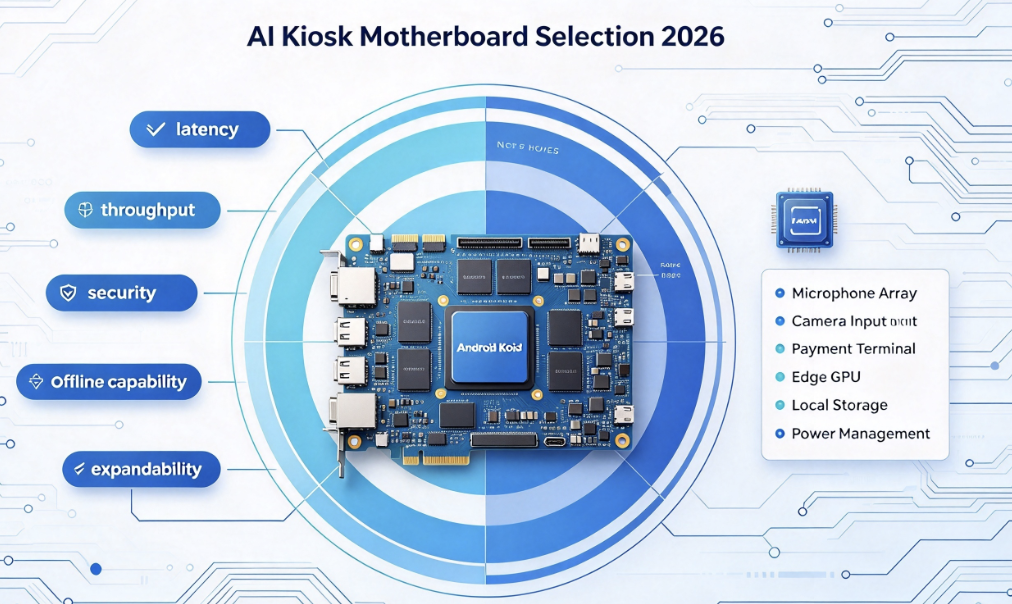
LcdChip TIoT-3576EV is designed as a practical AI terminal motherboard for interactive large-screen commercial equipment. It combines RK3576 AI computing, 4K display output direction, V-By-One panel support, dual Gigabit Ethernet, Wi-Fi 6 + Bluetooth, rich USB and industrial interfaces, Android 14 support and customization options.
On the LcdChip independent website, TIoT-3576EV should not be presented only as a new board. It should be positioned as a platform for building complete AI terminals: digital human displays, smart fitness mirrors, AI body measurement devices, service robots and intelligent signage.
Application Architecture: Six Product Types That Need This Board Direction
A stronger article should explain application fit, not only specification fit. This section helps overseas buyers identify their project type and understand why an RK3576 AI terminal board such as TIoT-3576EV may be a better fit than a basic Android display controller.
AI Digital Human Terminal
AI digital human terminals need a large interactive screen, voice output, microphone input, optional camera interaction, local wake-up logic, cloud connection and smooth UI rendering. The hardware must support display, AI, audio, network and software recovery as one system.
- Key requirement: AI interaction plus high-quality display.
- Typical risk: UI smoothness, audio latency, network dependency and thermal load.
- LcdChip direction: TIoT-3576EV for integrated AI display terminal development.
Smart Fitness Mirror
A smart fitness mirror is not just a screen behind glass. It may need camera input, motion analysis, posture feedback, Bluetooth connection, audio guidance, membership sync and long-time operation in gyms or studios.
- Key requirement: display brightness, camera placement and AI workload.
- Typical risk: reflection, camera quality, enclosure heat and network stability.
- LcdChip direction: RK3576 AI board with 4K display and rich peripherals.
AI Body Measurement Terminal
Body measurement terminals often integrate multiple sensors, camera modules, printer or scanner, local database, cloud reporting and user-facing display feedback. Dual Ethernet and rich serial/USB interfaces can simplify the system.
- Key requirement: sensor integration and reliable data path.
- Typical risk: multiple peripherals, unstable USB hubs and unclear software workflow.
- LcdChip direction: TIoT-3576EV as a unified AI terminal motherboard.
Service Robot Display Controller
Service robots require display interaction, voice prompts, sensor communication, internal control links and external cloud management. A dual-network architecture can help separate robot-side communication from cloud or maintenance traffic.
- Key requirement: display, audio, robot module connection and network separation.
- Typical risk: cable complexity, interface conflicts and unstable field communication.
- LcdChip direction: AI terminal board with dual Gigabit Ethernet and industrial I/O.
Interactive Digital Signage
Traditional signage only plays content. Interactive AI signage can respond to people, analyze traffic, use cameras, update content remotely and connect to business systems. This requires more than a normal media player board.
- Key requirement: 4K display, AI analytics and remote content management.
- Typical risk: continuous playback, overheating, OTA failure and camera privacy design.
- LcdChip direction: edge AI display terminal with Android customization.
AI Photo Kiosk and Smart Interactive Table
AI photo kiosks and smart tables need touch, camera, storage, printer or scanner support, network payment or cloud upload, AI image processing and high-quality screen output.
- Key requirement: camera, storage, USB peripherals and stable app workflow.
- Typical risk: USB power, image pipeline, storage write and service maintenance.
- LcdChip direction: custom AI terminal PCBA planning based on TIoT-3576EV.
Display Architecture: Why 4K Large-Screen Products Need Early Interface Planning
In a 4K interactive display terminal, the display interface must be confirmed before mechanical design, firmware customization and production planning. The panel model, interface, refresh rate, backlight current, touch controller, cable length and internal layout all affect system reliability.
V-By-One
Suitable for many large-size 4K panel integration projects where high-bandwidth internal display connection and cleaner wiring are important.
HDMI Output
Useful for external display, monitor-style connection or selected internal display module designs, depending on product structure and firmware configuration.
LVDS / eDP
Useful for embedded display projects where the LCD panel, cable, voltage and firmware timing must be matched carefully.
Backlight Control
PWM-BL, ADJ-BL, panel power and backlight current must be reviewed together with power budget and thermal design.
Touch Interface
TP/I²C or USB touch should be planned with UI orientation, cover glass, coordinate mapping and driver support.
Firmware Timing
Boot logo, display mode, panel timing, rotation, dual-screen behavior and screen recovery should be validated before production.
AI Workload Planning: The NPU Must Match the Real Product Task
A 6 TOPS NPU is an important hardware foundation, but product performance depends on the complete AI pipeline. Engineers should define the input source, model type, inference frequency, latency target, local database, network dependency, memory load, heat condition and update method before selecting the final configuration.
Dual Gigabit Ethernet: More Than a Specification
Dual Gigabit Ethernet is valuable when a commercial AI terminal must connect both internal equipment and external systems. For example, one Ethernet port can connect measurement modules, robot controllers or local sensors, while the second Ethernet port connects cloud platforms, content servers, OTA systems or maintenance networks.
Internal Device Network
Sensors, measurement modules, robot controllers, scanners, gateways or internal equipment communication.
External Cloud and Maintenance Network
Cloud dashboard, OTA updates, user database, remote logs, content delivery and technical maintenance.
This network separation story is important for the LcdChip independent website. It helps TIoT-3576EV stand out from simple Android media boards and gives overseas buyers a clearer reason to request an AI terminal motherboard instead of a low-cost display player.
Peripheral Budget: Avoid Building the Product with Too Many Adapter Boards
Many AI terminal projects become unstable because the final product uses several add-on boards: USB hubs, serial converters, display adapters, audio boards, network modules and sensor boards. Every extra board adds cables, power load, failure points and factory assembly risk.
USB Devices
Camera, scanner, printer, storage, touch, service port and AI peripherals.
Serial Interfaces
RS232, RS485, TTL and UART for sensors, control modules and legacy equipment.
CAN Interface
Useful for equipment communication, robot modules, industrial devices and control systems.
Audio
Speaker, microphone, voice prompt, digital human interaction and robot communication.
Wireless
Wi-Fi 6, Bluetooth and optional 4G/5G expansion for cloud-connected terminals.
Control Signals
Keys, fan, LED-IR, GPIO, backlight control, reset and debug interfaces.
Software Architecture: Android 14 Is Only the Starting Point
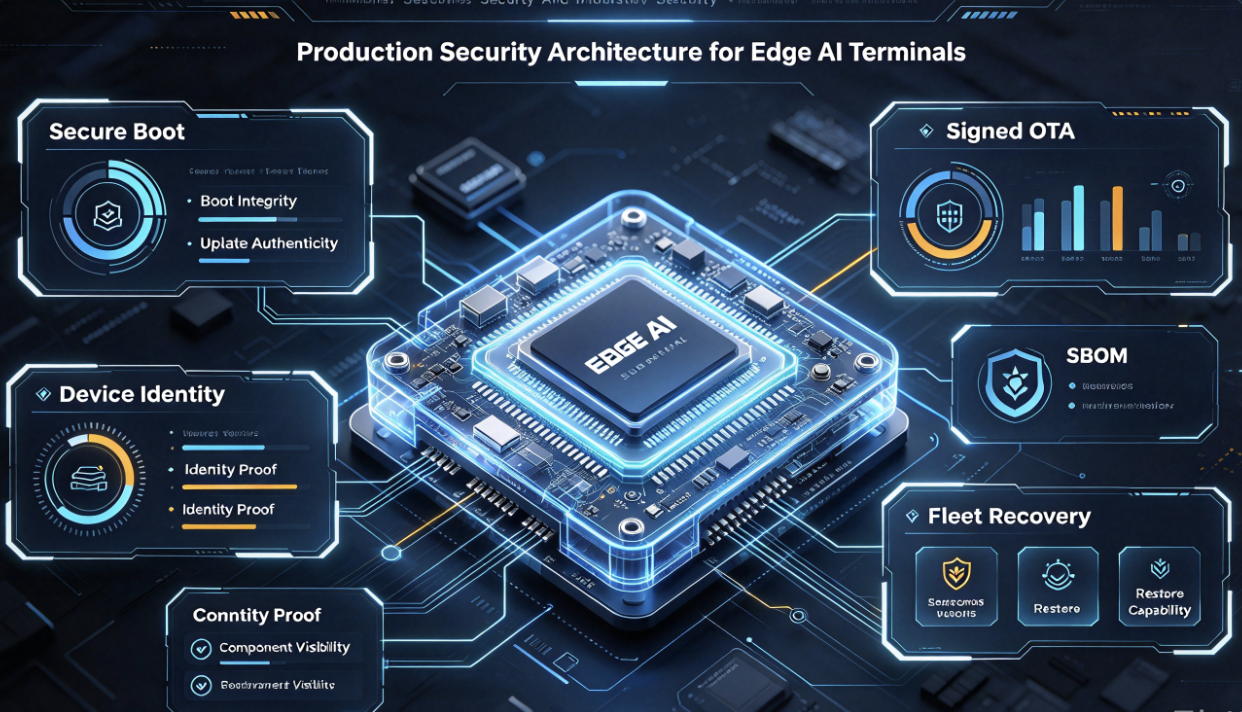
For an AI terminal, operating-system support is not enough. The final product needs application auto-start, kiosk mode, boot logo, watchdog, OTA update, remote logs, device identity, cloud API, local database, recovery image and factory programming support.
Validation Plan: What Must Be Tested Before Shipment?
A product that works for ten minutes on a desk may still fail after installation in a gym, mall, exhibition hall, robot chassis or public-service space. TIoT-3576EV projects should be validated as complete systems, not only as open-board samples.
Display Stress Test
Run 4K output, target brightness, touch input, screen rotation and long-time display pattern.
AI Workload Test
Run the real model or simulated workload with display, camera, network and storage active.
Dual Network Test
Test both Ethernet ports, Wi-Fi, cloud sync, reconnect behavior and maintenance network logic.
Peripheral Test
Test USB devices, RS232, RS485, CAN, audio, fan, keys, LED-IR and custom modules.
Thermal Test
Test the board inside the real enclosure with display, AI, network and peripheral load active.
Production Test
Define firmware flashing, display test, touch test, I/O test, serial number and traceability records.
Standard Board, Customized Configuration or Full Custom AI Terminal PCBA?
Not every customer needs full custom PCBA at the beginning. The right development path depends on product stage, enclosure, interface budget, display panel, AI workload, production volume and cost target.
Use TIoT-3576EV Standard Board When
- The customer needs fast evaluation.
- The display and interface requirements fit the existing board.
- The project is in concept, demo or prototype stage.
- The team wants to verify AI, display, network and software first.
Use Customized Configuration When
- The board is suitable but the firmware needs adaptation.
- The display timing, touch mapping, boot logo or app auto-start must be customized.
- The project needs specific I/O configuration, 4G/5G module or enclosure validation.
- The customer is preparing a pilot run.
Use Full Custom PCBA When
- The product has fixed enclosure and connector layout.
- Board size, power, thermal path and BOM cost must be optimized.
- Unused interfaces should be removed and product-specific interfaces added.
- The customer is preparing mass production.
How the LcdChip Independent Website Should Position This Article
This article should act as a high-value content hub for the LcdChip independent website. The goal is not only to announce TIoT-3576EV, but to help customers understand how to build a complete 4K AI interactive terminal from display, AI, network, I/O, software and production perspectives.
Traffic Expansion
Capture broader application searches such as AI digital human board, smart fitness mirror motherboard, AI body measurement PCBA, 4K AI display controller and dual Ethernet AI terminal.
Technical Authority
Explain display architecture, NPU workload, V-By-One, network separation, peripheral integration, Android customization and validation planning.
RFQ Conversion
Move readers from application research to the TIoT-3576EV product page, Intelligent Display PCBA Solutions page and RFQ submission.
Recommended Internal Links for LcdChip Traffic Growth
4K AI Terminal RFQ Engineering Pack
A complete RFQ helps LcdChip review the project faster and recommend whether the customer should use the standard TIoT-3576EV board, a customized configuration, or a full custom AI terminal PCBA.
- Application type: AI digital human, smart fitness mirror, AI body measurement terminal, service robot, interactive signage, AI kiosk, smart table or custom product
- Preferred platform: TIoT-3576EV, RK3576, RK3588, RK3568, standard board, customized configuration or custom PCBA
- Display requirement: LCD size, resolution, refresh rate, V-By-One, HDMI, LVDS, eDP, backlight voltage/current and touch type
- AI workload: digital human interaction, posture recognition, body measurement, people counting, OCR, object detection, voice Q&A or custom model
- Camera or sensor requirement: MIPI CSI, USB UVC, RGB camera, IR camera, dual camera, sensor model, lens, frame rate and sensor module list
- Network requirement: dual Gigabit Ethernet, Wi-Fi 6, Bluetooth, 4G, 5G, cloud sync, internal device network or local-only mode
- Peripheral requirement: USB camera, scanner, printer, body sensor, relay, RS232, RS485, CAN, TTL, GPIO, fan, key, LED-IR, speaker and microphone
- Software requirement: Android 14, boot logo, app auto-start, kiosk mode, OTA, watchdog, local database, cloud API and remote logs
- Power requirement: DC 12V input, adapter specification, power budget, backlight load, peripheral load and safety margin
- Mechanical requirement: board placement, connector direction, FPC cable routing, enclosure size, thermal path and service access
- Validation requirement: display test, touch test, camera test, AI workload test, dual Ethernet test, thermal test and 7 × 24-hour aging test
- Production plan: prototype quantity, pilot quantity, mass-production forecast, target schedule, delivery country, labeling and lifecycle expectation
Build Your 4K AI Interactive Terminal with LcdChip
Send your display, touch, camera, AI workload, network, I/O, software, power, enclosure and production requirements. The LcdChip independent website helps overseas buyers evaluate TIoT-3576EV, RK3576 AI terminal boards, intelligent display PCBA solutions and custom edge AI hardware for commercial large-screen devices.
View TIoT-3576EV View Intelligent Display PCBA Solutions Submit RFQ to LcdChipFAQ: 4K AI Interactive Large-Screen Terminal Design
What is a 4K AI interactive large-screen terminal?
It is a smart display product that combines a 4K large screen, local AI computing, camera or sensor input, network communication, touch interaction, software services and production-ready PCBA design.
Why is TIoT-3576EV suitable for AI large-screen terminals?
TIoT-3576EV combines RK3576 AI computing, 6 TOPS NPU, 4K display direction, V-By-One, dual Gigabit Ethernet, Wi-Fi 6 + Bluetooth, rich USB and industrial interfaces for commercial AI terminal products.
Which applications can use an RK3576 AI terminal board?
Typical applications include AI digital humans, smart fitness mirrors, AI body measurement terminals, service robot display controllers, interactive digital signage, AI photo kiosks and smart interactive tables.
Why is V-By-One important for 4K large-screen products?
V-By-One is useful for high-bandwidth internal display connection in many large-screen products, helping reduce unnecessary conversion stages and simplify display-system integration.
Why do AI terminals need dual Gigabit Ethernet?
Dual Gigabit Ethernet can separate internal device communication from external cloud or maintenance networks, which is useful for robots, measurement equipment, sensor networks and commercial AI terminals.
When should a customer choose custom AI terminal PCBA?
Custom PCBA is suitable when the final product has fixed enclosure size, connector direction, display cable routing, thermal path, power budget, special I/O or mass-production cost requirements.
Why should buyers use the LcdChip independent website?
The LcdChip independent website provides product information, engineering articles, AI terminal solutions, intelligent display PCBA guidance, RFQ checklists and custom hardware support in one technical source.
What should I send to LcdChip for project evaluation?
Send the application, display panel, touch, camera or sensor list, AI workload, network requirement, peripheral list, software needs, power input, enclosure information, quantity and production schedule.